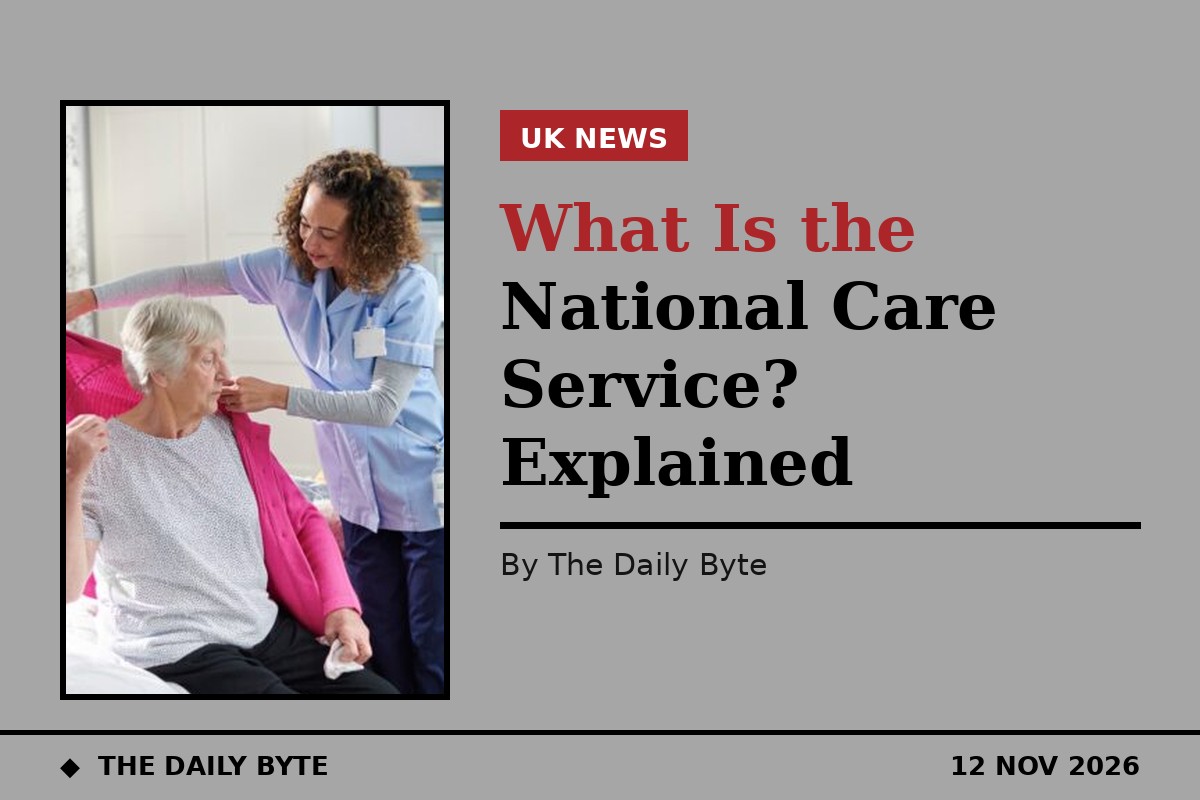
What Is the National Care Service? Explained
The National Care Service is Prime Minister Andy Burnham's plan for a new system of adult social care in England, free at the point of use and modelled on the NHS. Announced at the Labour Party conference in Liverpool on 29 September 2026, it would provide free personal care for older people, starting with support in their own homes, and would be paid for collectively rather than through the means-tested charges families face today. It is not yet a service anyone can use: the government says it will start laying the ground now and introduce it in the next Parliament, putting the full plan to voters at the next general election. An independent commission chaired by Baroness Louise Casey is due to report on how it should work in summer 2027.
Social care is one of the least understood parts of the British welfare state, and the National Care Service is now one of the most searched questions about it. This explainer sets out what the service would be, what it would and would not cover, how it would be paid for, and what happens to people who need care in the meantime.
What is the National Care Service?
The proposed National Care Service would provide social care on the basis of need rather than ability to pay. Burnham described it as a person-centred, high-quality care service that starts in the home, where everyone contributes and everyone is covered, free at the point of use, with no care charges paid out of a person's basic State Pension. His central argument was simple: broken social care will break the NHS too, because when people cannot get help at home, they end up in hospital, and when they cannot leave hospital, beds are blocked for others.
The idea has a long history. Labour's manifesto for the 2024 general election committed to creating a National Care Service underpinned by national standards, although it did not set out how it would be funded or when it would arrive. An earlier National Care Service white paper was published in 2010, before Labour left office that year. Burnham himself was Health Secretary at the time, and he has returned to the idea as Prime Minister, first setting out his ambition to reform adult social care on 29 July 2026, shortly after taking office, and then giving the plan its fullest statement at the party conference two months later.
What would the National Care Service cover?
The government has said the service would provide free personal care for older people. Personal care means help with the everyday tasks of living: eating, bathing, washing, dressing and using the toilet. The emphasis is on care at home first, so that people can stay in their own houses for as long as possible, with familiar carers rather than a rotating cast of strangers.
What it would not cover is equally important. A government press release issued after the conference speech said the service would not cover bed and board in care homes, for which the existing means-tested council contributions will remain. In other words, the cost of the care itself would be free, but the cost of living in a care home, the room and the food, would still be charged for, with councils continuing to contribute for people who cannot afford it. That distinction is often lost in the headlines, and it matters a great deal to families planning for residential care.
The table below summarises what is known about the scope of the service so far.
| Area | What is planned |
|---|---|
| Personal care | Free at the point of use, including help with eating, bathing and using the toilet |
| Care at home | The starting point: support in people's own homes, with familiar carers |
| Bed and board in care homes | Not covered; existing means-tested council contributions remain |
| Charges from the State Pension | No care charges to be paid out of a person's basic State Pension |
| Where it applies | England only; social care is devolved in Scotland, Wales and Northern Ireland |
How would the National Care Service be paid for?
The funding question is the least settled part of the plan. Burnham has said the service will be funded collectively, on the NHS principle that everyone contributes and everyone is covered, rather than through individual means-testing. The one specific funding measure he has announced is the reform of the state pension triple lock from April 2030, which he said would generate significant savings to build up the National Care Service.
The Department for Work and Pensions estimates that changing the triple lock could save £15 billion a year by 2039-40. But the Institute for Fiscal Studies has called that saving very uncertain and said it will not be the answer to funding universal social care on its own. Other estimates suggest a full NHS-style care system could cost more than £18 billion a year by 2035. Local authorities in England already spend billions each year on adult social care, and the workforce and provider capacity to deliver a national service would have to be built up over time.
Other funding options have been discussed in the press, including a social care levy on workers' pay, but no funding mechanism has been finalised. The government says the service will be introduced in phases, so that its scope can grow as the savings from the triple lock increase and as workforce and provider capacity are built up. The honest position, as of November 2026, is that the ambition is clear and the money is not.
When will the National Care Service start?
Not in this Parliament, at least not in full. Burnham has said the government will start laying the ground now and introduce the service in the next Parliament, and that the full proposals will be put to voters at the next general election. That means the service is a promise for the next Parliament rather than a change families will see this year or next.
The timetable depends on the Casey Commission. The independent commission into adult social care, chaired by Baroness Louise Casey, was set up to examine how a future system should operate and be funded. It was originally due to report in 2028, but Burnham brought it forward: shortly after becoming Prime Minister he announced that it would report in summer 2027 instead, dropping the previous two-phase approach in favour of a single accelerated process. The commission will advise on exactly how the service should work, and the government has said it will seek the maximum national consensus around its recommendations.
Why is social care being reformed now?
Adult social care in England is widely described as broken, by politicians of all parties, by care providers and by the NHS. The current system is means-tested: councils assess both a person's needs and their finances, and people with savings or property above a threshold pay for their own care until their money runs down. Many families are surprised by how much care costs and by how little help is available, and the fear of having to sell a home to pay for care is one of the most common worries in later life.
The system also affects the NHS directly. When older people cannot get care at home, they are more likely to be admitted to hospital. When they are medically fit to leave hospital but no care package is in place, they stay in beds that other patients need. Burnham's argument is that a National Care Service would break that cycle by treating social care as a national institution in its own right, rather than as an adjunct to the NHS. Experts in the field agree that the speech was significant for putting social care at the centre of the agenda, even while noting that the funding and the detail are still to come.
What happens to people who need care now?
Nothing in the announcement changes the system as it stands today. People who need care should still contact their local council for a needs assessment and a financial assessment, and the existing means-tested system continues to apply. The government has also announced shorter-term measures, including encouraging councils to commission home care by neighbourhood so that people see familiar carers and care workers spend less time travelling.
Families should also be aware that the National Care Service, even when it arrives, will not remove every cost. Bed and board in a care home will still be charged for, and the details of eligibility, the workforce and the funding are all still to be decided. Anyone making decisions about care now should plan on the basis of the current rules, not on the promise of a future service.
Frequently asked questions
What is the National Care Service? It is the government's proposed NHS-style system of adult social care in England, free at the point of use, announced by Andy Burnham on 29 September 2026.
When will the National Care Service start? The government says it will start laying the ground now and introduce it in the next Parliament, after the Casey Commission reports in summer 2027 and the proposals are put to voters at the next general election.
Will social care be completely free? Personal care would be free, but bed and board in care homes would still be charged for, with means-tested council contributions remaining.
Does the National Care Service apply across the UK? No. Social care is devolved, so the proposal covers England only.
How will the National Care Service be funded? The government says savings from reforming the state pension triple lock from April 2030 will help fund it, but no full funding mechanism has been finalised.
Sources: Full Fact and House of Commons Library.