What Is the UK Clean Power 2030 Plan?
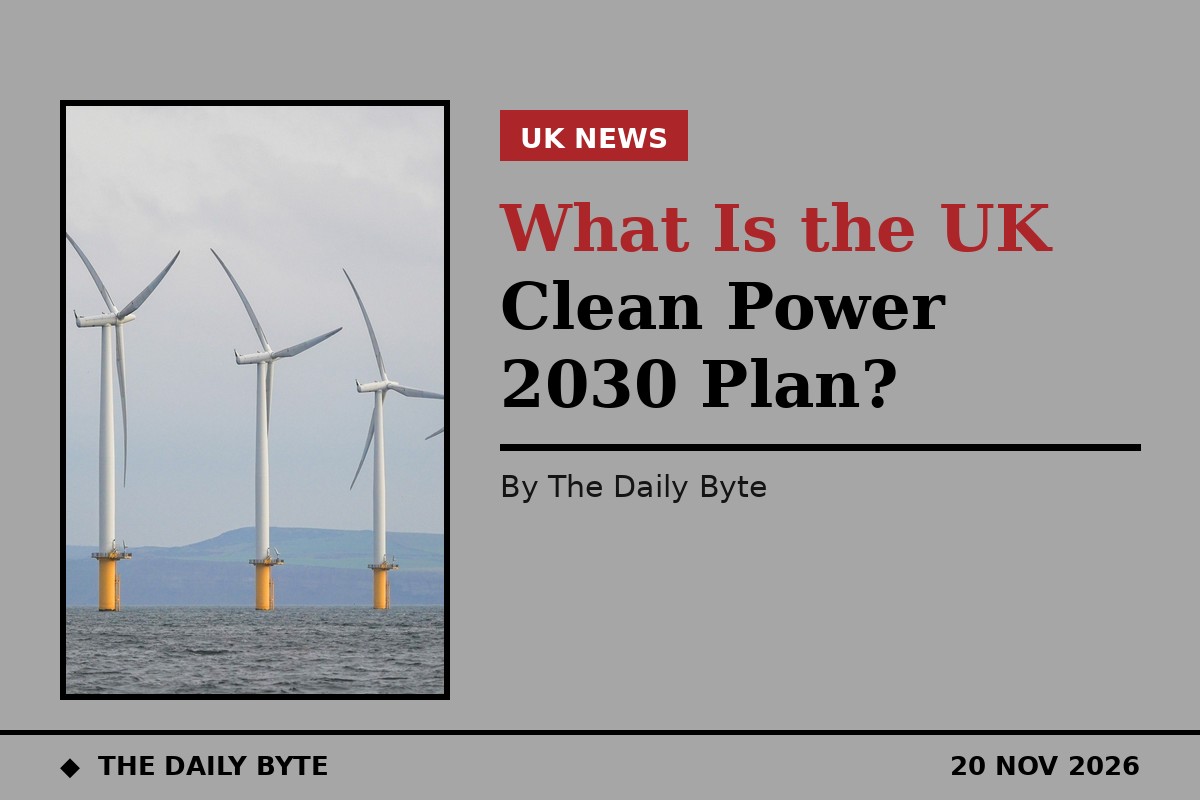
Clean Power 2030 is the UK government's plan to rebuild the electricity system so that, by 2030, Britain's power comes almost entirely from clean sources. It is one of the most ambitious energy targets any British government has set: in a typical weather year, clean sources would produce at least as much electricity as the whole of Great Britain consumes, and at least 95 per cent of all electricity generated would come from low-carbon sources. The plan to get there, the Clean Power 2030 Action Plan, was published by the Department for Energy Security and Net Zero on 13 December 2024.
The target covers Great Britain, meaning England, Scotland and Wales. Northern Ireland is part of a separate all-Ireland electricity network, so it has its own arrangements. This explainer sets out what clean power by 2030 actually means, where the target came from, what has to be built, how the grid is being fixed to carry it, and how far Britain has got so far.
What clean power by 2030 actually means
The target has three parts, and all three have to be met in a typical weather year. First, clean sources must produce at least as much power as Great Britain consumes over the whole year. Second, at least 95 per cent of the electricity generated within Great Britain must come from clean sources, with unabated gas providing no more than 5 per cent. Third, the carbon intensity of electricity generation must fall from 171 grams of carbon dioxide equivalent per kilowatt hour in 2023 to well below 50 grams by 2030.
Clean sources, in the government's definition, include wind, solar, nuclear, biomass and gas plants fitted with carbon capture and storage. Gas without carbon capture still has a role, but only as a back-up for when the wind does not blow and the sun does not shine. The definition was drawn up on the advice of the National Energy System Operator, the publicly owned body that oversees Great Britain's energy networks, and the government accepted it in full.
Where the target came from
The target began as a manifesto promise. The Labour Party fought the 2024 general election on a pledge to make Britain a clean energy superpower, with cheaper, zero-carbon electricity by 2030. After the election, the government asked the National Energy System Operator to advise on whether the target was achievable. The operator published its advice on 5 November 2024, saying the 2030 target was achievable without increasing costs and that it would insulate the UK from volatile international gas prices.
The Clean Power 2030 Action Plan, published a little over a month later on 13 December 2024, turned that advice into a delivery programme. It is a 136-page plan that the government described as the most ambitious reform of the energy system in generations, and it sets out the new capacity to be built, the reforms to planning and grid connections, and the investment needed to deliver it all.
What has to be built
The scale of the build is the heart of the plan. By 2030, the government aims to have 43 to 50 gigawatts of offshore wind in operation, 27 to 29 gigawatts of onshore wind, and 45 to 47 gigawatts of solar power. Offshore wind alone would need to roughly triple from its current capacity, and solar would need to roughly triple as well. Onshore wind would roughly double.
Flexibility matters as much as generation, because wind and solar do not produce power on demand. The plan calls for 23 to 27 gigawatts of battery storage, a five-fold increase, and 4 to 6 gigawatts of long-duration storage such as pumped hydro, roughly doubling what exists today. Around 35 gigawatts of unabated gas capacity would be kept in reserve, to be used only when it is needed. Nuclear also plays a part, including Hinkley Point C, the new nuclear plant under construction, which is expected to start generating around the end of the decade.
The plan estimates that delivering all of this will need investment of around 40 billion pounds a year between 2025 and 2030, most of it private money, with roughly 30 billion pounds a year for generation and 10 billion pounds a year for transmission. The government has said the investment will create jobs and new industries around the country, and that a system powered by homegrown clean energy will be more secure than one that depends on imported gas.
Fixing the grid connection queue
Building wind farms and solar parks is only half the job. They also have to be connected to the grid, and the grid connection queue had become one of the biggest obstacles in the whole energy system. Over five years the queue grew tenfold, and by the time the action plan was published it contained projects totalling 739 gigawatts of capacity, far more than the country could ever use, including many projects with little prospect of ever being built.
The action plan replaces the old first-come, first-served system with one that prioritises projects that are ready and needed for 2030. Projects that are close to commissioning are protected, while slow-moving and stalled projects can lose their connection agreements. New connection offers under the reformed system were expected to be issued by the end of 2025. The plan also says that around twice as much new transmission network will need to be built by 2030 as was built in the previous decade, to carry power from where it is generated, often offshore or in the north, to where it is used.
Planning reform and the renewables auctions
The plan also tackles the planning system, which has often taken years to approve new energy infrastructure. It promises a Planning and Infrastructure Bill to streamline consent for critical infrastructure, an updated National Planning Policy Framework, and changes to the Nationally Significant Infrastructure Projects regime, including bringing onshore wind back into it at a new threshold of 100 megawatts and changing the threshold for solar to 100 megawatts. The government has also said it will look again at the judicial review process, to strike a balance between reducing delays and keeping access to justice.
The other lever is the contracts for difference auctions, through which the government guarantees a price for renewable electricity and developers compete for contracts. The plan confirms the government is looking to secure at least 12 gigawatts of offshore wind capacity through the seventh, eighth and, depending on the speed of deployment, ninth auction rounds. It also expands the auction process so that projects can secure financing before their planning permission has been finalised, and it supports local and community-led renewable capacity.
How far has Britain got
The Department for Energy Security and Net Zero reports the three clean power measures each year. In its annual report for 2025 to 2026, updated on 19 August 2026, it recorded that clean sources provided 73.3 per cent of Great Britain's electricity generation in 2025, down 0.4 percentage points from 2024 because of a lower nuclear share and a rise in gas generation to make up for a fall in imported electricity. Clean generation met 64.4 per cent of Great Britain's electricity demand in 2025, against the target of 100 per cent by 2030. The carbon intensity of generation was 104 grams of carbon dioxide equivalent per kilowatt hour on a provisional basis, against the target of well below 50 grams.
Those figures show how much of the work is still ahead. The clean share of generation has to rise from 73.3 per cent to at least 95 per cent in five years, and the share of demand met by clean sources has to rise from 64.4 per cent to 100 per cent. That is why the plan is described as a sprint: the build rates for offshore wind, onshore wind, solar and batteries all have to rise sharply, and the grid and planning reforms have to land in time for the new capacity to connect.
What it means for households
The government's stated aim is that clean power will cut bills, create jobs and deliver security with cheaper, zero-carbon electricity. The argument is that electricity generated from wind and sun in British waters and on British land is not exposed to the swings in international gas prices that pushed household bills up sharply in 2022. The National Energy System Operator's advice said the target could be reached without increasing costs, and the plan says the investment will support reindustrialisation and new industries around the country.
None of that is a guarantee about any individual household's bill. The plan sets no tariff, and the price households pay will still depend on the wholesale market, on network charges and on government policy. What the plan does fix is the direction of the electricity system: more wind and solar, more storage, a reformed grid, and gas kept only as a back-up. Whether it is delivered on time will be visible in the annual figures the department publishes, and the next test is whether the build rates and connection offers keep pace with the 2030 deadline.


