What Is the UK Deposit Return Scheme?
From 1 October 2027, buying a bottle of water or a can of fizzy drink in the United Kingdom will work a little differently. A refundable deposit of 20p will be added to the price of drinks sold in single-use containers, and shoppers will get that money back when they return the empty container. It is called a deposit return scheme, and it is one of the biggest changes to everyday recycling in the UK for a generation.
The idea is simple: put a small cash value on an empty bottle or can, and far fewer of them end up dropped in the street, in a river or in a general waste bin. The scheme has been talked about, delayed and redesigned for years. Now the launch date, the deposit level and the rules for shops and drinks producers are all set, and businesses are already registering to take part. This explainer sets out what the scheme is, which containers it covers, how you will get your 20p back, and how the rules differ across the four nations of the UK.
How the deposit return scheme will work
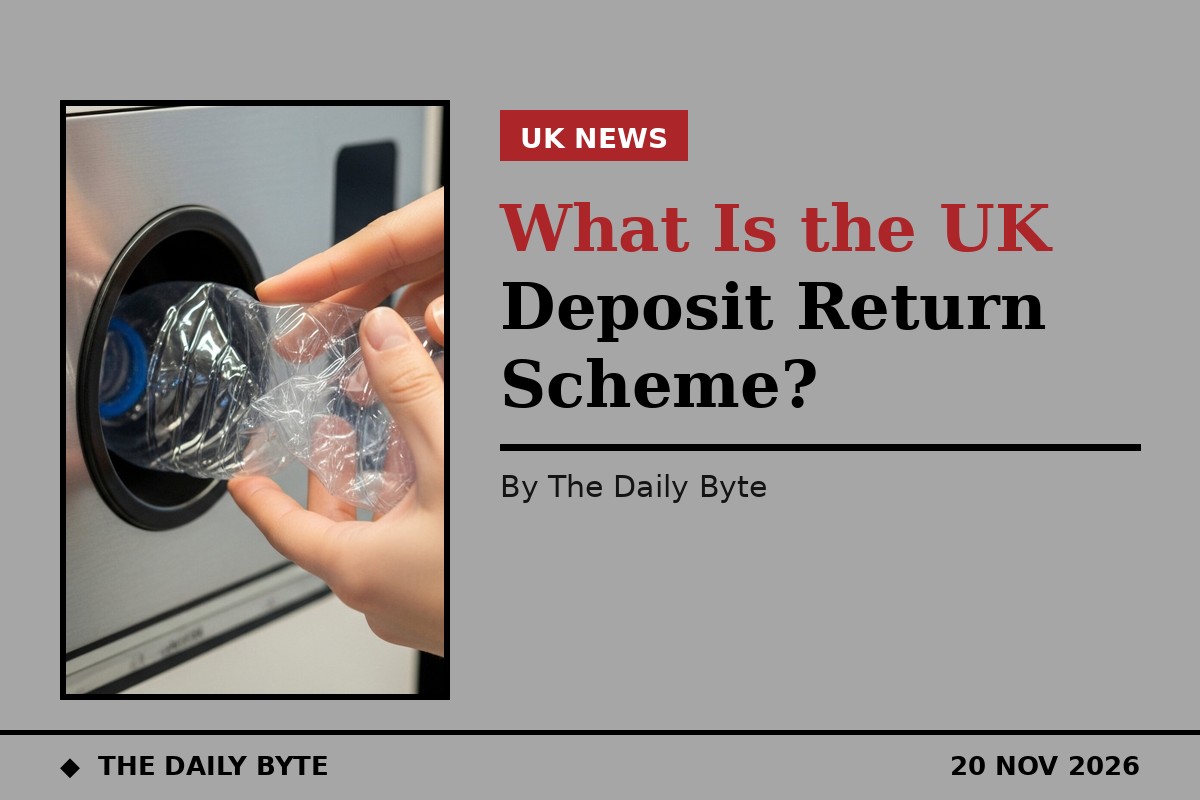
A deposit return scheme, usually shortened to DRS, charges the customer a deposit when they buy a drink in a single-use container. The deposit is refunded when the empty container is returned to a shop or to a reverse vending machine, a machine that accepts empty containers and pays the deposit back. The schemes are designed to reduce litter, increase recycling rates and support a circular economy, in which the material from a used bottle or can is turned into a new bottle or can rather than being thrown away.
In practice the chain works like this. The drinks producer pays a deposit for each container it places on the market and passes that cost down the supply chain. The retailer charges the customer the price of the drink plus the 20p deposit, and the deposit must be shown clearly as part of the price. When the customer brings the empty container back, the retailer refunds the 20p, and the returned containers are collected and sent for recycling. The scheme administrator then pays the retailer back the refunds it has handed out, plus a handling fee to cover the cost of taking the containers back and storing them.
The deposit is set at 20p on all containers in scope. That figure was confirmed in the government's plans for the scheme and in the House of Commons Library briefing on deposit return schemes, which notes that all parts of the UK are expected to start operating a scheme from 1 October 2027.
Which drinks containers are included
The scheme covers single-use drinks containers between 150 millilitres and 3 litres in size, made wholly or mainly from PET plastic, steel or aluminium. PET is the clear plastic used for most water and soft-drink bottles. That range covers the great majority of the bottles and cans sold in supermarkets, corner shops and petrol stations across the UK.
Containers must carry the scheme's logo and a return code so that a reverse vending machine, or a member of staff at a manual return point, can recognise them as part of the scheme. Retailers will be prohibited from selling in-scope drinks that have not been produced by a registered scheme producer and do not carry the correct labelling, so the marking on the container is what makes the whole system work.
There is also an exemption for low-volume products. Product lines that sell fewer than 5,000 units a year are exempt, a rule designed to protect small and specialist producers from the cost of joining the scheme for a handful of bottles.
What is not included in the scheme
Glass is the biggest exclusion. In England, Northern Ireland and Scotland, glass bottles are not included in the scheme. The UK Government decided against including glass because of concerns about safety, storage and recycling quality, including the risk of broken glass in shops and in collection vehicles. Wales is the exception: the Welsh scheme will include glass bottles, initially without a deposit, with deposits on glass expected to follow from October 2031.
Several other containers are outside the scheme as well. Milk bottles made from high-density polyethylene, the cloudy plastic known as HDPE, are not included. Containers used for liquid medicines, such as cough syrup, are excluded, as are containers for flavour enhancers and sweeteners that are added to drinks, such as syrups. Drinks sold for consumption on the premises, for example a can opened and drunk in a cafe or pub, are also treated differently: hospitality businesses must apply the deposit to drinks sold for off-site consumption, while charging it for drinks consumed on site is optional.
Where you return containers and how you get your money back
Supermarkets, grocery stores, convenience stores and newsagents that sell drinks covered by the scheme must host a return point, unless they qualify for an exemption. The return point can be a manual collection, where staff take the container and hand back the deposit, or an automated reverse vending machine, which scans the container, checks it is part of the scheme and pays the refund.
Refunds can be paid as cash, as a payment to a credit or debit card, or as a voucher. The machines and manual return points will be the familiar sight in the entrance or foyer of a supermarket: feed the bottle in, and the deposit comes back. Retailers that host a return point must register with the scheme administrator, pay the deposit back to consumers at the point of return, and store the returned containers until they are collected.
Some small shops will be exempt from hosting a return point, particularly small stores in urban areas where space is limited. The exact exemptions are set out in the regulations, but the expectation is that most places where people buy drinks will also be places where they can return them.
Who runs the scheme
The legal powers to set up the schemes come from the Environment Act 2021 for England, Wales and Northern Ireland, and from the Climate Change (Scotland) Act 2009 for Scotland. The detailed rules for England and Northern Ireland are set out in the Deposit Scheme for Drinks Containers (England and Northern Ireland) Regulations 2025, which came into force on 24 January 2025. Scotland and Wales have their own regulations under their own powers.
The scheme is run by a scheme administrator, the UK Deposit Management Organisation, known as the UK DMO. It was appointed in May 2025 and trades under the name Exchange for Change. The DMO will run the scheme in England, Northern Ireland and Scotland, setting the deposit level, overseeing compliance, registering producers and return point operators, and arranging the collection and recycling of returned containers. Exchange for Change is also the operator for the Welsh scheme. Enforcement sits with the environmental regulators in each part of the UK, for example the Environment Agency in England.
What businesses have to do
Drinks producers, meaning manufacturers and importers of in-scope drinks, must register with the scheme administrator, pay a deposit for each in-scope container they supply, apply the deposit to all containers they place on the market, comply with the labelling requirements and report how many drinks they have placed on the market. Their producer fee is based on the number of containers they sell.
Retailers must pay the deposit to producers or wholesalers when they buy the drinks, charge the deposit to consumers at the till, and, if they are a grocery retailer, operate a return point. Everyone in the drinks supply chain, including wholesalers, must charge the deposit on to their buyers when they sell filled containers that are in scope, and must only supply filled containers that were placed on the market by a registered scheme producer and carry the scheme labelling.
Registration is already under way. Phase 1 registration is open now for producers and return point operators, which includes most supermarkets, grocery stores, convenience stores and newsagents, so that those businesses can prepare for launch. Phase 2 registration will open in January 2027, when businesses will be asked to provide further information about their role in the scheme.
How the four nations differ
The schemes are launching on the same date, 1 October 2027, in all four parts of the UK, but they are not identical. England, Northern Ireland and Scotland share the UK DMO as administrator and the same scope: PET plastic, steel and aluminium containers from 150 millilitres to 3 litres, with no glass. Wales has decided to run its own scheme, also operated by Exchange for Change, and to include glass bottles in it, initially without a deposit.
The differences matter for businesses that sell across the UK, because a bottle sold in Wales may carry different rules from the same bottle sold in England. They matter less for shoppers, for whom the experience will be the same in practice: pay 20p, bring the empty container back, get 20p.
Why the scheme exists and what happens next
The scheme has had a long road to launch. Scotland originally planned to introduce a deposit return scheme years earlier, and the UK-wide scheme has been delayed several times while ministers, industry and the devolved governments argued over scope, timing and who should run it. The regulations for England and Northern Ireland are now in force, the administrator is appointed, and registration has begun, which is why 1 October 2027 is now treated as a firm date rather than an aspiration.
The government expects the scheme to increase the amount of plastic, aluminium and steel drinks containers collected for recycling, so that more material is processed for recycling and less litter is found on streets, in waterways, on beaches and in the natural environment. Other countries that already run deposit return schemes report much higher return rates for bottles and cans than countries that rely on kerbside recycling alone.
For shoppers, the practical change is small but visible: a 20p line on the receipt, a logo on the bottle, and a machine by the supermarket door. For the drinks industry, it is a large logistical exercise, with new labelling, new registration, new fees and new collection routes. The next milestones are the second phase of registration in January 2027 and the launch itself on 1 October 2027, when the first deposits will be charged and the first refunds paid.