What Is the UK Zero Emission Vehicle Mandate?
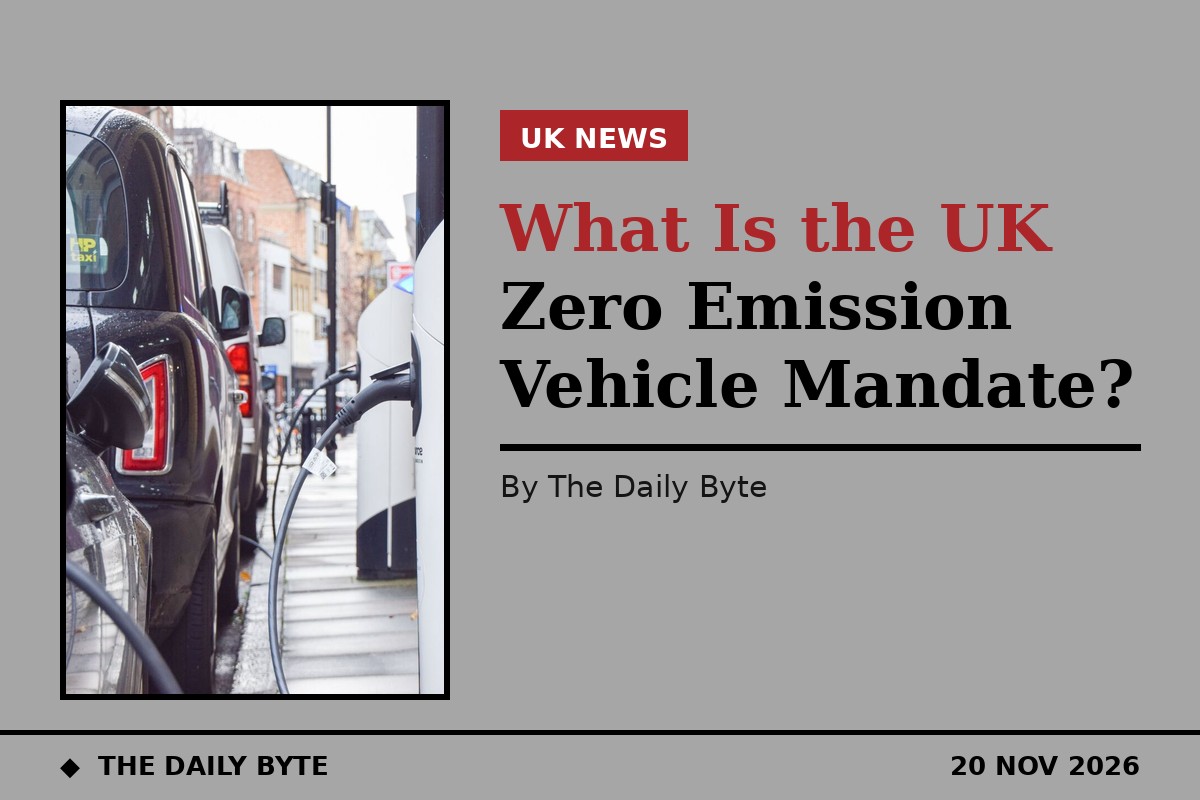
The zero emission vehicle mandate, usually called the ZEV mandate, is the law that decides how quickly electric cars take over from petrol and diesel cars on Britain's roads. It does not ban any car outright. Instead, it tells every carmaker selling in the UK that a rising share of the new cars and vans it registers each year must be zero emission, with the share climbing every year until all new cars and vans are zero emission by 2035.
For 2026, the target is 33 per cent: one in every three new cars a manufacturer sells must be a battery electric or hydrogen vehicle. For vans, the 2026 target is 24 per cent. The mandate is now under review, and ministers are considering whether the targets for 2030 should be lowered, which has made it one of the most argued-over policies in British industry. This explainer sets out what the mandate is, what the targets are, how it works in practice, where the review stands as of 20 November 2026, and what it means for anyone buying a car.
What the ZEV mandate is
The mandate came into law on 3 January 2024 under the Vehicle Emissions Trading Schemes Order 2023. It applies to every manufacturer selling cars and vans in Great Britain, and it sets annual minimum targets for the proportion of each manufacturer's new registrations that must be zero emission vehicles. A zero emission vehicle, for the purposes of the mandate, is a vehicle that produces no exhaust emissions at all, which in practice means a battery electric car or a hydrogen fuel cell car. A hybrid, even a plug-in hybrid, does not count towards the target, because it still has a petrol or diesel engine.
The targets rise every year. They are the mechanism the government uses to deliver its commitment to phase out the sale of new petrol and diesel cars by 2030 and to ensure that all new cars and vans are zero emission by 2035. The mandate sits alongside grants for electric cars and investment in charging points, but it is the mandate, rather than the grants, that sets the pace, because a manufacturer that misses its target faces a fine for every vehicle short.
The targets year by year
For cars, the headline targets are 22 per cent in 2024, 28 per cent in 2025, 33 per cent in 2026, 38 per cent in 2027, 52 per cent in 2028, 66 per cent in 2029 and 80 per cent in 2030, reaching 100 per cent in 2035. For vans, the trajectory starts lower and climbs more slowly: 10 per cent in 2024, 16 per cent in 2025, 24 per cent in 2026, 34 per cent in 2027, 46 per cent in 2028, 58 per cent in 2029 and 70 per cent in 2030, also reaching 100 per cent in 2035.
Those are the headline figures in the legislation. In practice, each manufacturer has its own individual target, based on its 2021 emissions baseline and on any credits it has banked or borrowed, so the figure a particular carmaker has to hit is typically below the headline national average. The targets beyond 2030 have not been written into law in the same detail; the stated ambition is for all new cars and vans to be zero emission by 2035, but the exact path from 2030 to 2035 is indicative rather than fixed.
How the mandate works in practice
The mandate works through a system of credits and flexibilities, not just a simple percentage. Manufacturers can bank credits earned by exceeding their target in one year and use them later, borrow credits from future years, and convert over-performance on carbon dioxide emissions into ZEV credits. These flexibilities mean the headline target is not quite the same as the share of electric cars that actually has to be sold. Analysts have estimated that, once banking and carbon dioxide transfers are taken into account, the 33 per cent headline target for 2026 can effectively be met with around a quarter of new cars actually being electric.
There is also a penalty for falling short. The headline fine is 12,000 pounds for each non-compliant car, reduced from 15,000 pounds by changes made in April 2025, and 15,000 pounds for each non-compliant van. In practice, manufacturers have a strong incentive to avoid the fines by discounting electric models, which is one reason electric cars have often been sold with large price cuts in the final months of a year, when carmakers are pushing to hit their annual target.
Small manufacturers are treated differently. Derogations apply to manufacturers selling fewer than 2,500 cars or vans a year, so that niche and specialist carmakers are not held to the same targets as the mass-market brands.
The 2026 review and what might change
The government launched a review of the mandate on 14 August 2026, bringing forward a review that had originally been scheduled for 2027. The consultation, run by the Department for Transport with the Office for Zero Emission Vehicles and the Department for Business and Trade, asked manufacturers, suppliers, charge point operators, dealers, consumers and communities for their views on the pathway to 2030, and it closed on 23 October 2026.
The consultation set out options to lower the 2030 target for cars from 80 per cent to 70, 60 or 50 per cent, with steeper rises after 2030 so that the 100 per cent target in 2035 is still met. For vans, the options were to cut the 2030 target from 70 per cent to 60, 50 or 40 per cent, or to keep the current targets and extend the flexibilities that let manufacturers bank, borrow and trade credits to 2034. The review also looked at the growing share of hybrids, which do not count towards the targets, and at how the 2030 phase-out of new petrol and diesel cars should be defined.
As of 20 November 2026, no decision has been taken. The Guardian reported on 8 November 2026 that ministers were expected to cut the 2030 car target to around 60 per cent and extend the flexibilities to 2034, but that report is not confirmed policy. The government has said it is fully behind the mandate and that no decisions have been taken, and in a written answer to Parliament on 11 November the Department for Transport said no policy decisions had been made yet and that it aims to publish the review outcome, with the devolved governments, by the end of 2026. The two end dates are not under review: new petrol and diesel cars will still be phased out by 2030, and all new cars and vans will still need to be zero emission by 2035.
Where electric car sales stand
The review is happening because sales are behind the targets. Battery electric cars took 26.6 per cent of UK new car registrations in the first ten months of 2026, against the 33 per cent target for the year, and the Society of Motor Manufacturers and Traders expects the full-year figure to be 27.2 per cent. Electric vans are further behind: they accounted for 11.0 per cent of new van registrations in the year to October, against a 24 per cent target, although they hit a record monthly share in October.
The car industry has argued that the targets are too steep, given supply chain disruption, tariff uncertainty and the cost of making electric cars, and the SMMT has said the mandate cost manufacturers 10 billion pounds in its first two years. Campaigners and the charging industry have argued the other way, warning that weakening the mandate would slow the arrival of electric cars and put investment in charging infrastructure at risk. The government has said it is investing 7.5 billion pounds to grow the electric vehicle market, boost manufacturing, increase sales and build up the charging network.
What it means for car buyers
For anyone buying a new car, the mandate is the reason electric models are often heavily discounted, particularly towards the end of the year, and the reason the range of electric cars on sale has grown so fast. If the 2030 target is lowered, that pressure on carmakers eases, which could mean fewer discounts but also less urgency for manufacturers to push electric models that buyers do not yet want.
What does not change, whatever the review decides, is the direction of travel. New petrol and diesel cars will stop being sold in 2030, and every new car and van will be zero emission by 2035. The review is about the pace of the climb in between, not about the destination. For buyers, the practical questions are the same as they have always been: the price of the car, the cost of charging it, and whether there is a charger nearby. The mandate shapes the first of those, by deciding how hard carmakers have to push electric cars, and the review's outcome, expected by the end of 2026, will set that pressure for the rest of the decade.


