What Was the UK-France One In, One Out Deal? Explained
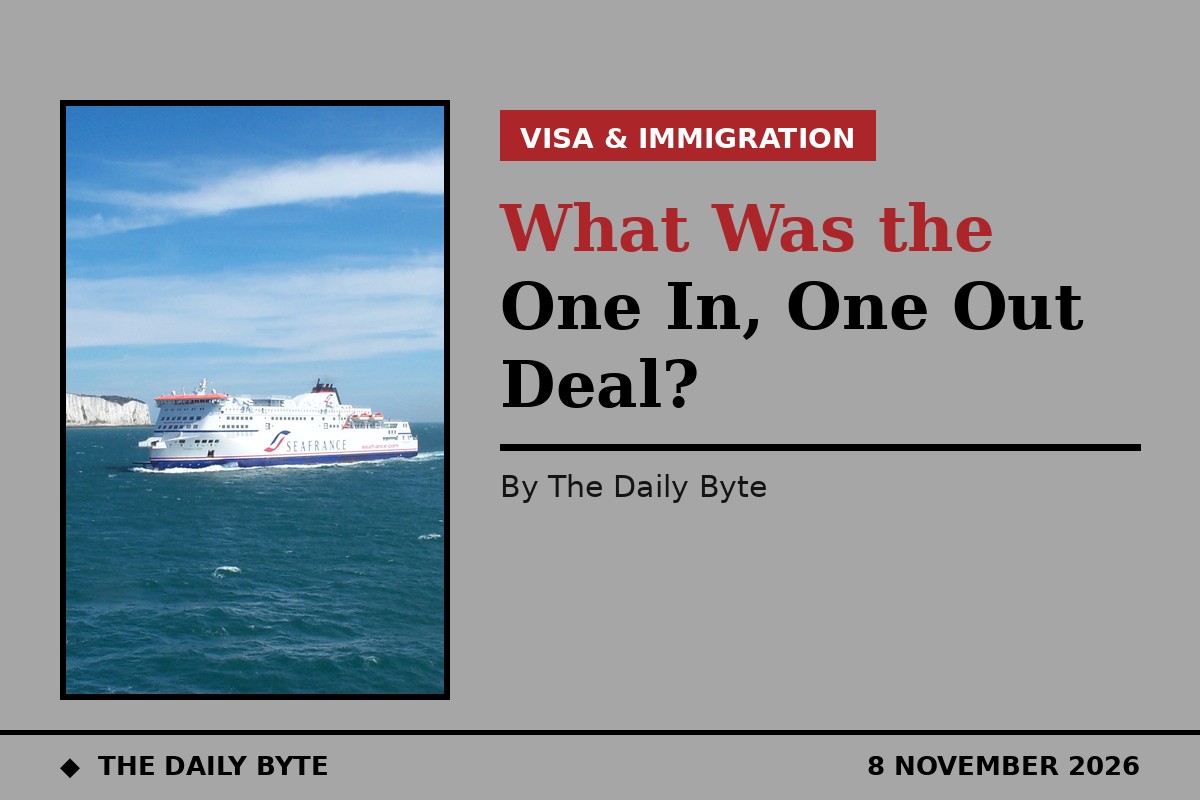
The UK-France 'one in, one out' deal was a pilot agreement under which the UK could return some people who crossed the Channel in small boats to France, and in return accept the same number of asylum seekers from France through a legal route. It ran from August 2025 until the end of September 2026, when the Home Office confirmed it was no longer processing new cases. In short: it was a small-scale test of reciprocal returns, it moved roughly equal numbers in each direction, and it ended because ministers said it had not reached the scale they wanted.
The deal was announced on 10 July 2025 by Prime Minister Keir Starmer and French President Emmanuel Macron, and the formal agreement came into force on 6 August 2025. It was known inside government as Operation Hillmore. The first removal under the scheme took place on 18 September 2025. The pilot was initially expected to return around 50 people a week to France.
How did 'one in, one out' work?
Under the agreement, a person who arrived in the UK by small boat could be detained and have their asylum claim declared inadmissible, on the grounds that they had arrived from France, which the UK considers a safe third country. They could then be removed to France without their asylum claim being considered in the UK. For every person returned, the UK agreed to accept one asylum seeker from France through a legal route, the UK/European Applicant Transfer Scheme. People admitted through that route had to apply from France, pass security and eligibility checks, and had not previously tried to enter the UK irregularly. Priority was given to people with a strong claim, including those with family members in the UK, and unaccompanied children were understood to be excluded from the returns side of the arrangement.
What did the pilot achieve?
Home Office figures covering 6 August 2025 to 30 June 2026 record 1,087 people returned to France and 1,117 people transferred to the UK under the scheme, so slightly more people came in than went out. By the end of the scheme, around 1,500 people had been returned to France in total, according to the BBC. Home Secretary Shabana Mahmood told the Home Affairs Committee on 15 September 2026 that each return cost about £56,000 on average. She also told MPs that the numbers entering and leaving had tracked fairly evenly, which she presented as proof that the concept could work. Separately, the Home Office said joint operations with France had prevented more than 48,000 crossing attempts and led to the seizure of 1,100 boats and engines.
Why did the deal end?
On 30 September 2026, the Home Office confirmed that the pilot was 'no longer processing new cases'. The agreement had been due to expire on 1 October, and the two governments did not extend it. The UK government said the scheme had not reached the scale ministers wanted. France, for its part, favoured a wider European approach to Channel migration rather than a bilateral arrangement with the UK alone. The two countries were discussing the terms of exit, according to the French interior ministry. A new three-year funding agreement worth £662 million for France to strengthen border controls in northern France was signed separately.
What happens now?
The end of the pilot does not mean all returns stop immediately. The Home Office said flights would continue over the coming weeks to remove people already detained under the scheme, and cases already in the system continue, including transfers from France where people had already been accepted. The Guardian reported on 1 November that charter flights were still running weeks after new cases stopped, with a flight on 28 October and another scheduled for 17 November. The UK/European Applicant Transfer Scheme, the legal route into the UK, is closed to new applications, and the Home Office says people who already applied will be informed of the decision in due course. No replacement returns arrangement has been announced.
| Key fact | Detail |
|---|---|
| Announced | 10 July 2025, by Starmer and Macron |
| In force | 6 August 2025 |
| First removal | 18 September 2025 |
| Returns to France (to 30 June 2026) | 1,087 |
| Transfers to the UK (to 30 June 2026) | 1,117 |
| Cost per return | About £56,000, per the Home Secretary |
| New cases stopped | 30 September 2026 |
| Legal route now | UK/European Applicant Transfer Scheme closed to new applications |
Frequently asked questions
Is the 'one in, one out' deal still running? No. The Home Office confirmed on 30 September 2026 that the pilot is no longer processing new cases. Returns of people already in the system continue for a short period, but no new cases are being taken on.
What does 'one in, one out' mean? For each person the UK returned to France, it accepted one asylum seeker from France through a legal route. The idea was to deter small-boat crossings by making return likely, while offering a safe alternative route.
Who could be returned to France? People who arrived in the UK by small boat and whose asylum claims were deemed inadmissible because they had come from France, a country the UK considers safe. Their claims were not considered in the UK.
Who could come to the UK through the legal route? Asylum seekers in France who had not previously tried to enter the UK irregularly, who passed security and eligibility checks, and who were considered to have a strong claim, with priority for vulnerable people and those with family in the UK.
Can I still apply under the scheme? No. The UK/European Applicant Transfer Scheme is closed to new applications. Immigration rules change frequently, so anyone affected should check the official GOV.UK page and seek regulated immigration advice rather than relying on social media or unofficial agents.
Sources: GOV.UK, UK/European Applicant Transfer Scheme; InfoMigrants. This is general information, not immigration advice.