When Does Advent Start in 2026?
Advent 2026 begins on Sunday 29 November and ends on Christmas Eve, Thursday 24 December. It is the season of preparation before Christmas in the Christian church, lasting for the four Sundays before Christmas Day, and it marks the start of a new church year.
Advent comes from the Latin word adventus, meaning coming or arrival. For Christians it is a time of looking forward to the coming of Christ, both in the celebration of his birth at Christmas and in the hope of his return. This guide gives the 2026 dates, explains the Advent wreath and its candles, and answers the questions people search for each year as the season begins.
Advent 2026 dates
The first Sunday of Advent in 2026 is Sunday 29 November. The season then runs through the four Sundays of Advent:
First Sunday of Advent: Sunday 29 November 2026. Second Sunday of Advent: Sunday 6 December 2026. Third Sunday of Advent, known as Gaudete Sunday: Sunday 13 December 2026. Fourth Sunday of Advent: Sunday 20 December 2026. The season ends on Christmas Eve, Thursday 24 December 2026, before the evening celebrations of Christmas begin.
The rule behind the dates is that Advent begins on the Sunday closest to 30 November, the feast of St Andrew, and always covers the four Sundays before Christmas. Because Christmas Day falls on a Friday in 2026, the fourth Sunday of Advent is 20 December, five days before Christmas itself.
The first Sunday of Advent is also the start of the church's liturgical year. In 2026 it opens Year B of the three-year cycle of Sunday readings, with the first Sunday's readings including Isaiah 64 and Mark 13, in which Jesus tells his followers to keep watch.
What is Advent?
Advent is a season of preparation, prayer and expectation. In many churches it is a quieter, more reflective time than the Christmas celebrations that follow it, and in the Catholic and Anglican traditions the liturgical colour of the season is purple, the colour of preparation and penitence. Some churches use blue instead, to mark hope and expectation.
The season has two directions at once. It looks back to the birth of Jesus at Bethlehem, which Christians celebrate on Christmas Day, and it looks forward to the return of Christ, which is the hope the season's readings keep returning to. That is why Advent readings speak so often of waiting, watching and being ready.
In the UK, Advent is marked in churches of many denominations, in schools, and in homes. Churches hold Advent Sunday services on 29 November, often including the lighting of the first candle on the Advent wreath, and many schools hold Advent assemblies and nativity rehearsals through December.
The Advent wreath and its candles
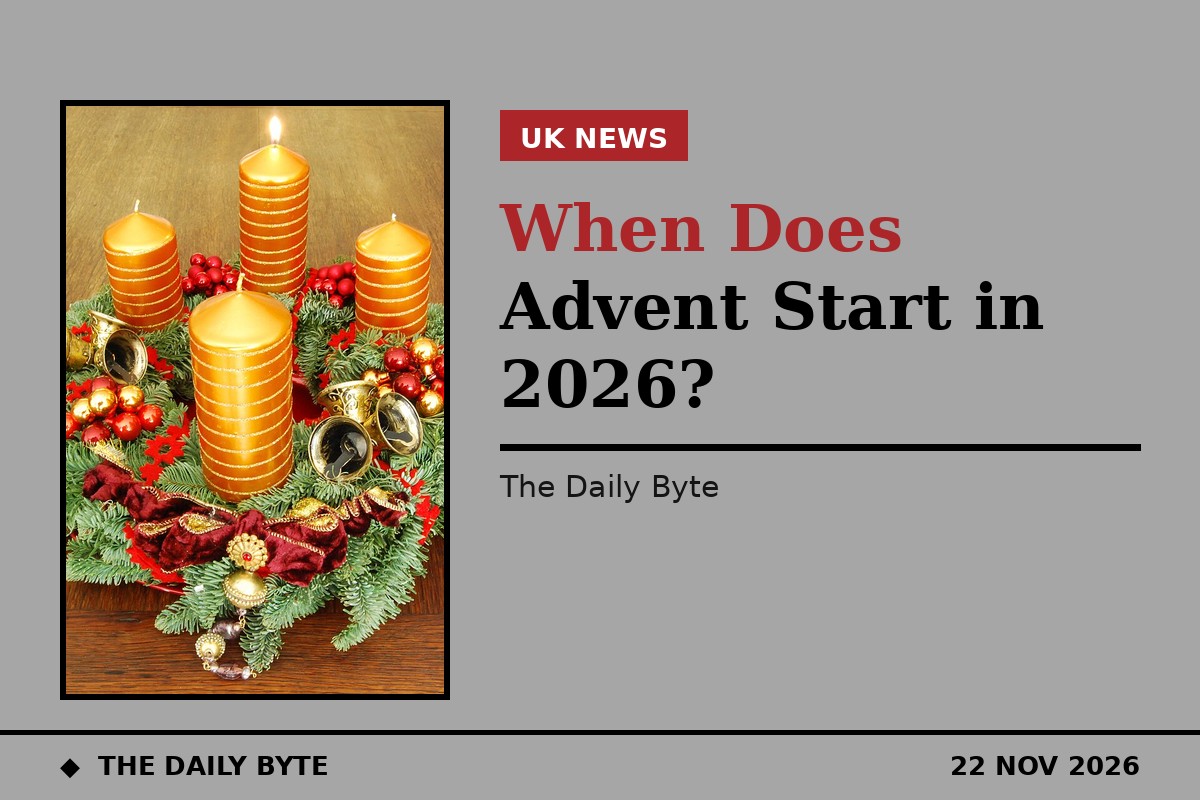
The most visible symbol of Advent is the Advent wreath: a circle of evergreen branches holding four candles, often with a fifth, larger white candle in the centre. One candle is lit on the first Sunday of Advent, two on the second, and so on, until all four are burning on the last Sunday before Christmas. The growing light pictures the coming of Christ, the light of the world, into a dark world.
In the most common modern scheme, each candle has a theme. The first Sunday is hope, often called the prophecy candle, recalling the prophets who foretold the coming of the Messiah. The second Sunday is peace, often called the Bethlehem candle, recalling the town of his birth. The third Sunday is joy, often called the shepherds' candle, recalling the good news of great joy announced to the shepherds. The fourth Sunday is love, often called the angels' candle, recalling God's love in sending his Son.
The colours follow the same pattern in the traditional scheme: three of the candles are purple, and the third is rose or pink. The rose candle is lit on the third Sunday, Gaudete Sunday, from the Latin word for 'rejoice', the first word of the old Latin entrance chant for that day, taken from Philippians 4:4, 'Rejoice in the Lord always'. The pink candle marks a joyful pause in the middle of a serious season, because Christmas is now near. The fifth white candle, the Christ candle, is lit on Christmas Eve or Christmas Day to celebrate that Jesus has come.
The modern Advent wreath is usually traced to Johann Hinrich Wichern, a Lutheran pastor in Hamburg, Germany, who in 1839 built a wooden ring of candles so the children at his mission school could count the days until Christmas.
Advent calendars
The other Advent tradition most people in the UK will know is the Advent calendar. The calendar runs from 1 December to 24 December, with a small door or window to open each day. The first printed Advent calendars appeared in Germany in the early twentieth century, and the chocolate-filled calendars that are now standard in British shops came later.
Advent calendars are now made in many forms, from simple paper calendars with pictures behind each door to calendars filled with chocolate, tea, beauty products or small toys. The idea is the same in every case: a daily countdown that marks the waiting of the season, one day at a time.
How long is Advent?
Advent lasts between 22 and 28 days, depending on the year, because it always covers four Sundays but the number of days before the first Sunday varies. In 2026 it runs for 26 days, from Sunday 29 November to Thursday 24 December. It is the shortest of the church's seasons, and it is followed by Christmas itself, which begins on Christmas Eve and runs through the twelve days of Christmastide to Epiphany on 6 January.
Many families keep Advent at home as well as in church. A wreath on the table, with a candle lit at Sunday lunch or in the evening, is a common practice, and some families read a short passage or say a prayer together as each candle is lit. Advent devotionals, booklets of daily readings and reflections for the season, are also widely used, and many churches give them out on Advent Sunday.
Advent is sometimes confused with Lent, the other great season of preparation in the church year, but the two are distinct. Lent comes before Easter and lasts for forty days, while Advent comes before Christmas and lasts for about four weeks. Both use purple as their liturgical colour, which is one reason for the confusion, but their moods are different: Lent is a season of fasting and repentance leading to the cross, while Advent is a season of hopeful waiting leading to the birth of Christ.
Frequently asked questions
When does Advent start in 2026? Sunday 29 November 2026, the first Sunday of Advent.
When does Advent end in 2026? Thursday 24 December 2026, Christmas Eve, before the evening celebrations of Christmas.
What are the four Sundays of Advent in 2026? 29 November, 6 December, 13 December and 20 December.
What do the Advent candles mean? In the common modern scheme the four candles stand for hope, peace, joy and love, one for each Sunday. The third candle is rose, for Gaudete Sunday, and a fifth white Christ candle is lit at Christmas.
Is Advent the same as Christmas? No. Advent is the season of preparation before Christmas, running for the four Sundays beforehand. Christmas begins on Christmas Eve and runs through to Epiphany on 6 January.
When do Advent calendars start? On 1 December, with one door to open each day until Christmas Eve on 24 December.
Sources: the Vanderbilt Revised Common Lectionary calendar for Advent 2026, and The Old Farmer's Almanac calendar for Sunday 29 November 2026, Advent Sunday. Advent 2026 begins on Sunday 29 November and ends on Thursday 24 December.