Why Did Andy Mitchell Win His Council Tax Court Case?
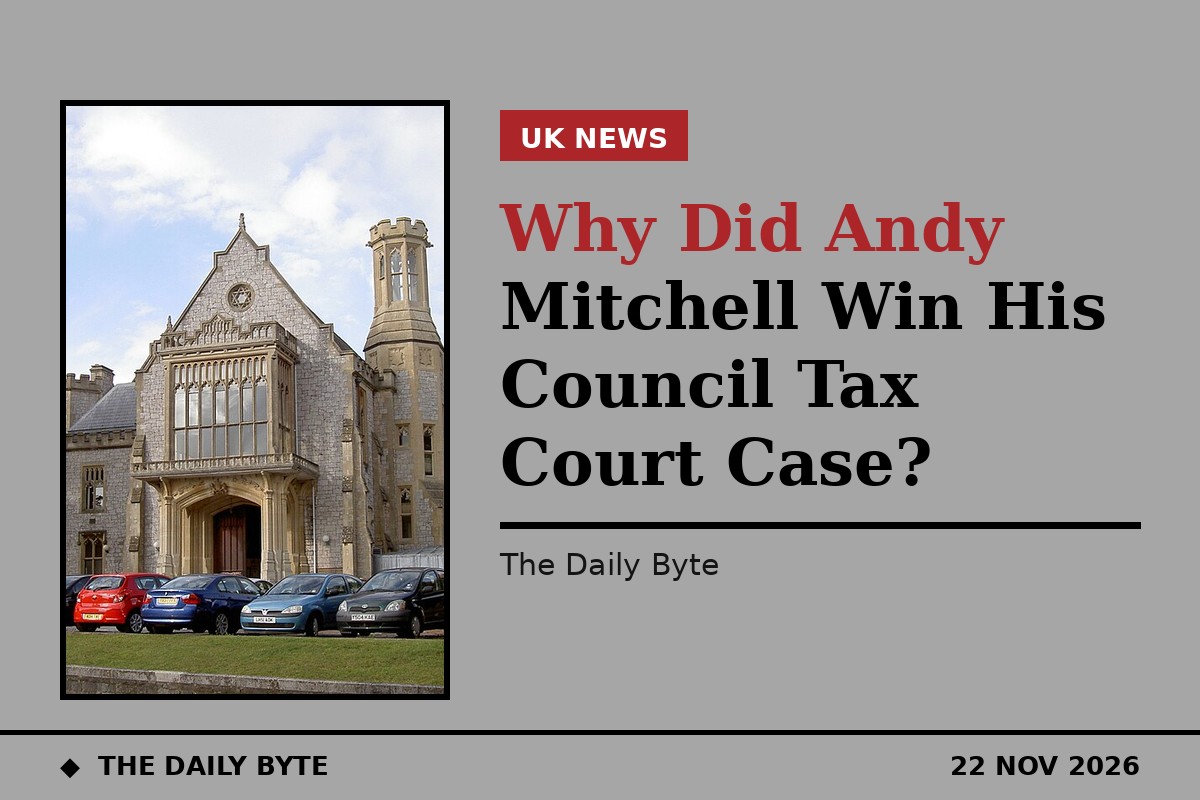
Andy Mitchell, a disabled man from Taunton in Somerset, has won his High Court challenge against Somerset Council after his council tax support fell from 100% to 10% when he was moved from Employment and Support Allowance to Universal Credit — even though his income changed by only ten pence a week. In a judgment handed down on 12 November 2026, Judge Barry Clarke found that the council's 2025/26 council tax reduction scheme was irrational and unlawfully discriminated against Mr Mitchell, breached the public sector equality duty, and had to be quashed. Somerset Council must now reassess his council tax bill for 2025/26, and he is entitled in principle to damages for injury to feelings.
The case matters well beyond one household. Mr Mitchell's lawyers estimate that about 4,000 disabled people in Somerset lost council tax support after being moved onto Universal Credit in the same way. The ruling warns every council that a benefit migration must not quietly strip disabled residents of support they previously received in full.
| Fact | Detail |
|---|---|
| Case | R (Mitchell) v Somerset Council |
| Citation | [2026] EWHC 2930 (Admin) |
| Court | High Court (judicial review) |
| Judgment date | 12 November 2026 |
| Judge | Judge Barry Clarke, President of Employment Tribunals, sitting as a High Court judge |
| Claimant | Andy Mitchell, disabled resident of Taunton, Somerset |
| What was challenged | Somerset Council's 2025/26 council tax reduction scheme |
| Outcome | Decision of 10 September 2025 quashed; liability for 2025/26 to be reassessed; damages in principle |
What happened to Andy Mitchell?
Mr Mitchell is disabled and unable to work because of multiple physical and mental health conditions. For more than five years he paid no council tax at all, because Somerset Council's scheme gave him full support while he received income-related Employment and Support Allowance (ESA). In July 2025 he was moved onto Universal Credit under managed migration. He was told his income would be protected and that he would not be worse off financially.
Instead, the council reassessed him under its 2025/26 scheme and sent him a bill requiring him to pay 90% of his council tax — more than £1,100 a year — despite no material change in his circumstances, income or needs. The bill for the rest of the year was £785.98. "Today's judgment is a huge relief," Mr Mitchell said. "When I was moved onto Universal Credit, I was told that my income would be protected."
Why did his bill change when his income did not?
The answer lies in how the council's scheme counted income. Under the 2025/26 scheme, anyone receiving income-related ESA had their whole income disregarded, so they received full council tax support. For Universal Credit recipients, only the housing costs element was disregarded. Two other elements of Mr Mitchell's Universal Credit award — the limited capability for work and work-related activity (LCWRA) element and the transitional element — were counted as spare income when the council worked out how much he could afford to pay. Both elements exist precisely because of his disability.
The result was stark. His actual income changed by ten pence a week on migration, yet he went from paying nothing to being placed in the scheme's 10% support band — meaning he had to pay 90% of the bill. The scheme's £30 disability disregard, as written, reached nobody on Universal Credit at all, according to the Solicitors Journal summary of the judgment.
What did the judge find unlawful?
Judge Barry Clarke accepted all of Mr Mitchell's arguments. He found breaches of Article 14 of the European Convention on Human Rights; sections 15, 19 and 21 of the Equality Act 2010, covering discrimination arising from disability, indirect discrimination and the failure to make reasonable adjustments; and the public sector equality duty under section 149 of the Equality Act. In the alternative, he held that the relevant rules were irrational.
The judge's central point was simple: the rules treated people with identical needs differently based only on the type of benefit they received, without justification. A disabled person on ESA received full support; a disabled person on Universal Credit with the same needs did not. A non-disabled person on Universal Credit, by contrast, would receive full support — which is why the treatment amounted to discrimination arising from disability.
The judge rejected the council's argument that its Exceptional Hardship scheme softened the impact. He also held that the council was not forced to apply the discriminatory rules: under section 13A(1)(c) and (7) of the Local Government Finance Act 1992, it had the power to reduce the amount further, including to nil, for the class of cases affected.
What is a council tax reduction scheme?
Every council in England must run a council tax reduction scheme — sometimes called council tax support — for residents on low incomes who cannot afford the full bill. Each council designs its own scheme within national rules, deciding how much income to disregard and how much support different groups receive. The schemes replaced the old national council tax benefit in 2013, and they vary widely from one area to another.
Somerset Council changed its scheme in December 2024, when councillors voted by 56 to 32 to approve the new rules despite warnings about the impact on disabled and vulnerable residents. The rules remain in the council's 2026/27 scheme, which is under review, and the council says it will review its draft scheme for 2027/28 in light of the judgment, with proposals going to its Executive in early December.
Who else could be affected?
Mr Mitchell's lawyers estimate that around 4,000 disabled people in Somerset are paying council tax despite previously being exempt, after being moved onto Universal Credit under the same rules. The ruling gives them a basis to ask for their bills to be reassessed.
The implications reach further. Managed migration to Universal Credit is happening across the country, and every council with a scheme that counts the LCWRA or transitional elements as income could face the same challenge. Law firm Leigh Day, which represented Mr Mitchell, called the judgment "a significant victory for disabled people" affected by changes to their council tax support after being forced onto Universal Credit.
What must Somerset Council do now?
The court quashed the council's decision of 10 September 2025 on Mr Mitchell's liability and ordered it to determine his liability for 2025/26 afresh. Mr Mitchell is entitled to damages for injury to feelings, to be agreed or assessed in the County Court. Somerset Council has said it will review its draft scheme for 2027/28 in light of the judgment.
Frequently asked questions
Why did the council count disability payments as income? Because its scheme disregarded the whole income of ESA claimants but only the housing element of Universal Credit awards. The LCWRA and transitional elements therefore counted as income by default. The judge found that design discriminatory and irrational.
Was Somerset Council ordered to pay compensation? Mr Mitchell is entitled in principle to damages for injury to feelings, with the amount to be agreed or assessed in the County Court. The judgment does not fix a sum.
Sources: Leigh Day; Solicitors Journal; Garden Court North Chambers. Judgment: R (Mitchell) v Somerset Council [2026] EWHC 2930 (Admin), 12 November 2026.