Why has Mini halted production at Oxford and what happens next?
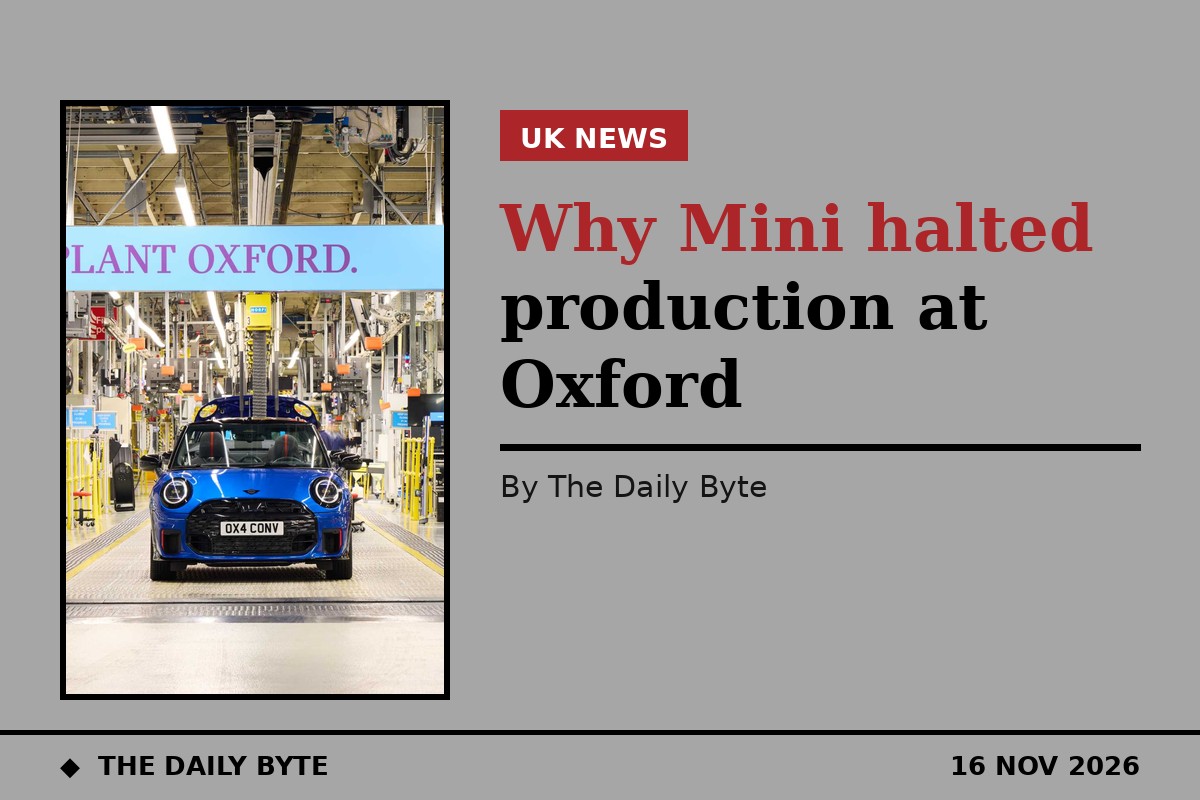
Mini has stopped building cars at its Oxford plant for two weeks because of a parts shortage, BMW has confirmed. Production of the petrol Cooper and Convertible was paused from Monday 9 November 2026 and is scheduled to run until 25 November, with staff told to stand down from Friday 6 November. The halt is the latest sign of how a single missing component — reportedly a wiring harness made in Ukraine — can stop a whole car factory.
BMW has said only that, due to temporary supply bottlenecks, it has adjusted the production plan at Plant Oxford for this week and next week, that it remains in close contact with its supplier network, and that it currently expects the shortage to be temporary. The company has not named the missing component, the supplier involved, or how many cars will go unbuilt.
What is a wiring harness, and why does it stop production?
A wiring harness is the bundle of cables that carries power and signals around a car — to its lights, engine management, safety systems, infotainment and driver-assistance features. Harnesses are fitted early in body assembly, are customised for each individual model and configuration, and are labour-intensive to make, which is why production is concentrated in lower-cost countries. Because each harness is made for a specific car, a missing harness cannot simply be swapped for a generic part, and a shortage quickly forces a line to stop.
That is what appears to have happened here. According to a report by Handelsblatt, cited by industry publications, the shortage stems from Russian attacks on the Ukrainian plants of German supplier Kromberg & Schubert. Autocar reported that the supplier's Rovantsi plant in Ukraine was hit by Russian missiles on 16 October, and the company said at the time that its operations had been halted and that its absolute priority was the safety, life and health of every employee. BMW has not confirmed the supplier or the component, so the link remains reported rather than confirmed by the carmaker.
Which plants and cars are affected?
The disruption is not limited to Oxford. BMW plants in Regensburg and Leipzig in Germany were also affected, and Skoda reported disruption to some of its models, including its electric Enyaq and Elroq. Production has since resumed in Regensburg, where BMW builds the X1, X2 and their electric versions, and Leipzig was expected to return to normal operations shortly. Recovery at the Mini plant in Oxford is likely to take longer, according to the same industry reporting, and the size of the production backlog at the three sites remains unclear.
At Oxford, the halt falls on the petrol-powered Mini Cooper in three-door and five-door form, as well as the Cooper Convertible — the cars the plant builds. The electric Cooper and the electric Aceman are built in China, so they are not affected by this stoppage. Plant Oxford employs around 4,000 people and built 124,283 vehicles in 2025, up from 110,939 the year before, according to BMW (UK) Manufacturing accounts reported by local media.
Has this happened before?
Yes. Shortly after Russia's full-scale invasion of Ukraine in spring 2022, a lack of wiring harnesses from Ukraine led to production stoppages at several European carmakers, and Mini production at Oxford was suspended at that time as well. Ukraine became a major centre for harness production because the work is skilled and labour-intensive; when plants there are hit, carmakers across Europe feel it within weeks. The current disruption is the second major Ukraine-sourced harness shock since 2022, and it shows how little slack remains in just-in-time supply chains for parts that cannot be made quickly anywhere else.
What happens next for Oxford, workers and buyers?
The two-week shutdown is scheduled to last until 25 November, but BMW has not given a firm restart date beyond that, and has not said whether customers with cars on order should expect delays. One Oxford worker told the Oxford Mail they feared the disruption could run into January, but that is a worry from the shop floor, not a forecast from the company, and it should not be treated as one. The longer question for Oxford is separate from this stoppage: BMW paused £600 million of funding for the site in February 2025, citing multiple uncertainties facing the automotive industry, and has not set a date for a decision on whether Oxford will ever build an electric Mini.
Frequently asked questions
When will Mini production restart at Oxford? The shutdown is scheduled until 25 November 2026, but BMW has not confirmed a restart date and says only that it expects the shortage to be temporary.
Which Minis are affected? The petrol Cooper three-door and five-door and the Cooper Convertible, which are built at Oxford. The electric Cooper and Aceman are built in China and are not affected.
Why can't BMW just use a different supplier? Wiring harnesses are customised for each model and configuration and are fitted early in assembly, so an alternative supplier cannot start producing them overnight. That is why a shortage at one supplier can stop several factories at once.
Source: Autocar — Mini production stops at Oxford plant amid parts shortages