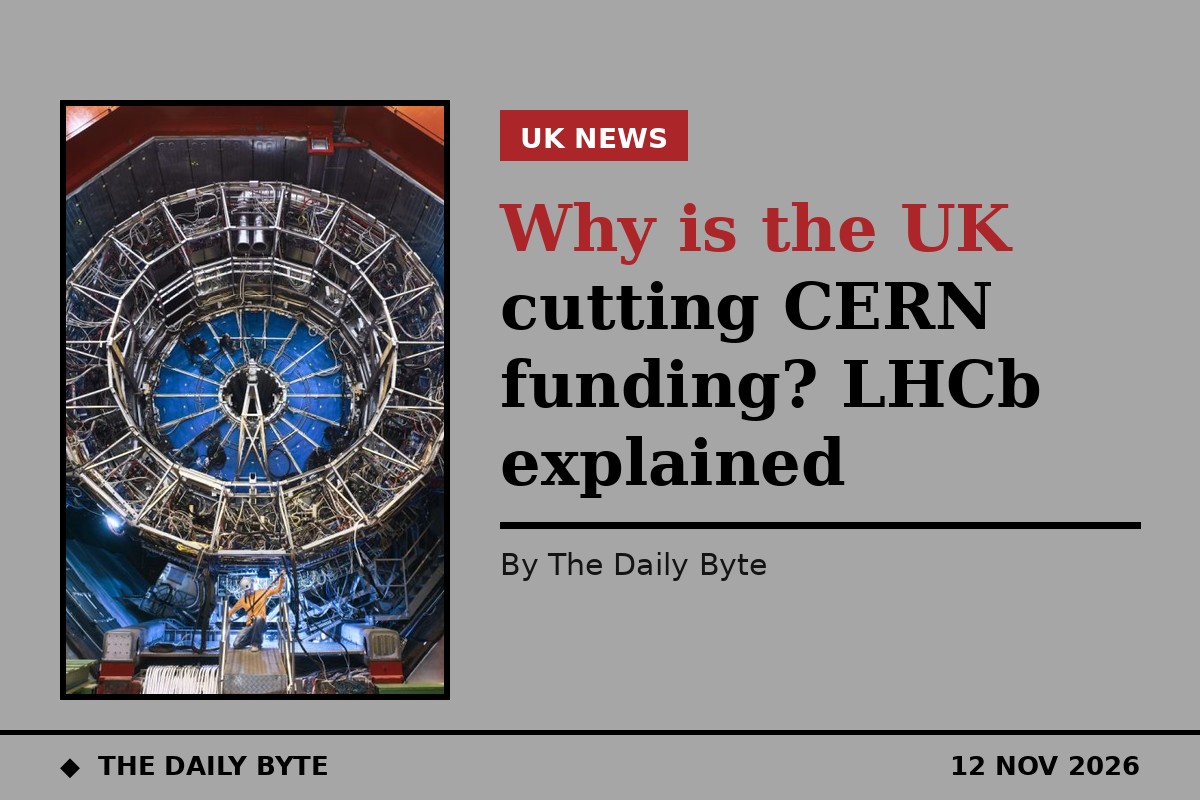
Why is the UK cutting CERN funding? LHCb explained
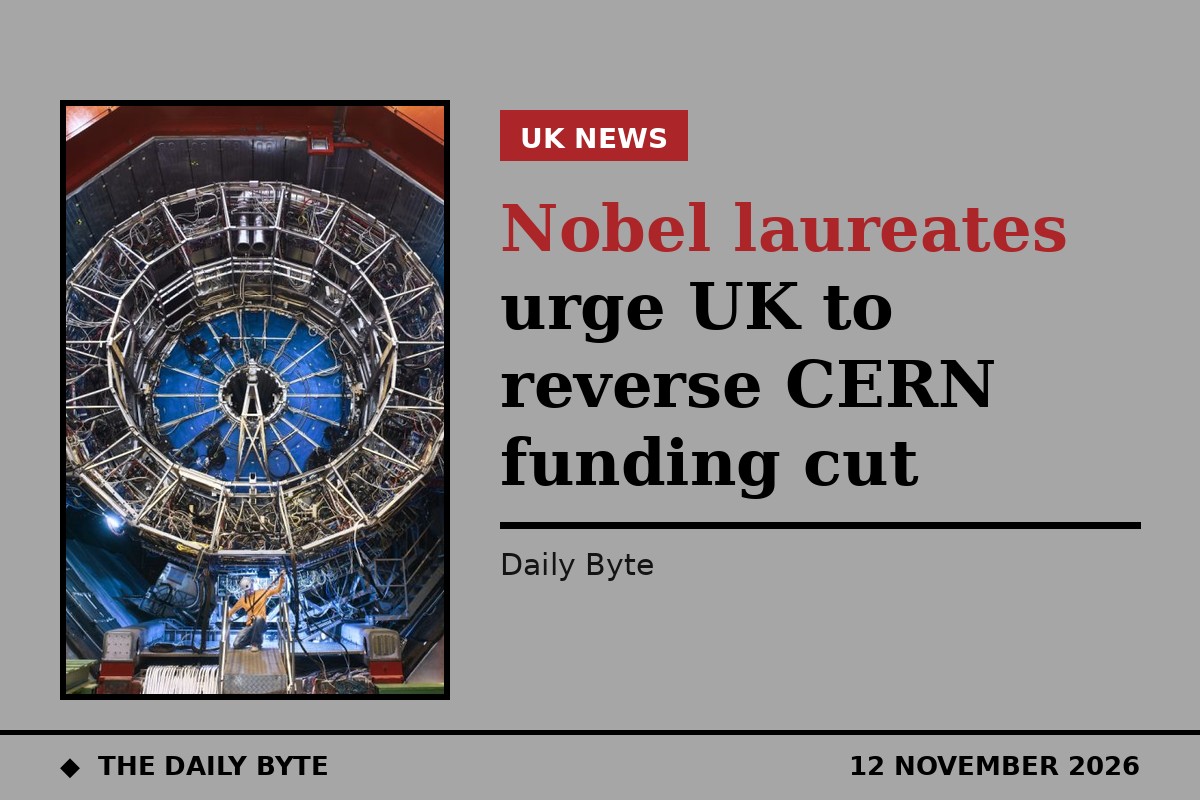
More than 400 leading physicists, including two Nobel laureates, have written to the UK government asking it to reverse its decision to withdraw funding from an upgrade to a particle detector at CERN. The open letter, published on 12 November 2026, is the latest attempt by the science community to save the LHCb Upgrade II project, which the UK had been leading until UK Research and Innovation (UKRI) cut its funding in January.
The cut does not mean the UK is leaving CERN. Britain still pays its annual CERN membership fee of about £160 million. What was withdrawn was the funding for one experiment's upgrade — but scientists say that single decision could end the UK's leadership in a field it helped to build, and could cut short the life of the LHCb experiment itself.
What is the LHCb experiment?
LHCb is one of the four large experiments on the Large Hadron Collider (LHC), the particle accelerator at CERN near Geneva. It studies particles containing the “beauty” quark to investigate why the universe is made of matter rather than antimatter, testing whether the known laws of physics — the Standard Model — fully explain a phenomenon called CP violation, and probing exotic particles such as tetraquarks and pentaquarks.
The UK has been one of the leading countries in the experiment: four of its eight spokespeople have come from the UK, and British physicists spent a decade planning its second upgrade, LHCb Upgrade II.
What funding was cut?
In 2022 UK researchers were awarded £49.4 million from UKRI's Infrastructure Fund to begin work on the upgrade. A three-year pre-construction phase, accounting for about £5 million of that sum, was completed in July 2026. Then, in a letter sent on 19 December 2025, UKRI chief executive Ian Chapman told researchers that the remaining funding had “not been prioritised” and would be cancelled.
The full upgrade was expected to cost about £150 million, with construction beginning in 2027 and the new components installed by 2035, allowing the detector to collect data for five to six years until the upgraded High-Luminosity LHC shuts down in 2040. Without the upgrade, the LHCb detector is expected to reach the end of its working life in 2033, after years of radiation damage.
Why did UKRI cut the funding?
UKRI put the project through a prioritisation exercise run by its Science and Technology Facilities Council (STFC), which funds physics and space research. The council's core budget is broadly flat, rising only from £835 million to £842 million between 2026 and 2030, and it says it needs to reduce spending by at least 30 per cent on 2024/25 levels. Four infrastructure projects were not prioritised, including LHCb Upgrade II.
UKRI has said the Infrastructure Fund received more excellent applications than it could fund and that it had to make tough choices. The scientists' letter says it is “staggering” that, ten months after the cut was announced, UKRI and the STFC have been “unable to communicate a clear reason for the decision”.
Who is asking for the decision to be reversed?
The open letter, coordinated by Matthew Kirk, a postdoctoral researcher at Durham University's Institute for Particle Physics Phenomenology, is signed by Physics Nobel laureates David Politzer and Giorgio Parisi, former CERN director-general Luciano Maiani, and more than 400 other senior UK and international physicists.
It is not the first protest. Physicist Brian Cox has previously condemned the decision, Chinese physicists led by Yifang Wang, director of the Institute of High Energy Physics in Beijing, called the withdrawal “irresponsible”, and the CERN council has also raised concerns. In October 2026, Research Professional News reported that a £51.2 million quantum cryogenics facility at UKRI's Daresbury Laboratory was fast-tracked through a “wildcard” route while the LHCb upgrade lost its backing.
What happens next?
The letter is described as a final plea asking the government to “reconsider this decision”. The new Science Secretary, Jonathan Reynolds, has already been urged to review the cut. As of 12 November 2026, UKRI has not reversed the decision, and the upgrade's future depends on whether the government intervenes or other countries fill the funding gap. Italy, which with the UK was to provide 40 per cent of the upgrade budget, is also reported to be uncertain about its contribution.
| Fact | Detail |
|---|---|
| Project | LHCb Upgrade II at CERN |
| Funding awarded in 2022 | £49.4 million |
| Spent on pre-construction | About £5 million (phase completed July 2026) |
| Estimated total upgrade cost | About £150 million |
| Decision to cut funding | Revealed January 2026; letter dated 19 December 2025 |
| UK CERN membership fee | About £160 million a year (continues) |
| LHCb expected to end without upgrade | 2033 |
| Open letter | 12 November 2026; more than 400 signatories |
Frequently asked questions
Is the UK leaving CERN?
No. The UK continues to pay its annual CERN membership fee of about £160 million. Only the funding for the LHCb Upgrade II project was withdrawn.
What is LHCb Upgrade II?
It is the second major upgrade of the LHCb detector, designed to take advantage of the High-Luminosity LHC and increase the experiment's data-taking capability by roughly an order of magnitude over the first upgrade.
Can the decision still be reversed?
The open letter asks the government to reconsider. As of 12 November 2026, UKRI has not reversed the cut.
Sources: Times Higher Education; Physics World