Xi Jinping says Taiwan reunification must happen
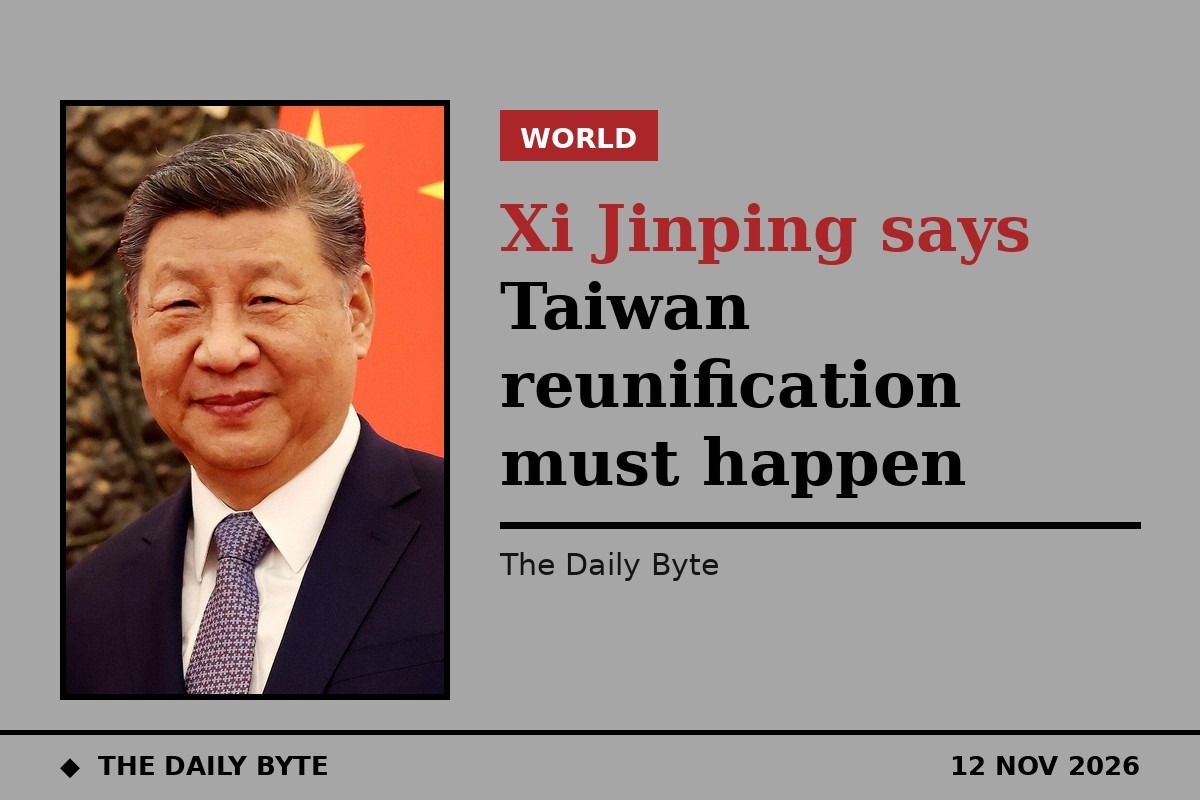
Chinese President Xi Jinping said on Thursday that the complete "reunification" of Taiwan with the motherland must be realised, pledging to pursue it peacefully and making no mention of the use of force. Speaking in Beijing, Xi called resolving the Taiwan question an "unwavering historical mission" of China's Communist Party.
"The tide of history cannot be stopped," Xi said. "The complete reunification of the motherland must be realised, and it will certainly be realised." His remarks came in a speech at the Great Hall of the People marking the 160th birthday of Sun Yat-sen, the revolutionary hero who helped lead the 1911 revolt that ended centuries of imperial rule in China.
Peaceful reunification, but no room for independence
Xi said China adheres to "peaceful reunification and the policy of 'one country, two systems'" and is willing to talk to Taiwan on the basis of upholding the "one-China principle", Beijing's position that both sides of the Taiwan Strait are one country. He added that, on the basis of the one-China principle and the 1992 Consensus, Beijing is willing to hold dialogue with people from all sectors in Taiwan on cross-Strait relations and reunification.
But he drew a firm line on independence. "We will never leave any room for 'Taiwan independence' separatist activities in any form," Xi said, calling on all Chinese people, including those in Taiwan, to join hands to oppose "Taiwan independence" separatist forces and work for the peaceful development of cross-Strait ties.
China views democratically governed Taiwan as its own territory, despite Taipei's strong rejection of that claim. Beijing has repeatedly offered a "one country, two systems" model of autonomy, which is not supported by any major Taiwanese political party. Taiwan's government did not immediately respond to a request for comment on Xi's speech.
Sun Yat-sen anniversary
Thursday's gathering in Beijing was attended by about 3,000 people, including senior Chinese leaders Li Qiang, Zhao Leji, Wang Huning, Cai Qi, Ding Xuexiang and Li Xi, all members of the Standing Committee of the Political Bureau of the Communist Party's Central Committee. Wang presided over the event, and Xi met Sun's relatives and representatives of overseas guests before it began.
Xi hailed Sun, who was born in 1866 and died in 1925, as a great national hero, a great patriot and a great pioneer of China's democratic revolution. In Taiwan, Sun is officially considered the "father of the nation" and his portrait hangs in the presidential office, although his political philosophy, the "Three Principles of the People", is no longer a required text for schoolchildren.
Last month, Taiwan called on its people to steer clear of any of China's events to mark this year's anniversary, saying China had a distorted view of Sun and his legacy. Beijing calls Sun a great national hero and patriot, as well as the forerunner of the 1949 communist revolution that forced the defeated Republic of China government to flee to Taiwan, where it remains to this day.
Why the timing matters
Xi's speech comes a week ahead of the APEC summit in China's southern tech hub of Shenzhen, where he is due to meet US President Donald Trump again, and a little more than two weeks before important local elections in Taiwan. Taiwan is taking part in this year's APEC leaders' summit on what its president, Lai Ching-te, has described as a principle of interaction on an "equal basis".
It also came a day after G7 foreign ministers said in a joint declaration published after their meeting in Paris that China's increasingly assertive activities in the waters east of Taiwan threaten regional stability, freedom of navigation and the safety of international shipping. China has stepped up activity off Taiwan's east coast since June with regular coast guard patrols, and officials in Taiwan say they believe Beijing is practising for a potential maritime blockade using overlapping military, paramilitary and civilian assets.
China's military operates around Taiwan on a daily basis, and Beijing has never renounced the use of force to bring Taiwan under its control, though it says it would prefer peaceful reunification. Xi's speech, with its emphasis on a peaceful path and no mention of force, sets the tone for a week in which Taiwan, the United States and China will all be watching the APEC summit closely.