53 New House Democrats to Boycott Harvard Event
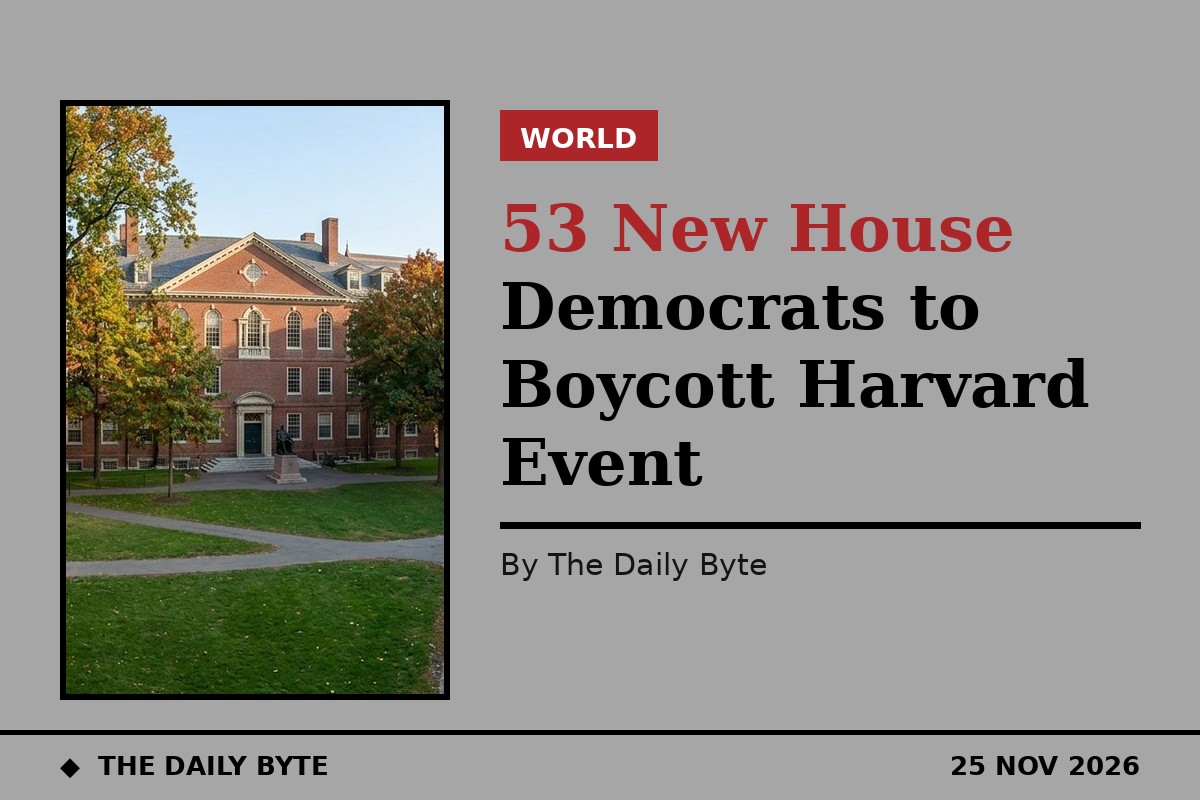
Fifty-three incoming House Democrats say they will skip Harvard University's orientation for newly elected lawmakers if attending means crossing a picket line set up by the university's striking graduate workers.
In a letter sent on Tuesday to Harvard's administrators, the newly elected members of the 120th Congress said they would stay away from the Bipartisan Program for Newly Elected Members of Congress, scheduled for 6-8 December at Harvard's Kennedy School, unless the labour dispute is resolved first.
'While we appreciate the invitation to Harvard's Institute of Politics, we will not cross a picket line,' the lawmakers wrote. 'So long as these workers are on strike, any trip we take to Harvard would be to stand in solidarity with our striking union siblings.'
The letter was addressed to Harvard President Alan Garber, Provost John Manning and Jacob Watts, the Kennedy School's director of programs and events. It was posted to social media by Representative-elect Sam Forstag of Montana, one of the signatories.
The letter and the picket line
'As newly-elected Members of the 120th Congress, we were elected because of our commitments to helping working people, and we remain steadfast in our support for unions and collective bargaining,' the lawmakers wrote, according to UPI.
The group said they would reconsider attending if Harvard and the union reach an agreement before the programme begins. Three of the signatories, Forstag, Claire Valdez of New York and Bob Brooks of Pennsylvania, also posted a video statement in support of the striking workers on Tuesday.
'Harvard has an endowment of $68 billion — they can afford to pay people a living wage,' Forstag said in the video.
The incoming Democrats are part of what UPI described as the largest House freshman class in three decades, with more than 100 new lawmakers scheduled to take office in January.
A strike now in its fifth week
The Harvard Graduate Students Union-United Auto Workers (HGSU-UAW) represents more than 4,000 graduate and undergraduate student workers, who have been on strike since 27 October. Contract negotiations began in March 2025.
The union is seeking higher pay and benefits, protections for workers who are not US citizens, and an independent process for handling harassment and discrimination complaints.
A separate union, Harvard Academic Workers-UAW, has been bargaining for a first contract for more than two years and recently staged a week-long strike of its own. That strike ended earlier this month after Harvard increased its proposed raise to 7 per cent, according to The Harvard Crimson, although the union has still not reached a contract.
Mediation continues
The graduate students union accepted Harvard's offer to enter mediation last week, and the two sides met with a federal mediator on Friday and again on Tuesday. Harvard Deputy Provost Jessica Soban said the university presented a revised pay proposal during Tuesday's mediation, addressing salary concerns for doctoral research assistants and teaching fellows, who make up about 60 per cent of the union's membership.
The parties are scheduled to meet again on 1 and 3 December, ahead of the orientation programme. The union's president, Denish K. Jaswal, linked the lawmakers' pledge to Harvard's pursuit of federal funding, saying in a statement cited by The Crimson that the university should expect members of Congress to demand dignified treatment of workers.
Harvard's response
Harvard Kennedy School spokesperson Daniel Harsha said the university respected the incoming lawmakers' decisions on whether to participate. He said the orientation gives new members of Congress an opportunity to discuss policy and governing challenges with faculty members and outside experts, and that Harvard had invited all newly elected members.
The Institute of Politics has hosted the congressional orientation every two years since 1972, with more than 800 legislators taking part over that time. It cancelled the programme in 1994 after most incoming Republicans attended a separate orientation sponsored by the Heritage Foundation instead.
Whether the 53 stay away will now depend on the next round of mediation. If Harvard and the union reach a deal before 6 December, the lawmakers have said they will reconsider — and the picket line that has kept a freshman class away from Cambridge will come down with it.