OpenAI Merges ChatGPT and Codex Usage Limits
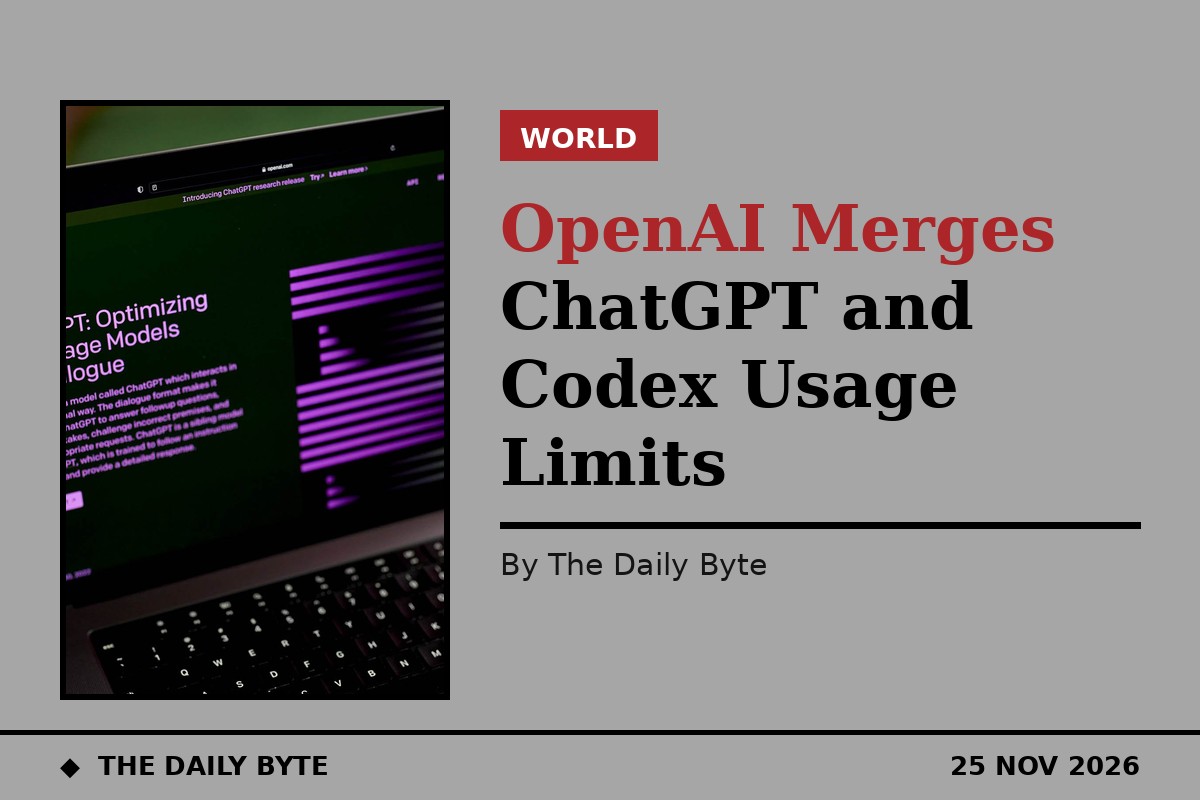
OpenAI has started rolling out a unified ChatGPT experience that merges its Chat and Work modes into a single shared usage allowance, and some of its heaviest-paying subscribers fear they will get less for the same money. TechCrunch reported on Tuesday, 25 November, that the rollout has begun for a small group of Pro subscribers.
Product lead Thibault "Tibo" Sottiaux announced the move in a post on X on Tuesday, writing: "We're beginning to roll out the combined Chat and Work experience to a small group of Pro users to learn from feedback before we roll out more broadly." The change follows an earlier announcement of the merger in an email to users, and OpenAI plans to bring the shared usage limits more broadly in December, according to its support page.
One allowance for chatting and coding
Until now, ChatGPT's conversational chat and its Work and Codex coding tools have drawn on separate allowances. Under the new system, Chat and Work will share a single usage meter across ChatGPT, an OpenAI spokesperson told TechCrunch. Usage will be measured in tokens, the small units of information AI models consume when processing and generating text.
That matters because the two kinds of work compete for the same pool. OpenAI's usage guide estimates that Plus subscribers can send as few as five Astra messages in Work or Codex within a five-hour window, depending on the task. Under the new system, spending an afternoon in long reasoning conversations could leave a user with less capacity to build an app in Codex later that evening, and developers who exhaust their allowance writing software could find themselves restricted to Instant chat.
Conversations using the Instant model will remain unlimited and will not count toward the shared allowance, the spokesperson said. Users can also continue using Instant after exhausting their usage limits. Starting in December, Plus, Pro and Business subscribers will all move to the single allowance covering ChatGPT and Codex.
What OpenAI has not said
An OpenAI spokesperson told TechCrunch that while most users are not expected to face more frequent usage resets, a small fraction of its heaviest users may hit their limits sooner. That is among the concerns raised by subscribers on social media and on OpenAI's community forum in recent days, with users arguing that merging the limits could leave them with less access to advanced reasoning models even as they continue paying the same subscription fees.
What the company has not disclosed is the new token budget for each plan, whether the combined allowance will equal the sum of the previous separate quotas, or how much individual users' effective limits could shrink. OpenAI's own guidance says it expects most users will not need to wait for resets more often than they do now. Subscribers who exhaust the shared allowance can wait for a reset, upgrade their plan, or buy credits for eligible features, OpenAI says. Its most expensive consumer subscription currently costs $500 a month.
The change comes after OpenAI doubled Work allowances for some Pro subscribers while keeping separate limits for conversational Pro models. A larger Work allowance does not necessarily compensate for the loss of a separate chat quota, which is much bigger than the one available in Work mode.
A wider push towards agents
The merger fits a broader shift across the AI industry, from chatbots that answer questions to agents that carry out whole jobs. ChatGPT Work lets users delegate complex assignments such as conducting research or creating presentations. Rival Anthropic also moved to bring its conversational chat service Claude and its work-focused Cowork tool under one interface, in September.
The changes also come as AI companies face mounting infrastructure costs and growing demand for increasingly capable models, putting pressure on their computing resources. Bringing conversational and work-related tools into a single interface could make AI chatbots simpler to use, allowing people to move between chats and more complex tasks without switching tabs. Whether subscribers accept that trade-off will depend on a number OpenAI has not yet published: how big the shared allowance actually is.