What Is an Executive Order? How Presidential Orders Work
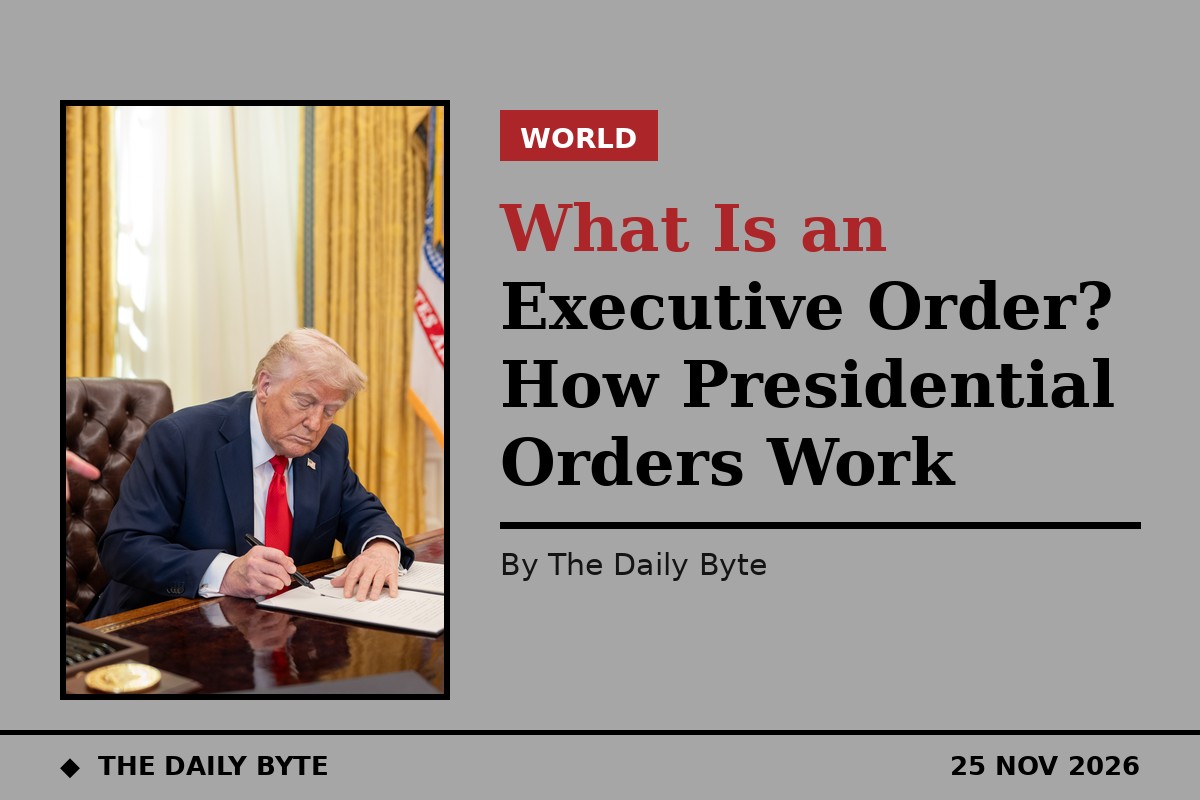
An executive order is a written directive from the President of the United States that tells federal officials and agencies how to carry out their responsibilities. It is not a law passed by Congress, and it is not mentioned anywhere in the Constitution. It is an instruction from the chief executive to the executive branch, and it carries the force of law only when it rests on the President's own constitutional powers or on authority Congress has given him. Executive orders can reshape how the government enforces the law, spends money and treats people, and they can be cancelled just as quickly as they are issued.
The question is in the news on 25 November 2026 for two reasons. First, a second federal judge has blocked enforcement of President Donald Trump's executive order limiting birthright citizenship. US District Judge Christopher Cooper in Washington DC issued a preliminary injunction in a class-action case, barring the State Department, the Department of Homeland Security and the Social Security Administration from enforcing the August order against the children covered by the case. A federal judge in Maryland had already blocked the order in September. Second, on 20 November the President issued Executive Order 14438, "Protecting the Executive's Privileges and Enhancing Efficiencies in Federal Contracting", which directs federal contractors to report congressional requests about their government work to their agencies and the White House, and to follow executive-branch instructions to withhold material the administration considers privileged.
| Fact | Detail | |---|---| | What it is | A written presidential directive to federal officials and agencies | | Who can issue one | Only the President of the United States | | Mentioned in the Constitution? | No; neither the Constitution nor any statute defines an executive order | | Source of authority | Article II of the Constitution, or a delegation of power from Congress | | Who it binds | The executive branch of the federal government | | How it is recorded | Numbered in sequence by the Office of the Federal Register and published in the Federal Register | | When it takes effect | When the President signs it, not when it is published | | How it can be ended | Revoked by the same or a later President, overturned by a court, or overridden by Congress | | Recent examples | EO 14438 (20 Nov 2026, federal contracting); birthright-citizenship order (Aug 2026, blocked twice) | | Famous historical examples | EO 9066 (1942, Japanese internment); EO 9981 (1948, desegregating the armed forces) |
What gives a President the power to issue executive orders?
The short answer is that the power is accepted, not written down. The Congressional Research Service, in its report "Executive Orders: An Introduction", states that the Constitution does not address executive orders and no statute grants the President a general power to issue them, yet the authority to do so is widely accepted. George Washington issued what is now regarded as one of the first executive orders, asking the heads of executive departments for written reports, and presidents have issued them ever since.
For an order to have legal effect, it must be rooted in one of two sources. The first is the President's own powers under Article II of the Constitution, which vests "the executive Power" in the President and makes him commander-in-chief of the armed forces. The second is a delegation of power from Congress: a statute that gives the President discretion to act in a particular area. Most orders rely on one or the other, and often on both. An order that has neither source behind it is vulnerable in court, which is the central lesson of the most famous case on the subject.
That vulnerability matters because an executive order is not a law. Only Congress can make laws, and a president cannot use an order to create powers the Constitution and Congress have not given him. The distinction is easy to blur, because orders are numbered, published in the Federal Register and printed in Title 3 of the Code of Federal Regulations, which makes them look like legislation. But they are internal directions to the government, not statutes that bind the public directly.
How is an executive order made and published?
There is no single procedure laid down by law, but a typical process exists, set out in an executive order issued by President John F. Kennedy. The process is coordinated by the Office of Management and Budget, which gathers comments and language from the agencies affected. Once the Office of Management and Budget and the agencies have reviewed the draft, it goes to the Attorney General and the Director of the Office of the Federal Register for review, and then to the President for signing. Not all orders go through this process, and the President's actions are not directly reviewable under the Administrative Procedure Act, so challenges to an order usually turn on whether its implementation is consistent with the Constitution or a statute, not on how it was drafted.
Once the President signs, the White House sends the document to the Office of the Federal Register, which assigns it a consecutive number in an ongoing series and prints the text in the daily Federal Register. That is why the contracting order issued on 20 November 2026 is known as Executive Order 14438: it is the 14,438th order in the numbered series. An order takes effect when the President signs it, not when it appears in the Federal Register; publication serves as public notice, so that agencies, courts and the public know what has been directed.
Executive orders are the most formal of the President's written instruments, but they are not the only ones. Presidents also issue proclamations, which are usually ceremonial or directed at the public, and executive memoranda, which are less formal directives to agencies. The form matters less than the substance: there is no general legal requirement that a president use a particular type of directive for a particular purpose, although a statute may require a specific form. In practice, an executive order outranks a memorandum, and a president can override a memorandum with an order, but not the other way round.
Is an executive order the same as a law?
No, and the difference is the most misunderstood thing about them. A law is passed by Congress and signed by the President, or passed over his veto, and it binds everyone. An executive order is issued by the President alone and binds the executive branch: the departments, agencies and officials who work for him. It tells them how to enforce existing laws, how to prioritise their work, how to allocate resources within existing budgets, or how to organise themselves.
That is still a great deal of power. An order can redirect agency priorities, impose requirements on government contractors, freeze hiring across federal departments, restructure how agencies share information, and shape foreign policy. The contracting order of 20 November 2026 is an example: it does not create a new law about privilege, but it tells contractors and agencies how to handle congressional requests, and it carries weight because the government is the customer. But an order cannot do things that require legislation. It cannot create a new criminal offence, raise taxes, or spend money Congress has not appropriated. When a president tries to go further than his authority allows, the courts can step in, and they have done so at the highest level.
Who can stop an executive order?
Three different actors can end or limit an executive order, and all three routes are in use today. The first is the courts. Executive orders are subject to judicial review and can be overturned if they lack support in the Constitution or a statute. The leading case is Youngstown Sheet and Tube Company v. Sawyer, decided by the Supreme Court in 1952. During the Korean War, President Harry Truman issued an executive order, Executive Order 10340, on 8 April 1952, directing the Secretary of Commerce to seize and operate the nation's steel mills to avert a strike he believed would jeopardise national defence. The steel companies sued. By a 6-3 vote the Supreme Court held the seizure unconstitutional: neither the President's Article II powers nor his role as commander-in-chief gave him the power to seize private property, and Congress had refused to authorise such seizures when it considered the Taft-Hartley Act in 1947. Justice Robert Jackson's concurring opinion set out a three-part framework for judging presidential power that courts and Congress still use today: a president's power is at its strongest when he acts with Congress's approval, at its weakest when he acts against Congress's wishes, and in a middle zone when Congress has said nothing.
The second route is Congress itself. Congress can pass a law that overrides an order issued under powers it delegated, or it can refuse to fund what the order requires. It can also simply decline to give the President the authority the order assumes. The third route is the presidency itself: a president may amend, rescind or revoke an order issued by himself or by any earlier administration, and new presidents routinely review the orders in force during their first weeks in office. Because of that, executive orders are impermanent in a way laws are not. What one president orders, the next can undo with a signature.
Which executive orders changed American history?
Some orders are remembered because they expanded rights, and some because they took them away. Executive Order 9066, signed by President Franklin D. Roosevelt on 19 February 1942 after the attack on Pearl Harbor, authorised the forced relocation of Japanese Americans from the West Coast. About 120,000 people, around two-thirds of them American citizens born in the United States, were sent to internment camps in remote desert locations, and most lost their homes, businesses and property. The Supreme Court upheld the internment in Korematsu v. United States in 1944. In 1988 President Ronald Reagan signed the Civil Liberties Act, issuing a formal apology and paying 20,000 dollars in reparations to surviving internees.
Six years after 9066, President Harry Truman signed Executive Order 9981 on 26 July 1948, mandating equality of treatment and opportunity in the armed forces and effectively desegregating the military. It was a decisive step towards civil rights, taken by executive action because Congress would not act. A decade later, President Dwight D. Eisenhower used Executive Order 10730 in 1957 to send federal troops to Little Rock, Arkansas, to enforce school desegregation after the Supreme Court's decision in Brown v. Board of Education. The same instrument that had been used to intern citizens was also used to protect them.
What is happening to Trump's birthright-citizenship order now?
The order at the centre of the 25 November ruling was signed in August 2026, after the Supreme Court ruled in June that the President's first attempt, an order from 2025, violated the citizenship clause of the 14th Amendment, which confers citizenship on people born in the United States who are "subject to the jurisdiction thereof". The new order tried again with narrower targets: it aimed at "birth tourism", in which women travel to the United States to give birth so their children can obtain automatic citizenship, and at children whose parents work for foreign governments or international organisations but lack diplomatic immunity, and children with a parent classified as an "alien enemy".
Two courts have now blocked it. A federal judge in Maryland blocked the order in September 2026. On Wednesday 25 November, Judge Christopher Cooper in Washington DC issued a preliminary injunction in a class-action case brought on behalf of children who would be denied citizenship under the order, barring the State Department, the Department of Homeland Security and the Social Security Administration from enforcing it against the children covered by the case. Judge Cooper said "the merits in this case are clear-cut", adding that the Supreme Court "has twice confirmed that all children born in this country are US citizens, save only for the small handful who are not subject to US law." He noted that the Supreme Court's June ruling had embraced its 1898 decision in United States v. Wong Kim Ark, which interpreted the 14th Amendment as recognising birthright citizenship regardless of the immigration status of a baby's parents.
The administration will now need to overturn both decisions in order to ever enforce the order. The White House spokeswoman, Lauren Bis, called Judge Cooper's ruling "just another ruling from an activist judge appointed by (former President Barack) Obama", and said the order was "consistent with the holdings and analysis set forth by the Supreme Court." The American Civil Liberties Union, which represented the plaintiffs, said the President "needs to accept that birthright citizenship is the law of the land." What happens next is a matter for the appeals courts, but the pattern is familiar from Youngstown onwards: an executive order that pushes against the Constitution gets tested in court, and the test can take the order down.
Frequently asked questions
### Can a President issue an executive order on anything?
No. An order must be grounded in the President's Article II powers or in authority Congress has delegated by statute. An order that tries to make new law, spend money Congress has not appropriated, or take powers the Constitution gives to Congress can be struck down by the courts, as Truman's steel-seizure order was in 1952.
### How is an executive order different from a presidential memorandum?
An executive order is the most formal presidential directive: it is numbered, published in the Federal Register and printed in Title 3 of the Code of Federal Regulations. A memorandum is a less formal instruction to agencies and is not always published. In practice an order outranks a memorandum, and a president can override a memorandum with an order.
### Can the next President cancel an executive order?
Yes. A president may revoke, modify or make exceptions to any executive order, whether it was issued by the current president or a predecessor. New presidents routinely review the orders in force during their first weeks in office, which is why orders are far less permanent than laws passed by Congress.
### Do executive orders apply to ordinary citizens?
Not directly. They bind the executive branch: federal departments, agencies and officials. They can still affect ordinary people deeply, because they direct how agencies enforce the law, who gets a benefit, or how a programme is run, but they cannot create a new criminal offence or a new tax. Only Congress can do that.