What Is a Filibuster? US Senate Rules Explained
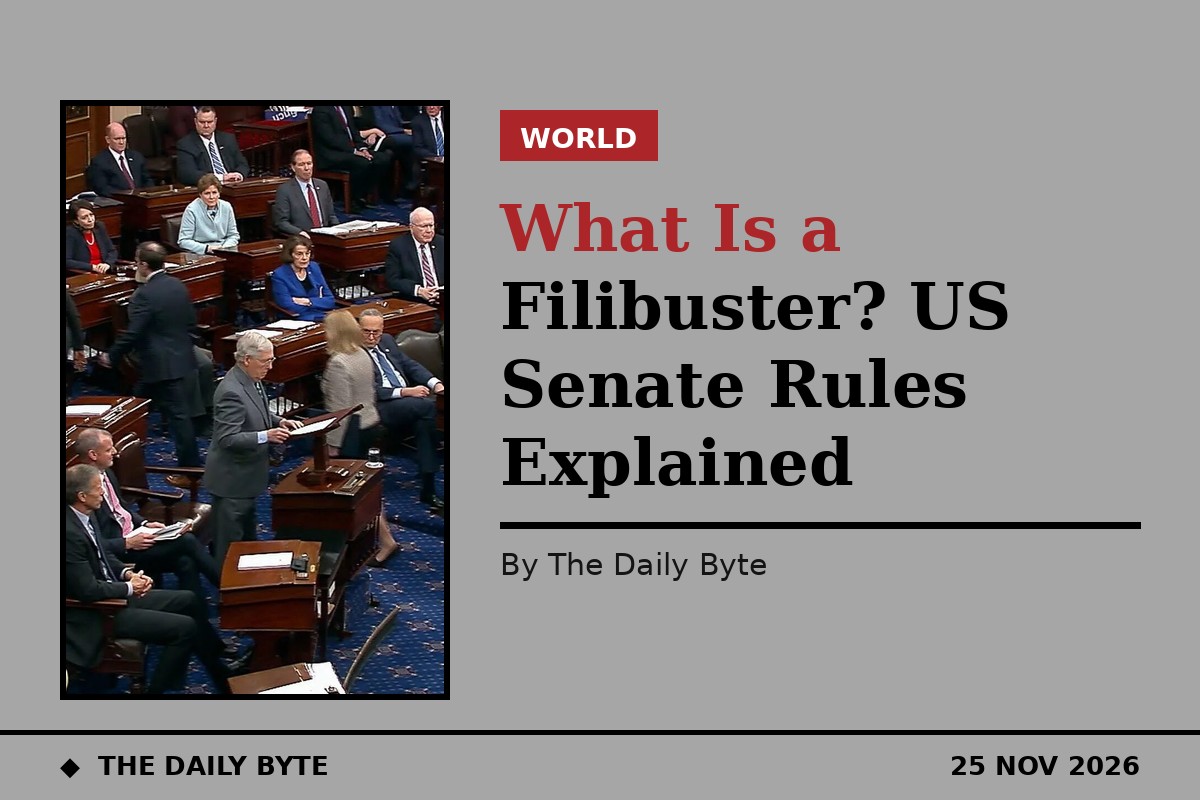
A filibuster is a tactic in the United States Senate in which senators delay or block a vote on a bill, nomination or other measure by refusing to let debate end. Because Senate rules place few limits on how long a senator may speak, a determined minority can keep talking, or simply signal that it will, until the majority either gives up, changes the bill or finds 60 votes to force the debate to a close. That 60-vote threshold is the reason the filibuster matters so much: most major bills in the Senate effectively need 60 of the 100 senators behind them, not just a simple majority of 51.
The question is in the news now because the filibuster is shaping the final weeks of the 119th Congress. The House has left for the Thanksgiving recess with the government's funding fight unfinished, a stopgap funding measure expires on 11 December, and reporting on the lame-duck session says the Senate filibuster "looms over negotiations" on funding bills, since Democrats, although in the minority until January, could use Senate procedure to block party-line funding measures. At the same time, Senate Republicans have been debating whether to use budget reconciliation, a special process that lets some bills pass with a simple majority and sidesteps a filibuster, to push through 350 billion dollars in extra military spending before they lose control of Congress in January. That effort has stalled, according to the Wall Street Journal, because Republicans could not hold their own conference together through the marathon amendment process reconciliation requires.
| Fact | Detail | |---|---| | What it is | Extended debate or delaying tactics used to block a Senate vote | | Where it applies | United States Senate only; the House of Representatives has no filibuster | | Votes needed to end debate (cloture) | Three-fifths of senators duly chosen and sworn, normally 60 of 100 | | Senators needed to start cloture | 16 must sign the motion | | When the cloture vote happens | Normally on the second day of session after the motion is filed | | Debate allowed after cloture | Up to 30 further hours in most cases | | Cloture rule adopted | 1917, as Rule XXII, at two-thirds of senators present and voting | | Threshold lowered to 60 | 1975, from two-thirds present and voting to three-fifths of all senators | | Nominations today | Cloture by simple majority, under precedents set in 2013 and 2017 | | Longest solo filibuster | Strom Thurmond, 24 hours and 18 minutes, 28-29 August 1957 | | What avoids it | Budget reconciliation (subject to the Byrd rule) and nominations |
Why is the filibuster in the news now?
The 119th Congress is in its lame-duck session: the midterm elections were held on 3 November 2026, Democrats won large majorities in the House and Senate, and the new Congress does not take office until 3 January 2027. Until then Republicans still control both chambers, but their options are limited. The government is funded under a stopgap measure that expires on 11 December, and all 12 annual spending bills for the coming year are still outstanding. The House has passed three of them; the Senate has passed none.
That is where the filibuster bites. Ordinary spending bills need 60 votes in the Senate, so a minority can block a party-line funding measure and force negotiation, or risk a shutdown when the stopgap runs out. Reporting on the lame-duck session has described exactly that danger: Democrats could block party-line funding measures until the new Congress sits, potentially setting the stage for a December government shutdown.
The same arithmetic explains the fight over the 350 billion dollars of extra Pentagon funding that President Donald Trump has demanded. Republicans hold only a narrow Senate majority, so a normal defence bill would need Democratic votes to reach 60. Budget reconciliation is the workaround: it lets some spending bills pass with a simple majority, avoiding a filibuster altogether. But reconciliation comes with its own costs. It requires near-unanimity among Republicans, it opens the door to marathon "vote-a-rama" sessions in which the minority can force dozens of politically painful amendment votes, and its use is limited by the Byrd rule, which lets the minority block provisions that are not closely tied to the budget. Senate Majority Leader John Thune warned colleagues they would have to act by Thanksgiving week to use the process, and by 18 November the effort appeared to be losing momentum. The Wall Street Journal reported that Senate Republicans were suspending the push, with one senator saying "we've got a lot of work to do because we have competing priorities, and I don't think we have the votes yet."
Where does the word filibuster come from?
The word comes from the Dutch "vrijbuiter" and the Spanish "filibustero", both meaning a freebooter or pirate. In the mid-19th century it described American adventurers who launched private military expeditions into Latin America, and it was soon applied to legislators who hijacked the Senate floor. The piratical sense fits: a filibuster is, in effect, a hijacking of the Senate's timetable.
The tactic itself was an accident. When the Senate adopted its first rules in 1789, both chambers had a "previous question" motion that could be used to end debate and force a vote. In 1805, Vice President Aaron Burr, presiding over the Senate in his final days in office, suggested the chamber clean up its rulebook by dropping redundant provisions. In 1806 the Senate removed the previous question motion. Historians generally agree nobody intended to create a right to unlimited debate, but the change left the Senate with no mechanism to force a vote while a determined minority kept talking. The House, by contrast, kept its previous question motion and later turned it into an effective tool for ending debate, which is why there is no filibuster in the House.
The first sustained filibusters came in the late 1830s and 1840s, and the first filibuster in Senate history is usually dated to 5 March 1841, a six-day obstruction over the firing of the Senate's printers. For most of the 19th century the tactic was used only occasionally. It grew more frequent after the Civil War and around 1900, and for much of the 20th century Southern senators used it to defeat or weaken civil rights legislation, from anti-lynching bills to voting-rights measures.
How does a filibuster work in practice?
In its classic form, a filibuster is a talking filibuster: a senator holds the floor and keeps speaking, sometimes for hours, so that no vote can take place. Senate rules traditionally required the speaker to remain standing, to keep talking, and to stay on the floor; yielding the floor, sitting down or leaving could end the speech. That is why the image of the filibuster is a lone senator talking through the night.
Modern filibusters usually look very different. In the 1970s the Senate created a two-track system that lets it take up other business while a filibuster is under way, so a senator no longer has to hold the floor physically to block a bill. Today the filibuster is often silent: the minority simply makes clear that 60 votes to end debate are not available, and the majority leader, rather than waste days of floor time, moves on to other business. The threat of a filibuster has therefore become a routine requirement: most major legislation needs 60 of the Senate's 100 votes to proceed, even though the final vote on passage itself needs only a simple majority.
A filibuster can take several forms. Senators may speak at length, offer a stream of amendments, raise repeated procedural motions, or object to routine requests to move business forward. The common thread is delay: the aim is to run out the clock, force concessions, or make the majority decide the bill is not worth the floor time.
What is cloture, and how does the Senate end a filibuster?
Cloture is the Senate's procedure for limiting debate so that a vote can happen. It was created by Rule XXII, adopted on 8 March 1917 after a group of about a dozen senators talked to death President Woodrow Wilson's bill to arm American merchant ships as the United States edged towards the First World War. The original threshold was two-thirds of senators present and voting. In 1975 the Senate lowered it to three-fifths of senators duly chosen and sworn, which is normally 60 votes when all 100 seats are filled.
The Congressional Research Service describes the process like this. A cloture motion must be signed by 16 senators and presented while the question it covers is pending. The Senate does not normally vote on the motion until the second day of session after it is filed. Then, for most matters, at least three-fifths of all senators, normally 60, must vote in favour. Invoking cloture on a proposal to change the Senate's standing rules themselves requires two-thirds of senators present and voting, a deliberately higher bar.
Once cloture is invoked, debate is not over immediately. In most cases up to 30 further hours of consideration are allowed, with each senator limited to no more than one hour, although time can be yielded to others. Only amendments that are germane and were submitted in writing before the cloture vote can be offered. Even after cloture, a bill can face more than one filibuster: a measure may need cloture on the motion to proceed to it, on amendments, and on the bill itself, so bills supported by 60 or more senators can still be delayed.
What can the filibuster not block?
The filibuster does not apply to everything the Senate does. The most important exception is budget reconciliation, the process at the centre of the current defence-funding fight. Reconciliation bills need only a simple majority to pass, which is why a majority party turns to them when it cannot reach 60 votes. But reconciliation is narrow: it can only be used for legislation that affects spending, revenue or the debt limit, and the Byrd rule lets the minority strike provisions that are not closely tied to the budget. Reconciliation also requires the majority to survive a vote-a-rama, an unlimited series of amendment votes that gives the minority repeated chances to force awkward votes.
Nominations are the other big exception. In 2013, under Democratic Majority Leader Harry Reid, the Senate changed its precedents so that cloture on executive-branch and lower-court judicial nominations needed only a simple majority. In 2017, under Republican Majority Leader Mitch McConnell, the same change was extended to Supreme Court nominations. Confirmations can therefore no longer be filibustered, although legislation still can.
There are also smaller exceptions created by statute or precedent, including some trade and fast-track procedures. But the general rule stands: for ordinary legislation, 60 votes are needed to end debate.
What is the longest filibuster in history?
The record for the longest solo filibuster belongs to Senator Strom Thurmond of South Carolina, who spoke for 24 hours and 18 minutes on 28 and 29 August 1957 against that year's Civil Rights Act. He began at 8.54pm, reading the election laws of each of the then 48 states, Supreme Court decisions, and George Washington's Farewell Address, and finished at 9.12pm the following evening. The bill passed anyway, shortly afterwards.
Thurmond held the record for the longest Senate speech as well until 2025, when Senator Cory Booker of New Jersey spoke for 25 hours and 5 minutes in a protest speech against the second Trump presidency. Booker's speech was not a filibuster in the strict sense, because it was not holding up a pending vote, but it passed Thurmond's mark for the longest single speech. Thurmond's 24 hours and 18 minutes remains the longest filibuster by one senator; longer filibusters have been carried out by groups of senators working in relays.
Why do some senators defend the filibuster and others want it gone?
Supporters argue that the 60-vote rule forces compromise. Because most bills need votes from both parties, the majority cannot simply impose its will, and the minority has a real say. Defenders, including former Senators Joe Manchin and Kyrsten Sinema, have argued that the supermajority requirement encourages bipartisan agreement and protects the rights of the minority party. In a chamber designed to cool the passions of the House, they say, a brake on hasty majorities is a feature, not a bug.
Critics argue the opposite: that the filibuster lets a minority veto the majority's programme and has become a routine 60-vote requirement for almost everything. They point to its history, above all its use by Southern senators to block civil rights legislation, and argue that a procedure created by accident in 1806 should not decide whether elected majorities can govern. Critics also note that the modern silent filibuster costs the minority nothing: senators no longer have to hold the floor through the night, so the public rarely sees the obstruction it causes.
That argument is not new. It flares up whenever one party holds the presidency and the House but falls short of 60 Senate seats, and it fades when that party finds itself in the minority. In November 2026 it is flaring again, because the lame-duck Congress has a funding deadline on 11 December, a stalled 350-billion-dollar defence package, and a Senate where neither side can reach 60 votes on its own. Whatever happens in the next few weeks, the question the filibuster raises will not go away: should 41 senators be able to stop a bill that 59 support?
Frequently asked questions
### How many votes does it take to break a filibuster?
Normally 60. Cloture requires three-fifths of senators duly chosen and sworn, which is 60 votes when all 100 seats are filled. A proposal to change the Senate's rules needs two-thirds of senators present and voting, and nominations need only a simple majority under the 2013 and 2017 precedents.
### Is the filibuster in the US Constitution?
No. The Constitution says each house may determine its own rules of proceedings, but it does not prescribe a 60-vote requirement. The filibuster grew out of the Senate's 1806 decision to drop the previous question motion, and cloture is an internal Senate rule, Rule XXII, not a constitutional provision.
### Can the House of Representatives filibuster?
No. The House kept its previous question motion and strengthened it, so debate in the House can be ended by a simple majority vote. The filibuster exists only in the Senate.
### What is the difference between a filibuster and cloture?
A filibuster is the delaying tactic itself: extended debate or other obstruction used to prevent a vote. Cloture is the procedure for ending it: a motion signed by 16 senators that, if it wins 60 votes, limits further debate to 30 hours and clears the way for a vote.