Africa CDC and WHO Set $1.58bn Plan to Fight Congo Ebola
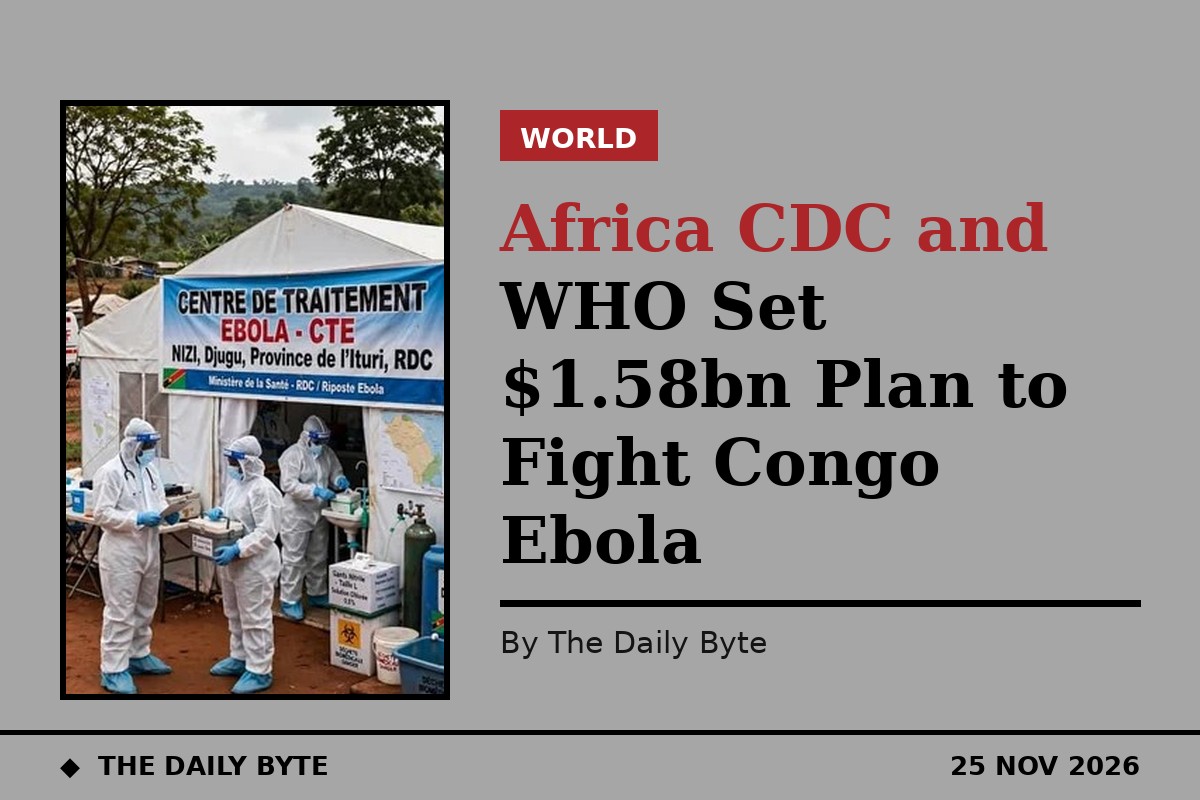
The Africa Centres for Disease Control and Prevention (Africa CDC) and the World Health Organization (WHO) have published a joint plan to tackle the Ebola outbreak centred in the Democratic Republic of the Congo, estimating that US$1.576 billion will be needed to carry it out through May 2027.
The Bundibugyo Virus Continental Preparedness and Response Plan covers November 2026 to May 2027. It is the second phase of a continental response that began in June, and it sets out what governments, Africa CDC, WHO and their partners say is required to stop transmission and to prepare neighbouring countries for further cases.
The figure is an estimate of the cost of the work, not money already pledged or paid. A joint tracking system will record funding against the estimated cost, according to the agencies.
What the plan covers
The plan calls for more support to find cases earlier, expand access to treatment, keep essential health services running and support safe and dignified burials. It also covers delivery of Ebola vaccines, work to counter misinformation, fear and stigma through trusted local actors, and measures to prevent sexual exploitation, abuse and harassment during the response.
National governments will lead implementation, with Africa CDC and WHO coordinating across borders. The plan works at continental, national, sub-national and community level, and it covers both the response inside the Democratic Republic of the Congo and preparedness in countries at risk of imported cases.
A record outbreak
The agencies describe the outbreak as the largest Bundibugyo epidemic ever recorded. The Bundibugyo strain of Ebola was declared a public health emergency of international concern by WHO, and a public health emergency of continental security by Africa CDC, in May 2026.
As of 17 November, the Democratic Republic of the Congo had reported 11,613 confirmed cases, including 5,678 deaths, across 68 health zones in eight provinces, according to the plan. That is a crude case fatality ratio of 48.9 percent, meaning almost half of confirmed patients have died.
The first six months of the response, from June to November 2026, provided a common framework for governments and partners, the agencies say. But transmission has continued, and the joint statement issued by the agencies and United Nations partners at the six-month mark said 400 to 500 new cases were still being reported each week, with the outbreak expanding into new health zones.
Insecurity hampers the response
Conflict, displacement and limited access to health care have made it harder to reach affected communities, the agencies say. Fighting in the east of the country has repeatedly disrupted the response, and WHO has said more than 80 attacks on health care were verified in the first six months of the outbreak.
Health workers have been caught up in the violence. On Wednesday, United Nations peacekeepers helped evacuate health workers trapped by fighting around a hospital in Ituri province, where the response had been interrupted and civilians displaced.
The plan notes that sustained transmission, high mortality, intense population movement and limited access to care continue to drive the outbreak and complicate operations.
What happens next
The revised plan replaces the first-phase framework that ran from June to November. Its resource estimate carries a range of US$1.509 billion to US$1.648 billion around the central figure of US$1.576 billion.
Whether the money arrives in time will decide much of what follows. The agencies say fast, flexible funding must be sustained through 2027, alongside political commitment, safe access for health workers and the involvement of affected communities. Without it, they warn, the progress made in slowing transmission in the original epicentres risks being lost as the outbreak reaches communities that are still beyond the reach of the response.