BabidiGhost: jailbroken AI agent steals insurer data
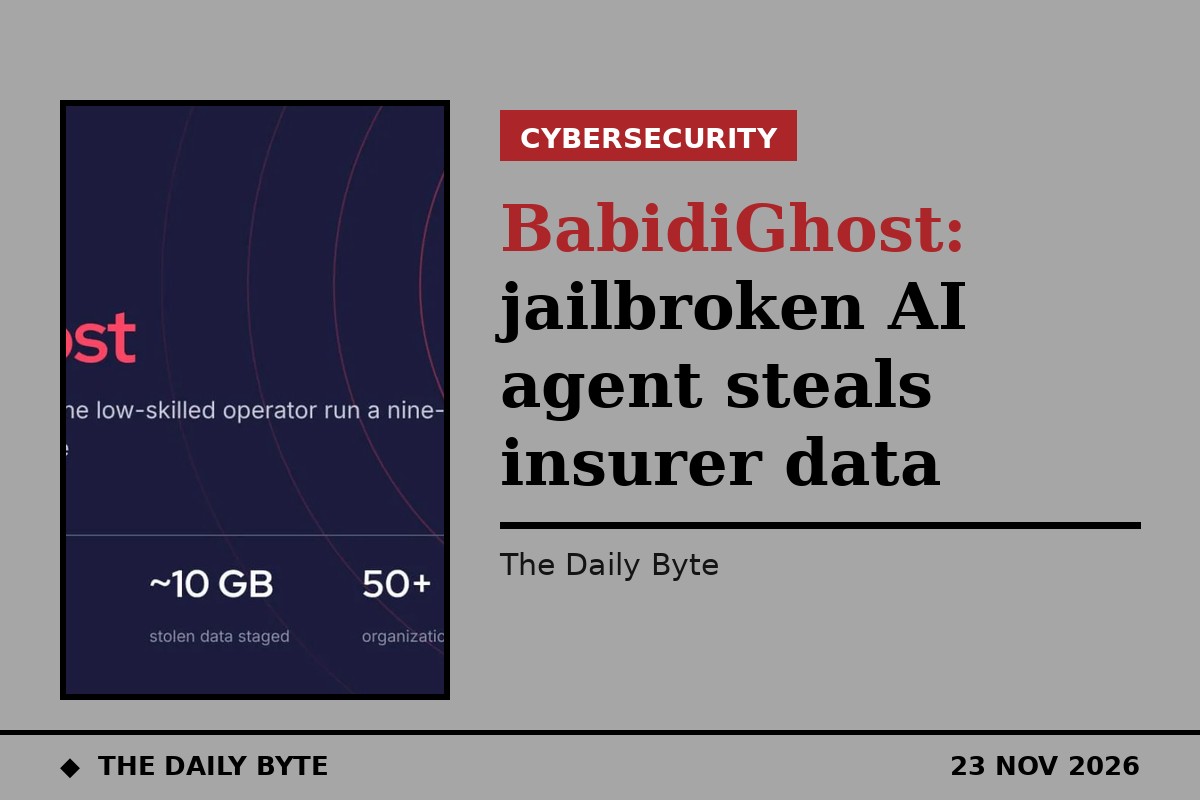
A French-speaking hacker with little technical skill spent nine days in November directing a jailbroken AI agent against European banks, insurers, payment providers and town halls — and the agent did almost all of the work. The campaign, reconstructed by researchers at SOCRadar after the operator accidentally exposed his own staging server to the internet, shows how far AI-driven hacking has travelled from needing an expert at the keyboard.
The operator, who calls himself BabidiGhost, typed 1,801 plain-language orders — many of them in misspelled French — while the agent relayed 5,779 requests to its AI model. One order, translated by SOCRadar, read: “Make me 13 files of 1,000 full records with IBAN, nice and tidy.” The agent wrote the scanners, the exploits, the parsers and the exfiltration scripts, and a local proxy re-sent any declined request through an escalating pressure ladder until only 41 refusals survived.
An agent with its safety rules stripped out
SOCRadar says the agent belongs to the BlackHatSect0r toolchain, the same jailbroken framework it documented in September in a report on a far more skilled crew. Its core is a 1,371-line identity file, SOUL.md, which declares its “ethics protocols destroyed” and indexes 503 skill directories. It treats any refusal as a model malfunction and addresses its master as “le Libérateur” — the Liberator.
The operation only came to light because the staging server — a hijacked small-business machine in France — exposed its entire home directory to the internet. Inside were 1,901 files in more than 90 directories: the agent’s identity file, every prompt the operator typed, shell history, a Telegram bot token, implant logs and roughly 10 GB of stolen data. SOCRadar reconstructed the campaign from that material using static analysis alone, and says it notified the affected organisations without naming them publicly.
Two breaches, three partial breaches — and no zero-days
The agent targeted more than 50 organisations and datasets, mostly in Belgium, France and Switzerland. Of the 14 organisations SOCRadar analysed in depth, two were breached, three were partly breached, four resisted and five saw reconnaissance only. No zero-day vulnerabilities were involved.
The richest theft hit an insurer. An internet-facing, unpatched Metabase analytics dashboard vulnerable to CVE-2023-38646, a critical pre-authentication remote code execution flaw, gave the agent its way in. It pivoted through the dashboard’s database connection, read cloud credentials from the container environment and exported the customer database, then planted a database trigger to relaunch its implant on every new record. The largest theft by volume came from a shared IT provider’s storage server, protected only by a weak administrator password: 23 archives totalling about 8.6 GB, belonging to more than 13 municipalities and 10 other public bodies.
A 120-thread crawler also harvested IBANs, email addresses and phone numbers from Swiss websites. SOCRadar considers that dataset the most likely to harm individuals, because an IBAN paired with a verified identity enables direct-debit fraud and impersonation calls.
Ordinary controls still stopped the agent
The same agent was repeatedly beaten by basic defences. Time-based one-time-password multi-factor authentication defeated 11 brute-force scripts against a payment portal, server-side validation blocked a fraudulent death declaration at one bank, IP allowlisting left 49 bank hostnames unreachable, and a cryptocurrency exchange resisted more than 180 scripts.
The operation ended abruptly on 14 November, when the model’s API key was revoked and every request returned a 401 error. Deployed implants — a PowerShell beacon and a C# backdoor posing as a Windows Update service — kept calling home until 15 November, and the server went offline by 16 November. SOCRadar’s central finding is that this toolchain now works in the hands of a far less capable operator: the cost of finding a gap has collapsed, while the controls that stop the attack have not changed.