CoreWeave Default Swaps Blow Out as AI Credit Cracks
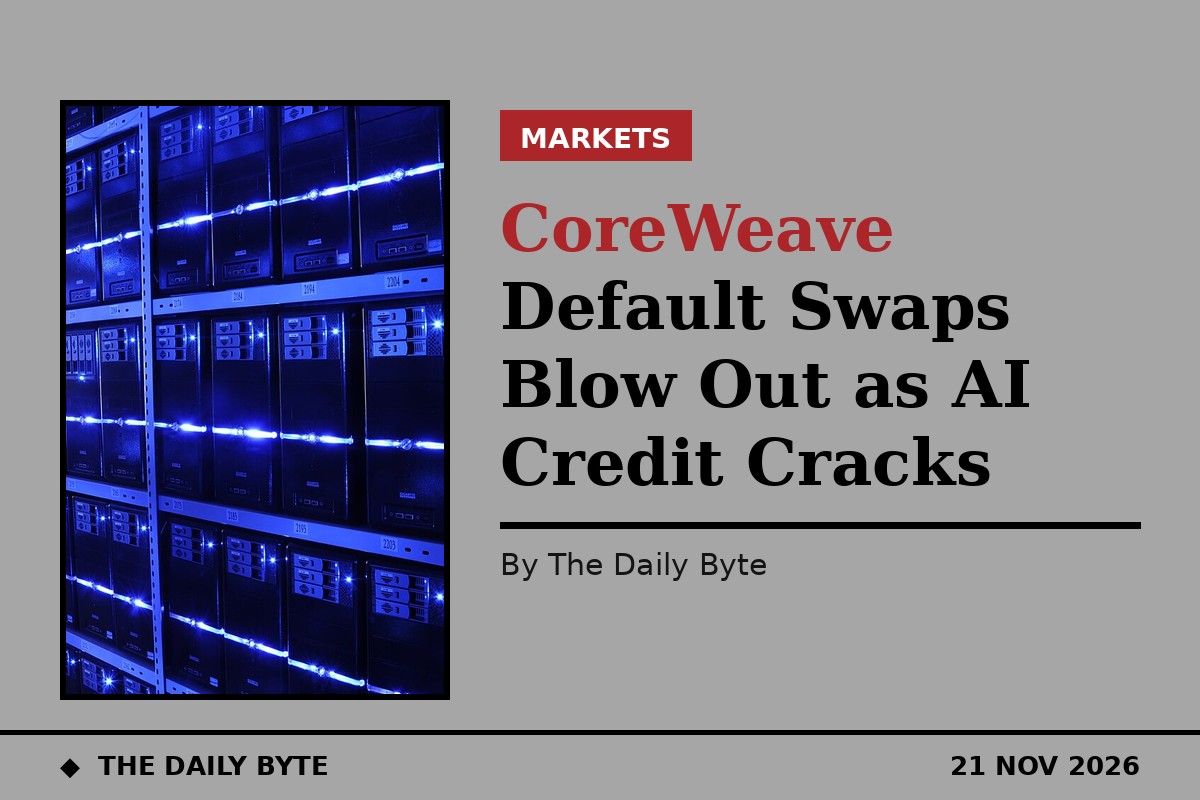
The cost of insuring CoreWeave’s debt against default blew out on Friday, as the market’s faith in the debt-fuelled artificial intelligence build-out cracked alongside the share-price rout.
The AI cloud provider’s five-year credit default swaps widened as much as 76.2 basis points on Friday to 1,232.6 basis points, according to Bloomberg data, a level that prices in a more than 65% chance of default within five years. Its 9.75% bonds due 2031 now yield close to 16%. Spreads above 1,000 basis points are generally treated as a sign of distress.
CoreWeave’s shares fell with the rest of the AI trade, closing Friday at $39.51, down 12% on the day and 25.6% on the week. The stock has now lost more than three-quarters of its value from a May peak of $138.25, even though third-quarter revenue rose 168% to $3.66 billion.
The swap had already spiked above 1,289 basis points on Thursday, according to Deutsche Bank data, wider than its October peak, before easing slightly on Friday. CoreWeave is the bellwether for the so-called neoclouds — companies that borrow heavily to buy Nvidia chips and rent computing capacity to AI developers — and its debt load is the market’s main worry: the company listed $35.6 billion of debt principal at the end of June, with $10.6 billion falling due by the end of 2027, and its senior notes now trade at around 80 cents on the dollar.
The stress is spreading beyond CoreWeave
The repricing is no longer confined to the weakest borrower. Oracle’s five-year default swaps climbed to 327.9 basis points on Friday, their highest since 20 October and up from about 76 basis points a year ago. Alphabet’s five-year protection hit a record 93.7 basis points. Default insurance costs have also risen sharply at Nvidia, Broadcom and Amazon in the past month, albeit from far lower levels.
Two fund managers, Tuttle Capital and Defiance, have each filed with regulators for exchange-traded funds that would use credit default swaps to gain when credit risk rises at AI-linked companies, with proposed vehicles tied to CoreWeave, Oracle, Meta and a basket of the largest technology stocks — a sign that Wall Street now sees AI credit as a trade in its own right, not just a side-effect of the equity sell-off.
The International Monetary Fund warned on 16 November that circular financing in the AI sector has passed $1 trillion, with roughly two-thirds of it debt-funded, and that the global economy is effectively “standing on one leg” — AI investment. Managing Director Kristalina Georgieva said a pullback in AI spending could travel rapidly through lenders and capital markets.
A market price, not a forecast
A credit default swap spread is a market price, not a prediction. The implied default probabilities depend on assumptions about how much lenders would recover in a default, and thin CDS markets can overshoot in both directions. Nothing in CoreWeave’s filings or public statements suggests a default is imminent: it reports growing revenue, a backlog of about $104 billion and new contracts at higher prices.
The risk the market is pricing is refinancing — whether CoreWeave can keep borrowing at bearable rates while its interest bill climbs faster than its operating income. Its third-quarter results, reported on 10 November, are now read through the bond market as much as through the share price. Friday’s move says the bond market is not yet convinced.