Fed's Cook Says More Rate Hikes Needed to Beat Inflation
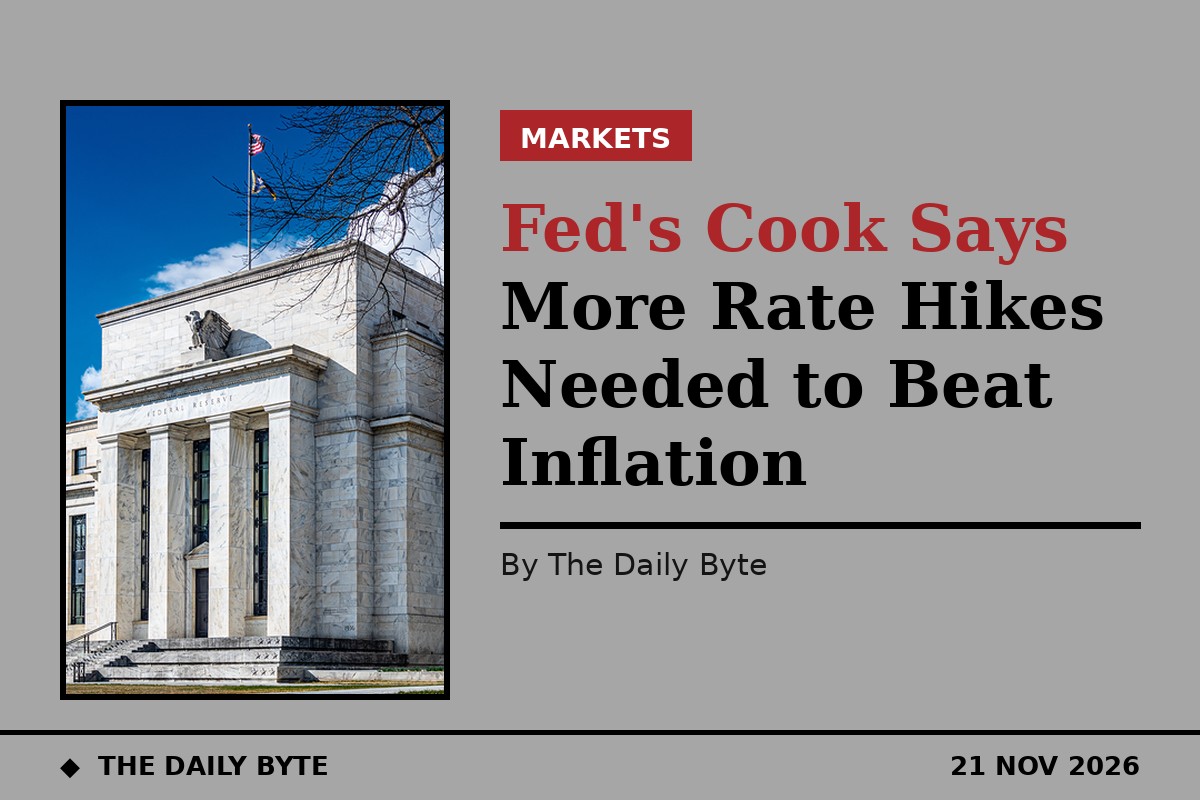
Federal Reserve Governor Lisa Cook said on Friday that US interest rates are not high enough to bring inflation under control, making the case for further rate rises even as Wall Street reels from its worst week in years.
Speaking in a text of a speech to be presented at a central bank conference in Chile, Cook said the Fed's current policy rate is not high enough to deal with inflation levels she views with "great concern". She argued that the quarter-point rate rise the Fed delivered in September was not enough to moderate price pressures.
"In a different environment, the Committee could afford to be patient, but I continue to believe that in this economic climate we do not have that luxury," Cook said, given how high inflation is and for how long it has been above the Fed's 2 per cent target.
Defending her dissent
Cook was one of two Fed officials who dissented when the central bank left its policy rate unchanged in the 3.75 to 4.00 per cent range at its 27-28 October meeting. She used Friday's speech to defend that vote publicly, saying it reflected the urgency she feels about tackling inflation.
"My vote reflected the urgency I feel to tackle inflation," she said, noting that inflation "has been above target for more than five and a half years, and every additional day poses greater risk that price- and wage-setters will adjust their inflation expectations upward."
Cook said data received since the September increase, including reports last week, "fail to provide me with sufficient evidence that inflation is returning to a sustainable path". She added: "There is little evidence inflation is declining."
She also singled out the investment boom in artificial intelligence as a significant force pushing inflation higher this year, arguing that the current level of rates cannot meaningfully restrain it. Financial conditions, she said, remain too loose to provide the restraint the economy needs.
Markets expect a December rise
A wide range of Fed officials in recent weeks have signalled support for more rate rises, and financial markets broadly expect the Fed to raise rates at its 8-9 December meeting and to follow that with further increases next year. Traders put a 97 per cent probability on a quarter-point rise in December, according to CME FedWatch data, with some debate over whether the Fed will move in consecutive quarter-point steps or deliver a single larger increase.
Cook did not say directly in her prepared remarks what the Fed should do at the December meeting. But she warned that delay carries its own danger. "Waiting longer to implement rate increases risks getting behind the curve," she said. "If we fall behind, additional and larger rate increases may be required later to catch up, which could increase stress on our financial system and have unnecessarily damaging effects on American households."
Most Fed officials have made the case for gradual action, arguing that moving slowly gives the economy time to adjust to higher borrowing costs. Cook's message was that patience has a price when inflation has already run hot for so long.
Upbeat on growth, under pressure
Cook was nevertheless upbeat about the economy, describing growth as "strong and accelerating" and the jobs market as "solid". Her remarks came as she faces extraordinary political pressure from the White House, which is seeking her removal, a move her lawyer has challenged. Her lawyer, Abbe Lowell, wrote to the White House counsel this week saying Cook would not take part in a closed-door hearing unless the White House changes certain procedural arrangements.
For markets, the timing matters. Cook's public defence of her dissent, days before the December meeting and in the middle of a stock market rout driven partly by rate fears, leaves little doubt about the direction of travel: rates are going up, and the only open question is how fast.