Fincantieri Wins 2 Billion Euro Carnival Ship Deal
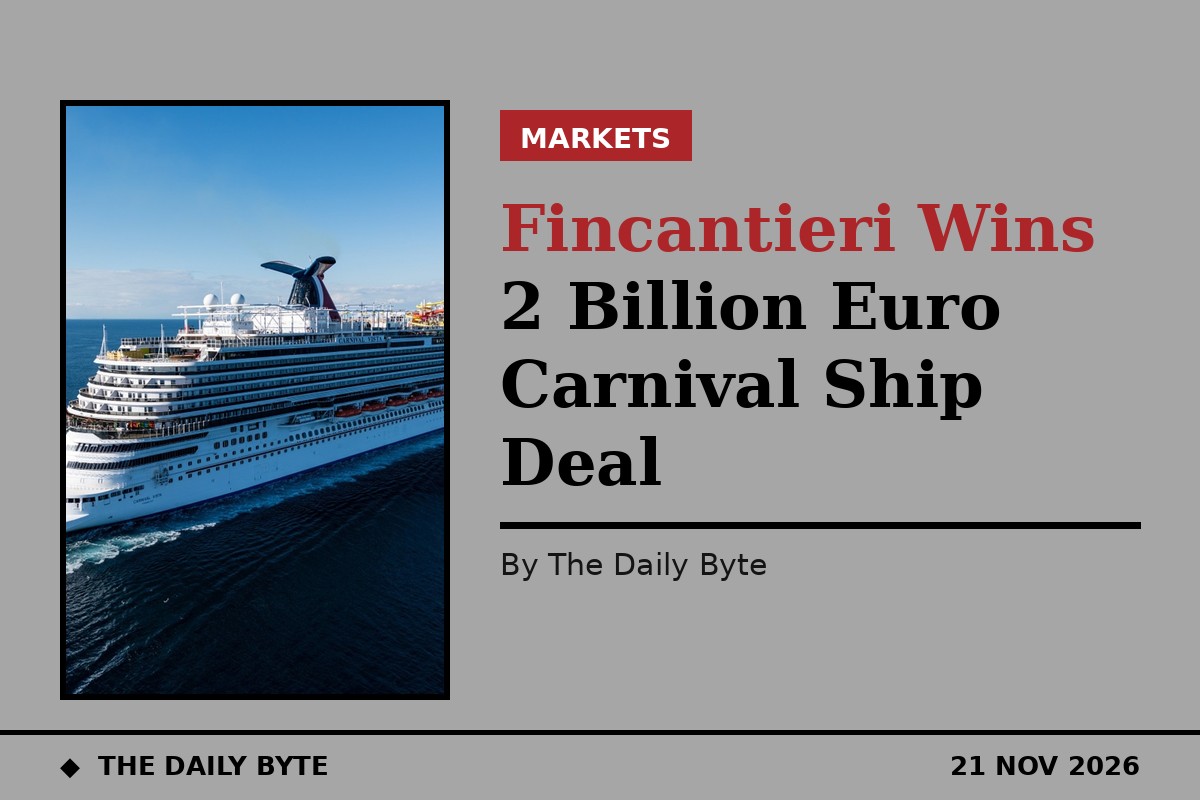
Italian shipbuilder Fincantieri has signed a contract worth more than 2 billion euros to build two next-generation dual-fuel cruise ships for Carnival Cruise Line, the companies announced on 20 November 2026. The deal, reported by Reuters, adds two large new vessels to Carnival's order book at a time when cruise operators are rebuilding fleets with cleaner-burning ships.
The two vessels will be built at Fincantieri's Marghera shipyard near Venice and are scheduled for delivery in 2033 and 2035. Each ship will have a gross tonnage of about 130,000 tons and around 1,650 guest cabins, and will run primarily on liquefied natural gas as part of a dual-fuel propulsion system. The contract is subject to financing and other customary conditions, and neither company disclosed an exact price beyond the figure of more than 2 billion euros, about 2.20 billion dollars.
Order book stretches to 2039
The two new ships add to a three-vessel Ace-class programme already under way for Carnival Cruise Line. Steel cutting on the first of that series, Carnival Destiny, began at Fincantieri's Monfalcone yard in July 2026, with the three Ace-class ships scheduled for delivery in 2029, 2031 and 2033. Together with the two new vessels and other ships already on order, Carnival's newbuilding programme now extends to 12 ships through 2039, ten of which are assigned to Fincantieri.
The scale of the relationship is long-standing. Fincantieri has delivered 76 cruise ships to Carnival over more than three decades, and its chief executive, Pierroberto Folgiero, described the new contract as an endorsement of the yard's capability in high-complexity cruise construction. For Fincantieri, whose order book is dominated by cruise work, the deal secures production at Marghera well into the next decade.
A smaller, more flexible ship class
The new vessels will be considerably smaller than the 230,000-gross-ton Ace-class ships, and Carnival has presented the class as a way to reach a wider range of ports that cannot take its largest vessels. The ships will combine advanced environmental and digital technologies with a more efficient design, according to the companies, with liquefied natural gas as the main fuel in place of conventional marine fuel.
Cruise operators have been ordering steadily as demand for seagoing holidays has recovered, and shipyards in Europe have benefited from a wave of newbuilding contracts. Deliveries in 2033 and 2035 are far in the future, and the contract still depends on financing being completed, but the agreement gives Fincantieri one of the largest single cruise orders announced this year. This article reports market news only and is not investment advice.