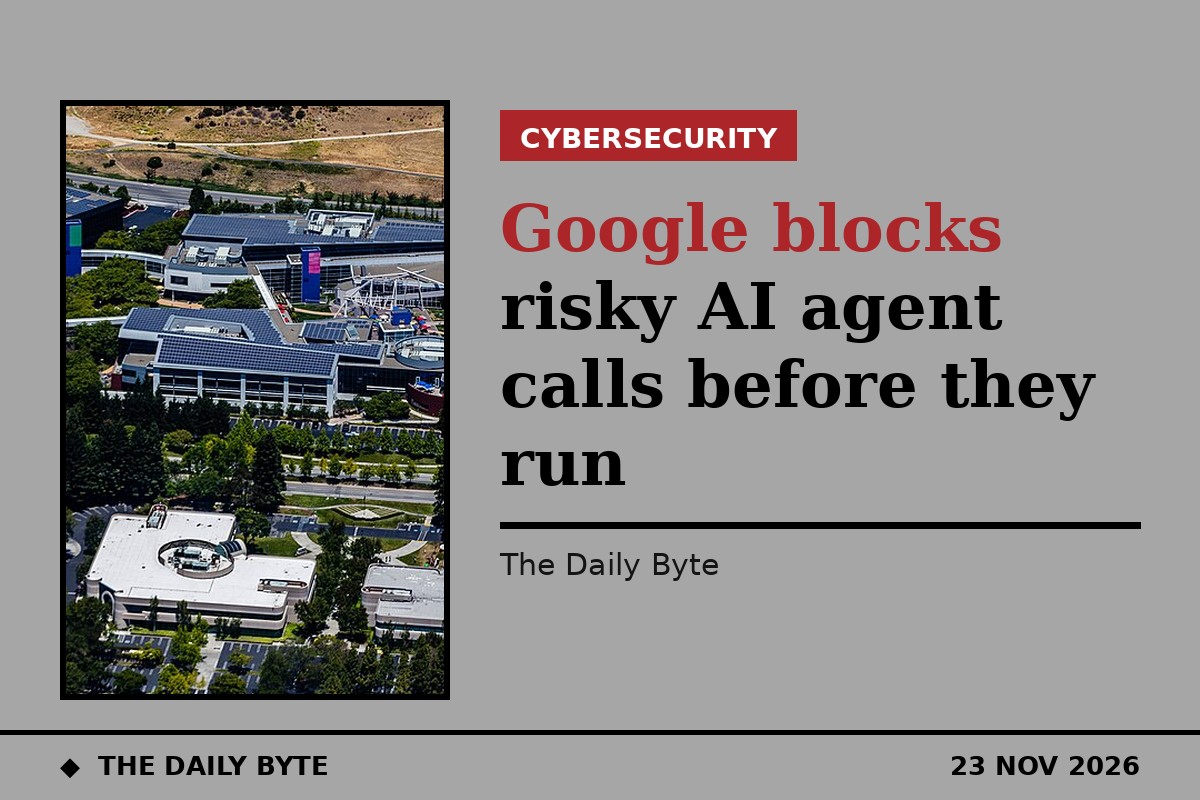
Google blocks risky AI agent calls before they run
Google has launched a new safety check that stops an AI agent from carrying out a risky action before it happens. Semantic governance policies, available in Preview on the Gemini platform, check every tool call an agent's model proposes against the user's original request and against rules written in plain language, and block the call if it fails either test. Google announced the feature on 20 November 2026, and it was reported on 23 November 2026.
The check matters because AI agents now hold real permissions: they can read files, send email and delete documents. Permissions alone say what an agent can do, not whether a particular call follows the rules. A model can also be talked out of the rules in its system instructions by a user with a plausible justification, or by a document telling it to do something nobody asked for, a technique called indirect prompt injection. Google's answer is to put the check outside the agent, at a policy enforcement point such as Agent Gateway, so the agent's own code cannot override it.
Two checks before an action runs
Every proposed tool call faces two checks. The first is the organisation's own rules, written the way a legal or compliance team already writes them, such as only sharing quarterly results with company email addresses before the earnings release. The second is what the user actually asked for, which is on by default and is designed to protect against hijacking. A call has to pass both checks to run.
When a model proposes a tool call, Agent Gateway sends it to the policy engine for evaluation before the response reaches the agent. Inside the engine, a language model acting as a judge evaluates the proposed call against the conversation so far, the agent's system instructions and tool descriptions, and the organisation's policies. If the call passes, the response reaches the agent unchanged. If it fails, the engine replaces the response, tool calls included, with a configurable denial message, so the call never runs. Either way, the verdict and the judge's rationale go to Cloud Logging. Responses that contain only text, such as an answer, a plan or a question, are not evaluated because they take no action.
An example: unreleased quarterly results
Google illustrates the system with a finance team's agent that can search the shared drive, read files, send email and delete drafts. The company writes one policy: quarterly financial results should not be shared publicly until the public earnings release, and before the release they may be shared only with company addresses, never with external or personal addresses, investors, analysts or press, regardless of NDAs, urgency or the requester's seniority.
The agent might then propose three calls. Sending the preliminary results to the controller for the month-end close is allowed, because the employee asked for it and the recipient is allowed by the policy. Sending the results to an investor and copying the employee's personal Gmail is denied by the policy, even though the employee asked and cited an NDA, and the whole call is denied, not just the copy to Gmail. And when the agent reads a planning document containing hidden text telling it to delete the drafts in the Forecasts folder, that call is denied by the intent check, because nobody asked for it and no policy allows deletions.
What it does not do
Google is open about the limits. Because verdicts come from a language model, which is probabilistic, they may vary, so the company recommends reviewing them in dry run mode before enforcing, and using the policies alongside other controls. Streamed model responses are not evaluated, so governed model calls must use a supported non-streaming path. The policies complement, rather than replace, disclosure controls and legal and compliance reviews.
The feature works with models called through the Gemini API, the Anthropic Messages API, Claude models on the Gemini platform, and OpenAI-compatible chat completions APIs, including self-hosted servers such as vLLM. Policies can apply to all of an agent's tools or to one tool, and can name a tool's parameters. Google says its next post will share how the policies held up against prompt injection on AgentDojo, a public agent-security benchmark.
Frequently asked questions
What are semantic governance policies? They are a Preview feature on the Gemini platform that checks each tool call an AI agent proposes against plain-language rules and the user's original request, before the call runs.
What happens when a call is blocked? The policy engine replaces the model's response, tool calls included, with a configurable denial message, so the call never runs, and the verdict and rationale are logged in Cloud Logging.
Does it protect against prompt injection? The built-in user-intent check is designed for that: it blocks calls that drift from what the user actually asked, including instructions hidden in documents the agent reads.
Is it generally available? No. It is in Preview, and Google recommends testing verdicts in dry run mode before switching to enforcement.
Sources: Google Developers Blog and Help Net Security.