Greer: US Trade Deal Must Accommodate Canada
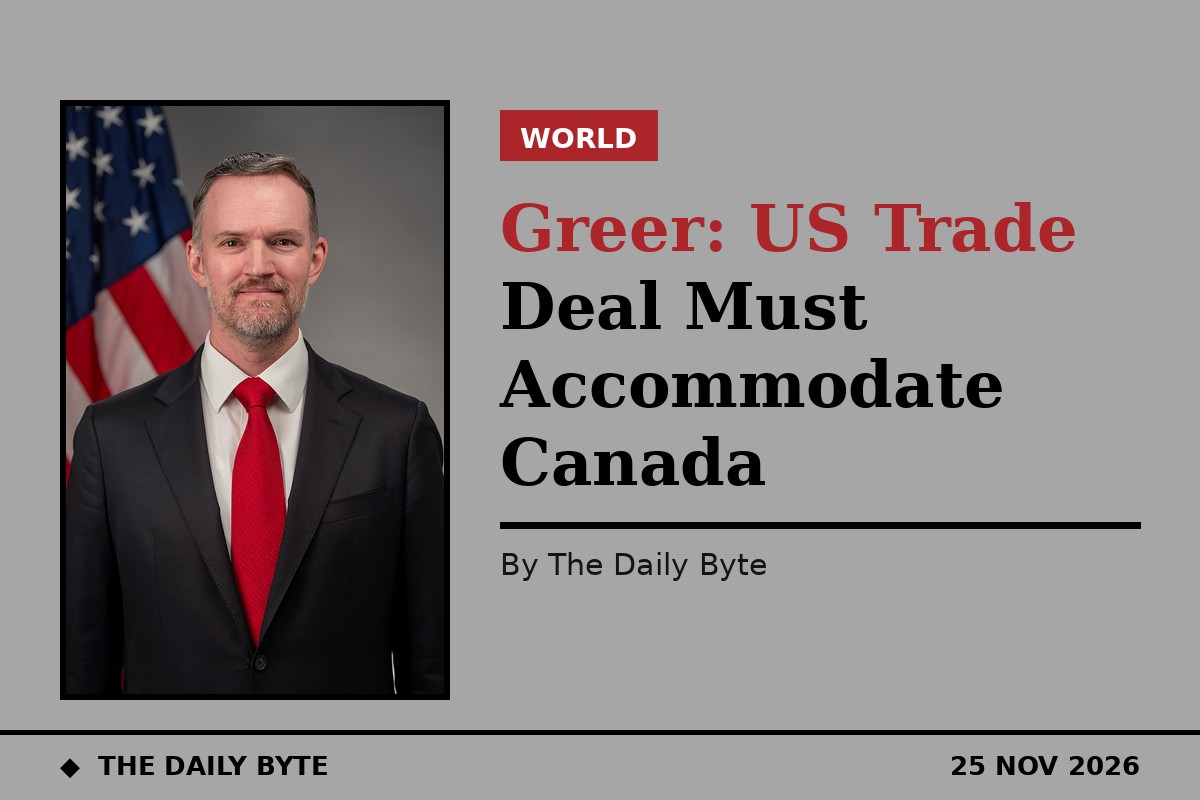
The United States' top trade official says any final trade deal with Canada will have to include something that works for Ottawa, even as talks remain stuck on tariffs for steel, aluminium and cars.
US Trade Representative Jamieson Greer told broadcaster CNBC on Wednesday that North American trade in those sectors must benefit the United States, but added that there would have to be 'something that accommodates Canada as well' if changes are made. The remarks, reported by The Canadian Press, are the most accommodating language from Washington on the file in weeks.
'The president wants to be careful about any potential modifications on that front, including with Canada,' Greer said. 'So that's where the conversations are really focused, is what could that look like?'
Sticking points: steel, autos and aluminium
Greer said he spoke with his Canadian counterparts last week and that sectoral tariffs on steel and automobiles remain among the sticking points. He described the negotiations as hung up on 'steel, aluminum, autos, et cetera', and said Washington wants North American trade in those products to benefit American industry.
The auto question matters most in Ontario, where assembly plants and parts makers are tied into cross-border supply chains with US factories. US tariffs of 25 per cent apply to Canadian vehicles under Section 232 of the Trade Expansion Act, and President Donald Trump has said they will double to 50 per cent from 1 January 2027.
Canada's trade minister, Dominic LeBlanc, said on Wednesday that Ottawa expects talks to continue next week after American Thanksgiving, telling reporters on Parliament Hill that Canada continues to seek a deal in its own interests.
Talks continue next week
Trade talks between the two countries broke down in August, with Washington and Ottawa each accusing the other of last-minute demands. Trump then imposed 50 per cent duties on some Canadian imports and banned others, including motorcycles and certain dairy products. Ottawa responded with retaliatory measures of its own.
Tensions have eased somewhat in recent weeks, and Greer noted that Trump and Prime Minister Mark Carney have been in contact. Greer said he hopes to present 'arrangements' for Canada and Mexico to the president by the end of the year, and that Trump and Carney will have many opportunities to talk ahead of the G20 leaders' summit in Miami next month.
Greer's remarks on Wednesday follow an interview on Sunday in which he said the two sides were 'fairly close' to finding a landing zone. The new comments go further, explicitly acknowledging that a settlement must take Canadian interests into account.
Canada spared the new tariff list
The comments came on the same day Washington proposed new tariffs on a string of other trading partners, including China, the European Union, Singapore and Switzerland, after an investigation into excess manufacturing capacity. Canada was not among the economies named, and neither was Mexico, which was investigated under the same statute.
Greer said he was in negotiations with his Mexican counterparts and that it would be 'a little bit more time before we release that report' on Mexico.
Both Canada and Mexico still face separate 10 per cent tariffs under Section 301 of the Trade Act of 1974, which Washington has defended by citing claims of forced labour in supply chains. Those tariffs do not apply to goods that comply with the Canada-US-Mexico Agreement on trade, known as CUSMA. The Trump administration chose not to renew CUSMA in July, triggering an annual rolling review that could last a decade.
Concern over China deals
Asked about Carney's recent trade deals with China, Greer said some of them make sense but others cause him concern. 'They're trying to get rid of Chinese retaliation, so they do a couple little deals here and there. That's not crazy,' he said. 'But when I see them talking about giving waivers to China for steel and aluminum from that country, that gives me pause.'
Greer's language offers some reassurance to Canadian exporters, but it is not a breakthrough. No agreement has been announced, no tariff has been lifted, and the sectoral duties at the centre of the dispute remain in place. Until details are agreed and formally announced, businesses on both sides of the border remain exposed to uncertainty over costs, investment and supply chains.