IMF Warns AI Correction May Last Longer
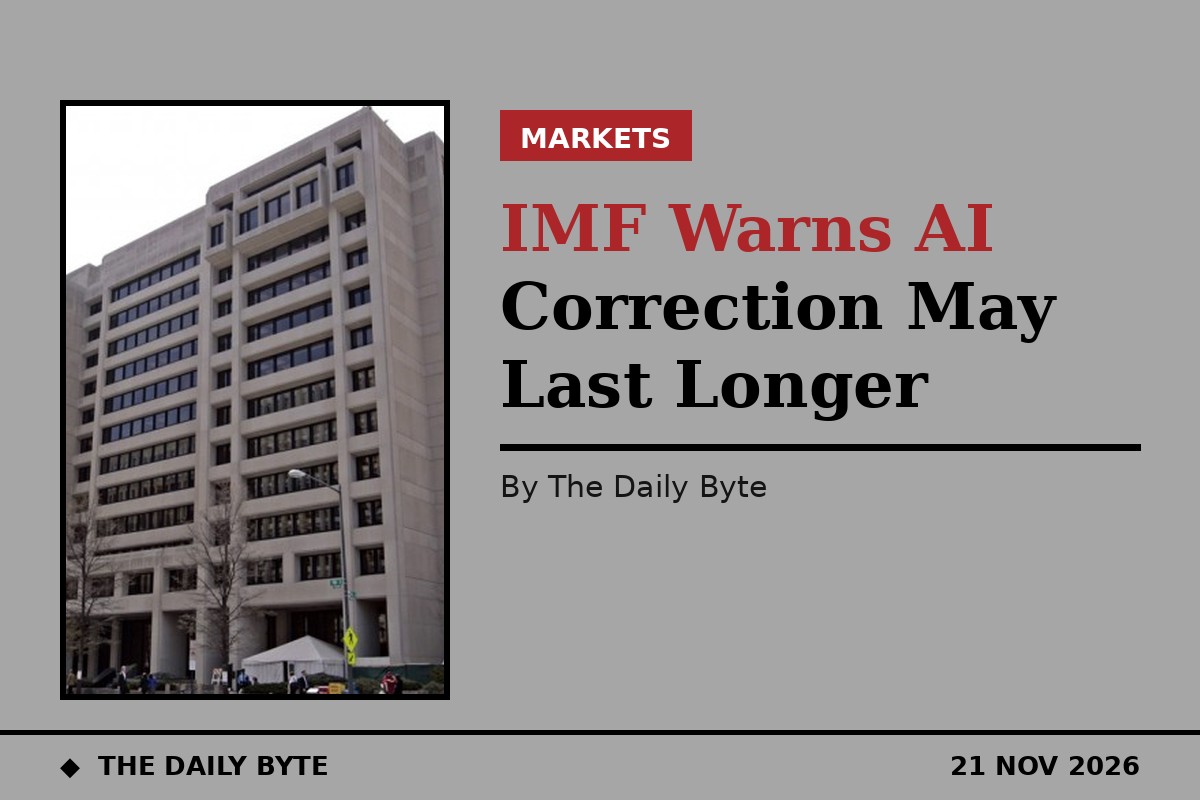
The head of the International Monetary Fund has warned that the correction sweeping artificial intelligence stocks may last longer than investors hope. Kristalina Georgieva, the fund's managing director, told Bloomberg on Friday 20 November that the adjustment in AI-linked markets could continue for a while yet, even though she does not expect a major crash.
Georgieva said the fund does not see a major correction at this point, but does expect perhaps a little bit more of one, adding that it would bring markets to a more sustainable place. Her warning landed at the end of a brutal week for technology shares, in which the Nasdaq Composite fell 5.28 percent on Friday alone to 22,617.73, its worst week since March 2020, and the index turned negative for 2026. Even the historic debut of Anthropic, which raised 81.3 billion dollars in the largest initial public offering in history and closed 17 percent above its issue price, failed to steady the sector.
The warning is the second Georgieva has issued in five days. Speaking to CNBC on 16 November on the sidelines of the ASEAN summit in the Philippines, she said the world economy is standing on one leg, the AI leg, and that if that leg wobbles, financial stability troubles could follow. A sudden loss of investor confidence, followed by a wave of capital withdrawals from the AI sector, could weaken global economic growth, she said.
More than one trillion dollars of circular financing
At the centre of the IMF's concern is what it calls circular financing: arrangements in which money invested in an AI company returns to the investor through purchase orders for its products. The fund estimates that circular financing among AI firms has grown to slightly more than one trillion dollars, and that about two-thirds of it is financed with debt. The total is not enormous yet, Georgieva said, but it is rising quickly, and the concern is the speed of its growth and a gradual shift away from equity towards debt.
The IMF has examined 14 disclosed deals since 2023. In those transactions, large technology companies known as hyperscalers provided roughly 300 billion dollars in equity and 650 billion dollars in debt in return for about 1.4 trillion dollars in future revenue commitments. The scale of the borrowing is visible in the bond market: hyperscalers now account for about 10 percent of global investment-grade bond issuance, up from under 1 percent in 2024, according to a blog post Georgieva published on 15 October.
Nvidia sits at the centre of many of these arrangements, and the chipmaker has lost more than one trillion dollars in market value over the past month. UBS analyst Tim Arcuri has estimated that a retreat in Nvidia's financing activities could remove 50 billion dollars or more from the system, at a time when higher interest rates are already making corporate borrowing more expensive.
The worst case the IMF is modelling
The fund's downside scenario is stark. If AI fails to meet the market's very high expectations, United States stocks could fall 20 percent in 2026, while global output could be 1.1 percent below its baseline by 2028. That is the worst case, not the forecast: at its October meetings, the IMF projected world growth of 3.1 percent in 2026 and 3.4 percent in 2027, sustained in large part by heavy AI spending that has offset energy shocks from the conflict in the Middle East.
Georgieva has been careful to balance the warning with reassurance. She has described recent market swings as orderly and said they were unlikely to escalate into a crisis severe enough to weaken the world economy. She argues that investor expectations have moved ahead of what AI technology has so far demonstrated it can deliver, saying the industry tends to rush ahead of reality, which makes some corrections necessary. Her conservative estimate is that AI will add around 0.5 percent to global growth, making 2026 the first year in which AI has been a measurable driver of the world economy.
For now, her message is vigilance rather than alarm. The fund is watching the leverage building up around AI, the debt behind the boom, and the speed at which it is growing. If the correction she expects does arrive and then stops, markets will have found the more sustainable footing she described. If confidence breaks instead, the one leg the world economy is standing on will be tested in earnest. This article reports market news only and is not investment advice.