Micron Falls 14% as NAND Price Warning Hits Memory
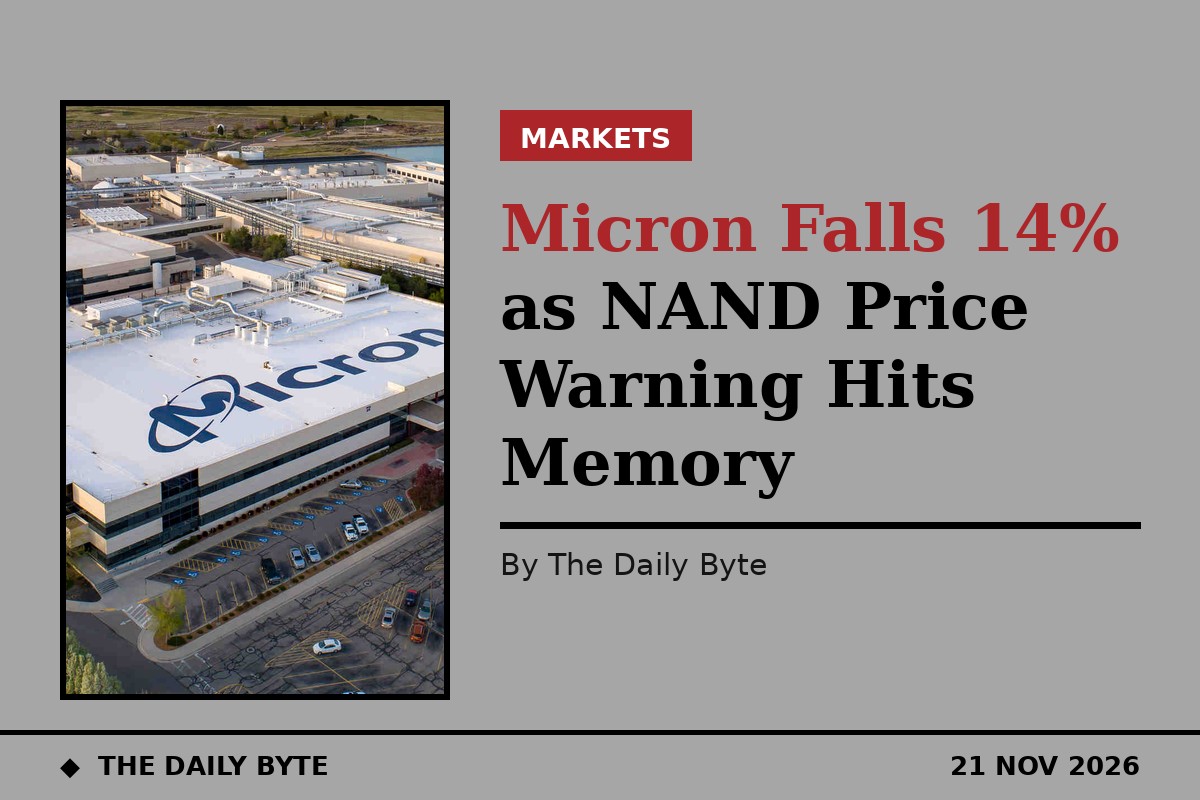
Micron Technology shares fell almost 14 percent on Friday after memory market researcher TrendForce warned that prices for NAND flash memory are sliding, with major Chinese buyers cutting orders for next year.
Micron closed at 594.51 dollars, down 95.93 dollars or 13.89 percent, after opening at 665.46 dollars, more than 3 percent below Thursday's close of 690.44 dollars. Rival SanDisk fell 16.05 percent, making it the worst-performing stock in the S and P 500 for the session.
TrendForce published a negative forecast for NAND flash demand in 2027, according to a report by StreetInsider cited by the Motley Fool. Major Chinese cloud providers are likely to cut orders for enterprise solid-state drives next year, TrendForce warned, and are already cutting orders now. NAND spot prices have already fallen 20 percent as distributors clear inventory, and the firm expects prices to keep falling in the first and second quarters of 2027 and beyond.
Memory joins the AI sell-off
The falls came as the Philadelphia Semiconductor Index dropped 7 percent on Friday, with the wider artificial intelligence trade under pressure all week. Micron has now fallen for seven consecutive trading days, its longest stretch of daily declines since August 2020, and is down 23.62 percent over five sessions and 32.25 percent over twenty sessions.
Morningstar, citing Dow Jones Newswires, reported that Micron shares are down 50.99 percent from their peak, while SanDisk shares are down 72.85 percent from their highs and Western Digital stock has shed 64.97 percent. The slide reverses a run in which memory makers were among the biggest winners of the AI infrastructure boom, as investors paid up for the high-bandwidth memory used in advanced AI systems.
That boom is now being questioned from two directions. Investors are asking whether the huge spending on AI data centres will generate enough return, and memory buyers are pulling back at the same time. The result has been a sharp repricing of stocks that only weeks ago were priced for unbroken growth.
NAND is only part of the story
Micron is less exposed to NAND than SanDisk. Only about 26 percent of Micron's revenue comes from NAND, with the balance coming from DRAM memory, so a NAND price slide will pinch rather than devastate the company. But investors also have to watch whether the same dynamics depress DRAM demand and prices, in which case Micron would not dodge the blow.
There are signs of resilience in the underlying business. Micron chief executive Sanjay Mehrotra said at the TomorrowX Summit on 18 November that 75 percent of the firm's 2027 supply is already sold out. The company is due to report fiscal first-quarter results on 17 December, which will give investors their first hard numbers on whether the NAND warning is showing up in orders and pricing.
For now, the market has chosen to sell first. Friday's 14 percent fall was larger than about 99 percent of Micron's daily moves since 1984, and trading volume of 59.1 million shares was more than double the 63-day average of 28.3 million shares. The next test comes in December, when Micron's own results will show whether the memory cycle is turning, or whether Friday's selling overshot.