Ontario Faces Deficits to 2051, Watchdog Warns
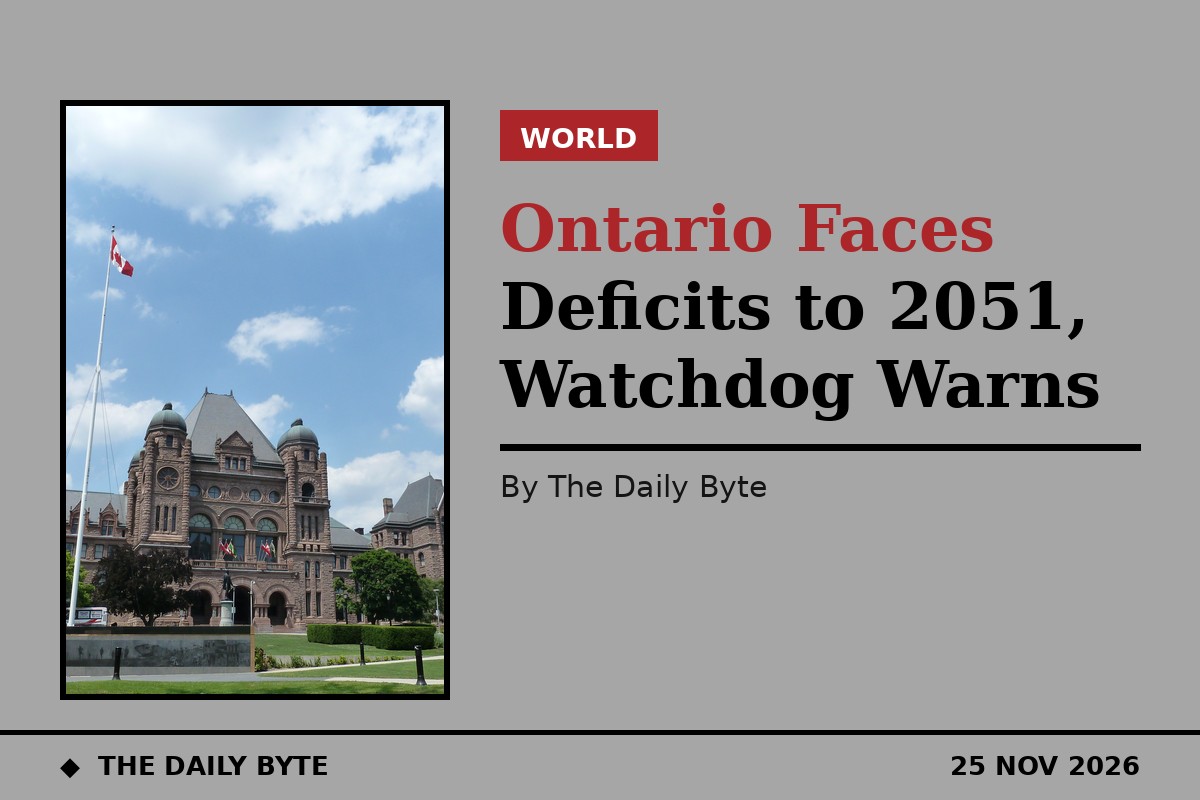
Ontario will run a budget deficit in every year to 2050-51 unless its government changes course, the province's independent budget watchdog warned on Wednesday, with net debt climbing to nearly half the size of the economy.
The Financial Accountability Office of Ontario (FAO) released its long-term budget outlook on Wednesday morning, covering the 2026-27 to 2050-51 period. It is the office's first long-term projection of the province's finances, and its central message is blunt: on current policies, Ontario never returns to balance.
Deficits every year to 2051
The FAO projects an average budget deficit of 1.2 per cent of gross domestic product (GDP) across the 25-year outlook, worse than the 0.9 per cent average recorded over the previous 25 years. By 2050-51, the annual deficit is projected to widen to 1.5 per cent of GDP.
The gap opens because spending is expected to grow slightly faster than revenue. Total revenue is projected to rise by an average of 3.8 per cent a year, while total spending grows by 3.9 per cent a year. In 2025-26, revenue stood at 17.7 per cent of GDP against spending of 18.8 per cent, a deficit of 1.0 per cent of GDP. By 2050-51, revenue is projected at 17.1 per cent of GDP and spending at 18.6 per cent.
Health care is the fastest-growing large spending area, rising by an average of 4.4 per cent a year, followed by the amortised cost of infrastructure investment at 5.0 per cent. Interest payments on the province's debt grow fastest of all, at 6.5 per cent a year on average.
Debt climbs to 47 per cent of GDP
The accumulated deficit is projected to rise from 20.5 per cent of GDP in 2025-26 to 28.8 per cent in 2050-51. Net debt is projected to climb from 36.2 per cent of GDP to 47.0 per cent, with about 60 per cent of the increase coming from ongoing deficits and most of the rest from infrastructure investment.
All three of the government's own fiscal sustainability targets would be missed. The 2026 Ontario Budget set targets of net debt below 40.0 per cent of GDP, net debt below 200 per cent of revenue, and interest payments below 7.5 per cent of revenue. By 2050-51 the FAO projects 47.0 per cent, 277.8 per cent and 12.2 per cent respectively.
The fix: a $10.1 billion adjustment
Ontario law, the Fiscal Sustainability, Transparency and Accountability Act, 2019, requires the government to plan for a balanced budget each year unless extraordinary circumstances justify a deficit. Given its projection of deficits through 2050-51, the FAO estimates the government would need a permanent fiscal adjustment of $10.1 billion in 2027-28 to keep the budget balanced on average over the outlook, through higher revenue, lower spending, or a mix of both.
A smaller adjustment would meet the debt targets alone. The FAO estimates $8.4 billion would be enough to meet all three sustainability targets by 2050-51, $6.3 billion would meet the two debt targets, and $3.5 billion would meet only the net debt-to-GDP target.
An older, slower-growing province
The driving force is demographics. Ontario's population is projected to grow from 16.2 million people in 2025 to 20.0 million by 2050, but growth slows to an average of 0.8 per cent a year. Deaths are expected to outnumber births each year from the early 2030s, leaving population growth solely dependent on net migration, especially international immigration.
The population also gets older. Seniors are projected to rise from 18.9 per cent of the population in 2025 to 22.5 per cent in 2050, while the working-age share falls from 66.4 per cent to 64.5 per cent. Labour force growth slows to 0.8 per cent a year, from a 25-year historical average of 1.5 per cent. Real GDP growth is projected to average 1.9 per cent a year, with productivity growth assumed to strengthen, helped by technology including artificial intelligence.
What could change the picture
The outlook is sensitive to growth. Under a high-growth scenario, the 2050-51 deficit improves to 0.8 per cent of GDP and net debt to 37.1 per cent, below the government's 40 per cent target. Under a low-growth scenario, the deficit worsens to 2.0 per cent of GDP and net debt rises to 55.9 per cent.
The FAO lists geopolitical tensions, trade pressures, federal immigration policy, climate change and technological change among the risks to its baseline. The report lands weeks after the government's own fall economic statement, which projected a $16.9 billion deficit for 2026-27 and a return to balance in 2029-30. The FAO's longer view suggests that even if that near-term path holds, the province's finances deteriorate again over the decades that follow unless policy changes.