South Africa Child Gauge Warns Grants Are Failing Babies
Progress in improving the lives of South Africa's children has stalled, with fiscal austerity, red tape and rising food prices eroding many of the gains made over the past 30 years, according to a new report from the University of Cape Town's Children's Institute.
The South African Child Gauge 2026 was launched on Tuesday 24 November. It traces how policy, law and practice have shaped children's lives since the Constitution was adopted three decades ago, and it warns of what its authors call worrying signs of regression across a range of services, from immunisation to welfare grants.
The report's central finding is that the state is reaching fewer of the youngest and most vulnerable children, even as the overall number of children receiving support has held up.
Fewer babies on the grant
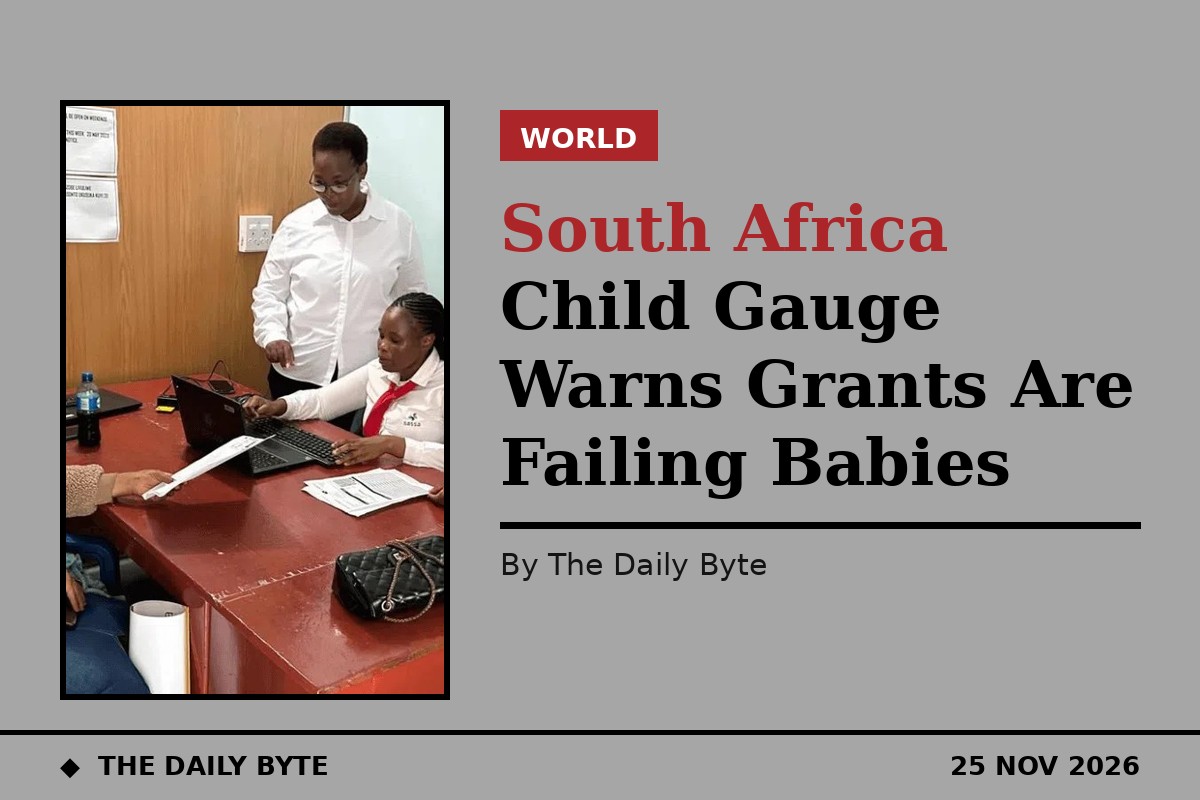
The sharpest warning concerns the Child Support Grant, the monthly payment made to caregivers of children in low-income households. The number of infants under the age of one receiving the grant has fallen by 44 percent in six years, from about 650,000 in March 2020 to about 366,000 in March 2026, according to the report. That takes uptake among babies back to levels last seen in 2008.
The fall is not explained by a shrinking population of babies. Between 2020 and 2024, the number of births registered each year fell by about 12 percent, while the number of infant grants fell by 44 percent. Over the same period, the total number of children receiving the grant rose slightly, from about 12.8 million to 13 million.
The researchers, led by Wanga Zembe-Mkabile and Katharine Hall, say the decline has serious implications for child outcomes, because the grant's protective effect largely depends on early and continuous receipt, preferably from birth.
Part of the fall dates to the Covid-19 lockdown, when Home Affairs staff could not register births at hospitals and grant applications stalled. But the researchers say lockdown disruption does not explain why the decline continued. They point instead to the South African Social Security Agency's increasingly stringent requirements, including automated income and eligibility screening against government and third-party databases, a new electronic biometric system linked to Home Affairs, and stricter conditions attached to the agency's budget by the National Treasury in 2025.
Almost 115,000 Child Support Grants lapsed in the 2025/26 financial year because caregivers did not complete their reviews, the report says. Birth registration remains a barrier too: more than 160,000 babies are not registered before their first birthday, with budget constraints at Home Affairs, system downtime, power cuts and higher transport costs for parents among the reasons given.
A grant that buys less
Even for families who do receive it, the grant is worth less than it was. The Child Support Grant stands at R580 a month, while the food poverty line stands at R868, and annual grant increases have repeatedly fallen below food inflation, widening the gap between the two.
That gap sits alongside a reversal in child poverty. The share of children living below the food poverty line fell from 53 percent to 33 percent between 2003 and 2013, the report says, but it had risen back to 37 percent by 2024.
Early learning and health
The report finds the same mixed picture in health and education. Access to early learning had widened by 2025 to reach 70 percent of children aged three to five, but more than half of them, 55 percent, were not developmentally on track. Childhood stunting, a measure of chronic malnutrition, has remained stubbornly high at 29 percent.
About 200,000 infants have not received any of the vaccinations recommended by the health department, according to the report.
The authors blame a managerial culture of compliance and control that prioritises regulatory requirements over the needs of mothers and children. Co-editor Paula Proudlock said the recent regression in services had been fuelled by that culture, which she said puts paperwork ahead of people.
What the report calls for
The Child Gauge sets out five recommendations: strengthen existing platforms to reach the children left behind, including community-based and outreach services; strengthen collaboration between departments and organisations at local level; transform institutional culture from control and compliance to support for frontline workers; protect children's services in times of crisis by including child experts in emergency planning; and keep investing early in the services that underpin children's development.
Maropene Ramokgopa, the minister in the Presidency for planning, monitoring and evaluation, spoke at the launch on Tuesday. The report's message to government is blunt: three decades of progress for children is now going backwards, and reversing that will take deliberate protection of children's services, not further cuts.