Sanofi Weighs $35bn Takeover of Insmed
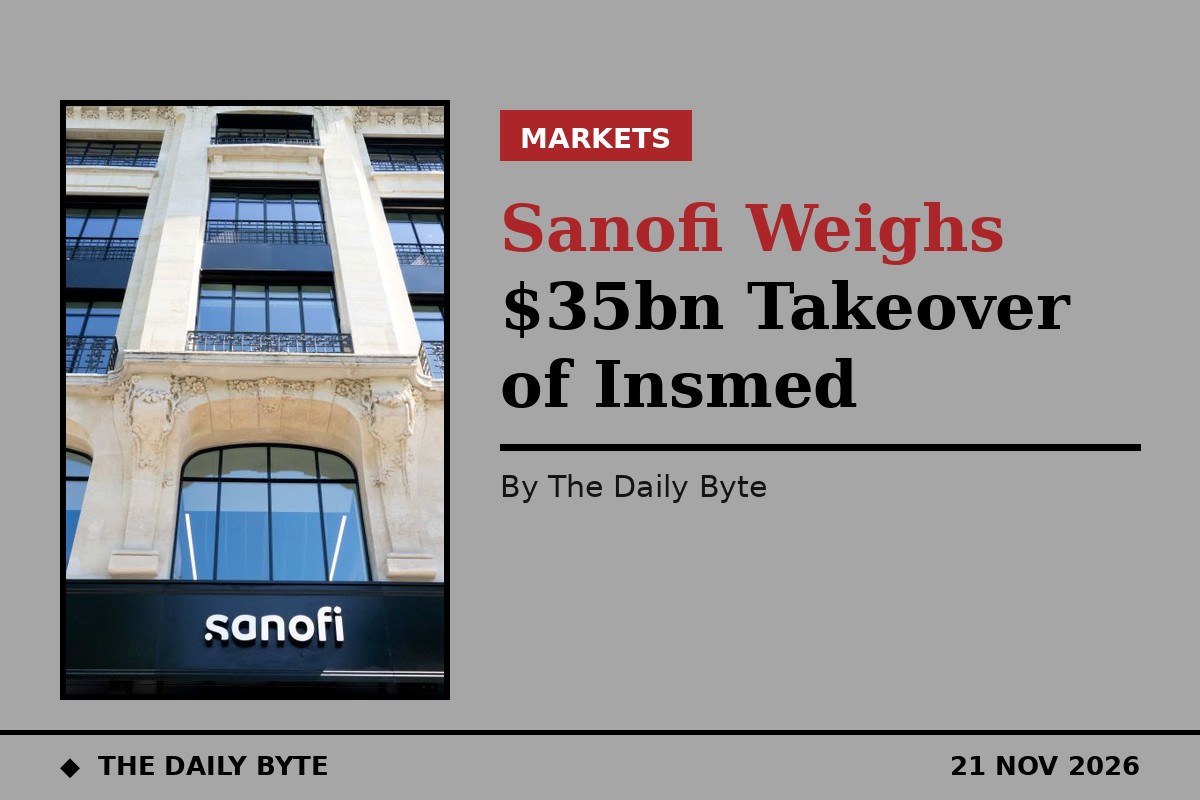
Sanofi is weighing a takeover of United States drugmaker Insmed in a deal that could be valued at between 35 billion and 43 billion dollars, according to a Bloomberg report published on 19 November 2026. The French pharmaceutical group is working with advisers to assess a possible acquisition, and if it went ahead at the top of that range it would be the largest biopharma buyout since Pfizer paid 43 billion dollars for Seagen in 2023.
Investors reacted immediately. Insmed shares closed 20.6 percent higher at 144.46 dollars on Thursday, after rising as much as 24.4 percent during the session to 149.07 dollars, when trading was briefly halted by a volatility circuit breaker. The company had a market value of about 26.28 billion dollars. Sanofi shares slipped about 2 percent on the report, a sign that investors see the price tag as demanding even if the strategic logic is clear.
The logic centres on Dupixent, Sanofi's blockbuster treatment for eczema, asthma and other inflammatory conditions. The drug generated 5.7 billion euros in third-quarter revenue, nearly 40 percent of Sanofi's total group sales, but it is heading towards patent expiry in the early 2030s. That leaves a large revenue hole that chief executive Belén Garijo has repeatedly described as the company's defining challenge, with acquisitions and licensing alongside improved research productivity as the main ways to fill it.
Brinsupri is the prize
Insmed's lead product is Brinsupri, known generically as brensocatib, a treatment for non-cystic fibrosis bronchiectasis, a chronic lung condition in which the airways widen and become damaged. Brinsupri generated 400 million dollars in third-quarter sales alone, and Insmed projects full-year 2026 revenue of between 1.8 billion and 1.9 billion dollars across its portfolio. The company reported third-quarter revenue of 524.4 million dollars, up 268 percent from a year earlier.
The portfolio also includes Arikayce, a treatment for a form of bacterial lung infection, which posted 124 million dollars in third-quarter sales, with full-year guidance of between 460 million and 470 million dollars. Beyond its marketed medicines, Insmed has a pipeline led by treprostinil palmitil inhalation powder, known as TPIP, which is in the Phase 3 PALM programme across four lung indications and which the company projects could reach peak annual sales above 6 billion dollars.
Sanofi has been moving in this direction for some time. The company completed a 9.5 billion dollar acquisition of Blueprint Medicines in 2025 to build out its rare disease portfolio, and Garijo has told investors the group will turn to mergers and acquisitions to secure growth, including deals larger than its usual range of 2 billion to 5 billion dollars. Insmed, with two approved respiratory medicines and a pipeline spanning respiratory, immunology and neurological disease, fits the profile she has described.
The price is the obstacle
The valuation is the chief barrier. At 35 billion to 43 billion dollars, Sanofi could not fund an all-cash transaction without taking on substantial debt, and analysts have pointed to Insmed's elevated valuation as the main reason a deal might not happen. Bloomberg Intelligence analysts noted that Garijo faces a familiar challenge for Sanofi: improving a historically underperforming research organisation while securing new sources of growth to fill the Dupixent void.
There is no guarantee of a deal. Bloomberg reported that deliberations are ongoing, that no agreement has been reached, and that any agreement could still be weeks away. Neither company has confirmed the talks, and representatives of both declined to comment. A transaction, if it comes, is seen as most likely in early 2027, around the January healthcare investment conference season when large industry deals are often unveiled.
One complication sits inside Insmed itself. Its chief financial officer, Sara Bonstein, departed the company on 30 October after nearly seven years in the role, an executive transition that adds a layer of uncertainty ahead of any potential transaction. For now, the market has priced in a real possibility rather than a certainty, with Insmed's shares holding most of their jump while Sanofi's slipped. This article reports market news only and is not investment advice.