Scarlettgroup names CHU Bordeaux in ransomware claim
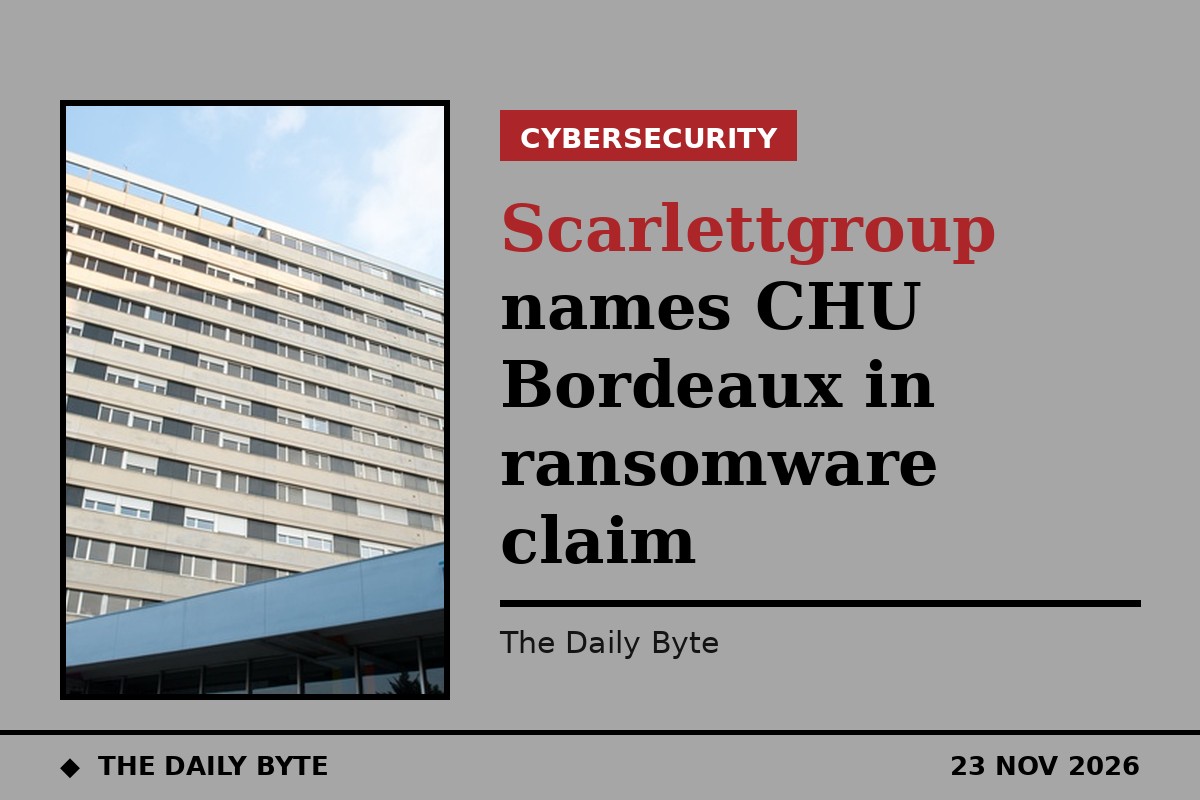
The ransomware group known as Scarlettgroup has named CHU de Bordeaux, a major public university hospital in France, as a victim on its leak site, according to threat intelligence reports published on 23 November 2026. The listing is an unverified claim: neither the group has published evidence of a successful intrusion nor has the hospital confirmed a breach.
QPulse Intelligence reported that the claim was published on 22 November 2026 and discovered at 23:09 UTC. CHU de Bordeaux provides specialist healthcare, emergency services, medical research and education. Undercode News, reporting the same claim, stressed that the listing does not disclose a claimed data volume, sample files, affected departments or technical evidence, and should be treated as an unverified ransomware claim rather than confirmation of a breach.
Credential exposure linked to the claim
The incident appears to be linked to infostealer activity, according to HudsonRock, cited by QPulse. Data indicates that five employees, 293 users and 11 third-party employees had credentials linked to the hospital's domain compromised. A separate exposure report by ParanoidLab identified 7,763 passwords, with 106 marked as critical, and 27 cookies, with one marked as critical.
Ransomware.live, which tracks leak-site claims, notes that such listings reflect claims made by criminal groups and have not been independently verified. Inclusion on a leak site does not confirm that a breach occurred, but the credential exposure is a real risk in its own right: stolen passwords and session cookies can allow account takeover and can bypass some forms of multi-factor authentication.
What defenders are advised to do
QPulse's advisory recommends forcing password resets for all identified compromised users and employees, invalidating active session cookies, monitoring network logs for logins using stolen credentials, and enforcing phishing-resistant multi-factor authentication across enterprise systems. It also recommends an audit of the external attack surface to find and remove exposed credentials and vulnerable endpoints.
The Bordeaux claim appeared on the same day as a separate, unrelated claim in which the MedusaLocker group listed Lee Health, a healthcare provider in Florida in the United States. There is no evidence connecting the two claims or suggesting a coordinated campaign, and the Lee Health listing is also unverified.
FAQ
Has CHU de Bordeaux been hacked? Not confirmed. Scarlettgroup has named the hospital on its leak site, but no evidence of intrusion, data theft or disruption has been published, and the hospital has not confirmed a breach.
What data is at risk? The verified concern is credential exposure: thousands of passwords and session cookies linked to the hospital's domain have been found in infostealer data. No patient data theft has been established.
What should hospital staff and patients do? Anyone with hospital-related accounts should change passwords, watch for suspicious account activity, and use multi-factor authentication where available.