Siemens Wins Dutch Grid Deal for 800 Substations
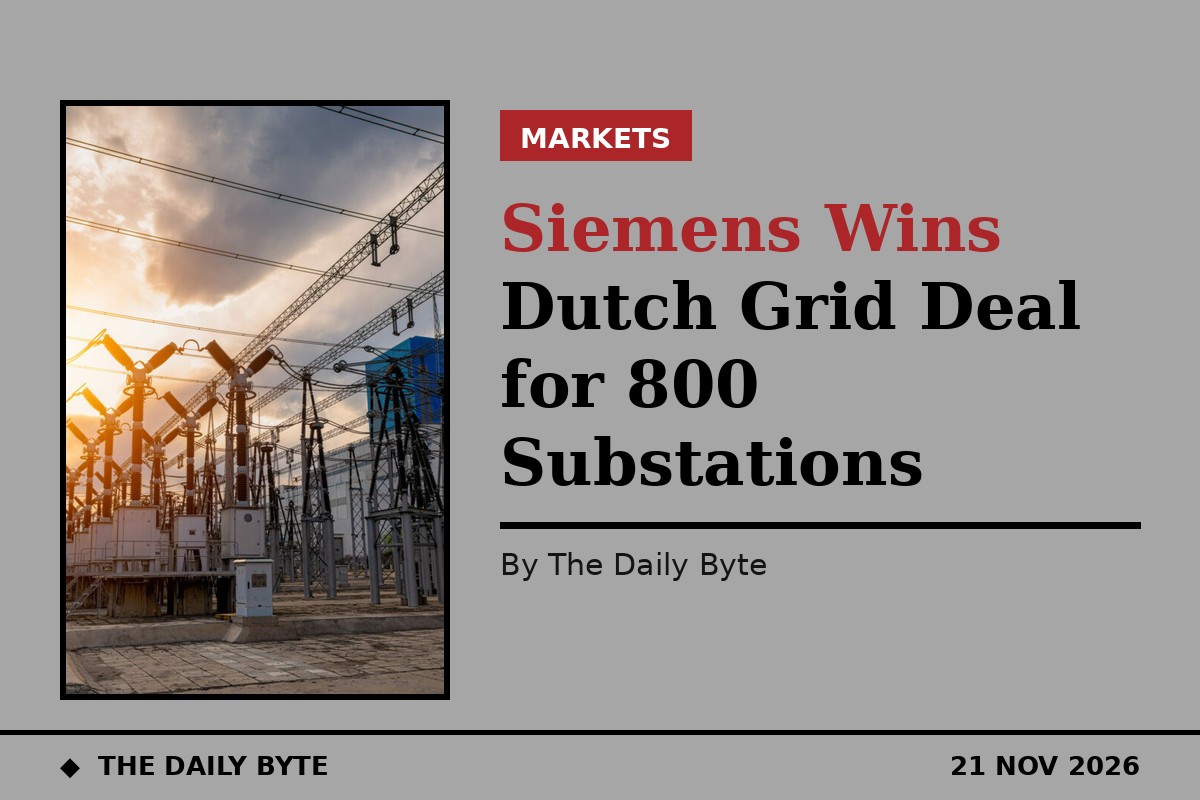
Siemens has won a major role in the Netherlands' energy transition, after Dutch grid operator Enexis selected the German group's technology for a programme to build up to 800 new substations over eight years. Siemens announced the collaboration in a press release on Wednesday 19 November 2026.
The plan uses fully pre-assembled and tested switchgear units from Siemens, known as Skids, which can be installed and commissioned in prefabricated stations within a single day. Enexis has chosen Siemens' NXPLUS C 24 blue GIS technology, which is free of F-gases, as the foundation for the expansion. With standardised units, construction capacity can rise from about 10 substations a year to about 100 a year, a tenfold increase in pace.
Demand for grid capacity in the Netherlands is growing rapidly. Households, businesses and renewable energy projects are increasingly hitting the limits of the electricity network, and the traditional way of building substations was too slow for Enexis to keep up. The first Skid was installed in October 2024, and stations have been delivered on demand from 2025 onwards.
A grid under strain
Enexis serves 2.9 million customers with 139,000 kilometres of power lines and 46,000 kilometres of gas lines in the Netherlands, and employs more than 5,700 people. The new substations are intended to cut grid bottlenecks and help connect more customers, including homes, businesses and renewable projects waiting for capacity.
Stephan May, president of electrification and automation at Siemens, said the energy transition required innovative and scalable solutions to future-proof power grids, and that the standardised Skid concept could massively accelerate grid expansion. Han Slootweg, chief operations officer at Enexis, said the company saw every day how great the need for additional grid capacity was, and that the standardised approach would let it build faster and connect more customers.
The Dutch order is part of a wider run of grid work for Siemens. Earlier in November, Siemens and Austrian operator Kärnten Netz signed a six-year contract covering digitalisation and expansion of grid capacity, with Siemens supplying its Gridscale X platform.
Chip deal and split analyst views
Siemens has also been expanding in software. On Tuesday 17 November it signed an agreement to acquire Breker Verification Systems, a United States firm whose technology Siemens intends to fold into its system-on-chip verification offering. The transaction is expected to close in December 2026, subject to customary conditions, and financial terms were not disclosed. On 10 November Siemens signed an agreement to acquire Lauterbach, a provider of debug and trace solutions for embedded software, with that deal expected to close in the first half of 2027.
Analysts are split on the shares. Oddo BHF downgraded Siemens from outperform to neutral on Wednesday and trimmed its price target to 302 euros from 310 euros. Citigroup moved the other way, reaffirming its buy rating and raising its target to 340 euros from 335 euros. Siemens shares slipped 0.6 percent on Tuesday and were down 0.9 percent on Wednesday, despite the new orders.
The mixed market reaction comes against a stronger outlook. On 12 November Siemens lifted its medium-term target for comparable revenue growth to 7 to 11 percent, from 6 to 9 percent. For fiscal 2027 it is guiding to comparable revenue growth of 9 to 11 percent and earnings per share before purchase price allocation effects of 10.20 to 10.80 euros.
In the fourth quarter of fiscal 2026, orders jumped 58 percent to 34.8 billion euros, revenue climbed 11 percent to 23.7 billion euros and net profit rose 32 percent to 2.4 billion euros. For the full year, comparable revenue grew 8 percent to 83.4 billion euros, the industrial business posted a record result of 13.3 billion euros, and Siemens proposed a dividend of 5.50 euros per share. This article reports market news only and is not investment advice.