UBS Cuts Global Stocks to Neutral on AI Risks
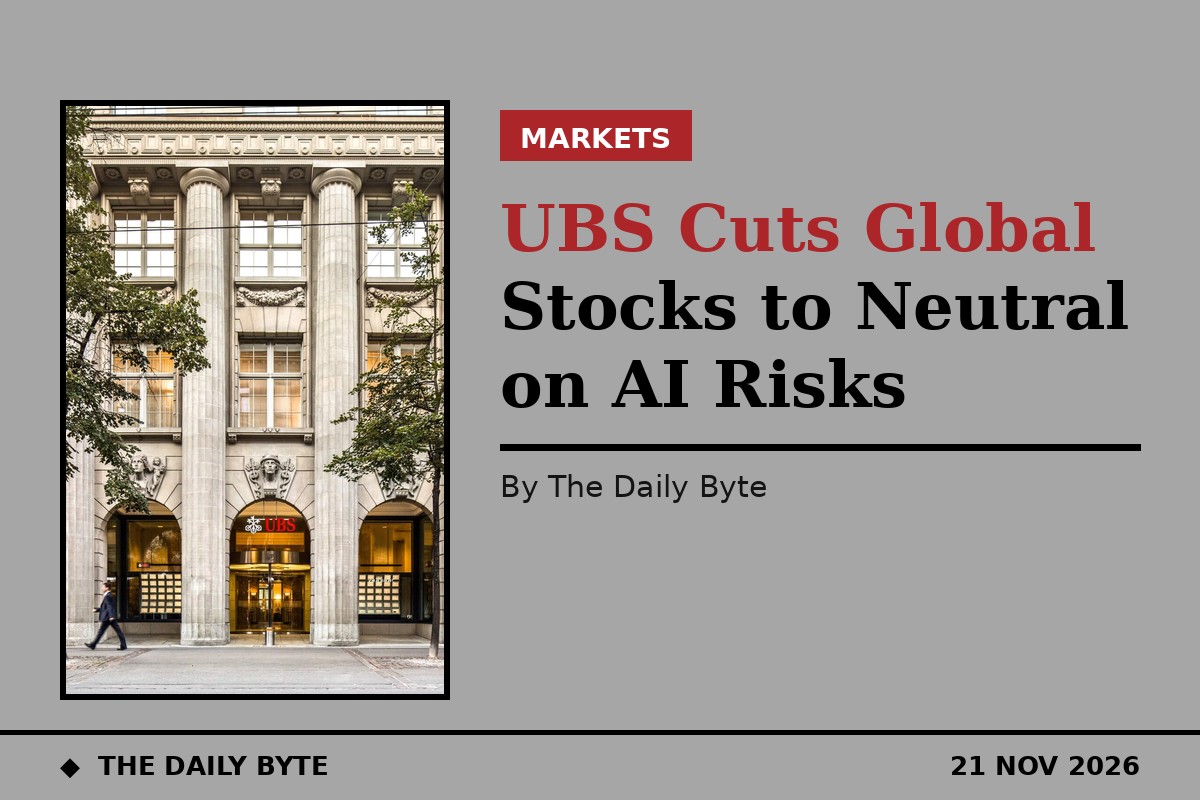
UBS has cut its stance on global equities to Neutral from Attractive in its Year Ahead 2027 outlook, arguing that after a multi-year bull run the balance of risk and reward has evened out. The Swiss bank still expects markets to rise, but says elevated expectations, heavy concentration and uncertainty over the artificial intelligence investment cycle leave less room for disappointment.
In its base case, UBS sees the S&P 500 reaching 8,200 by the end of 2027, about 19 per cent above Friday’s close of 6,910.39, after the index lost 8.6 per cent in its worst week since April 2025. It also set end-2027 targets of 7,000 for the Euro Stoxx 50, 1,170 for MSCI Asia ex-Japan and 1,460 for MSCI AC World.
The AI concentration problem
The bank’s central concern is concentration. The 10 largest companies in the S&P 500, most of them exposed to AI, now make up around 40 per cent of the index, according to UBS, giving revisions to a small group of earnings forecasts an unusually large effect on index returns.
“AI investment is accelerating, but so are the risks,” UBS said. It forecasts global AI-related investment rising from 1 trillion dollars in 2026 to 1.4 trillion dollars in 2027 and 1.5 trillion dollars in 2028, while cumulative United States technology investment could approach 5 trillion dollars by 2028. Revenues, it said, “will probably have to reach at least” 1.5 trillion dollars by 2030 “for the industry to earn an adequate return”.
The bank also warned that “competition, price cuts, costly monetisation, and open-weight models may threaten returns”, and that external financing is becoming harder to secure. Cannibalisation, financing and execution risks around AI have increased while expectations and index concentration remain high, it said, making the market more sensitive to earnings disappointment or a further rise in discount rates.
Four scenarios, including an AI bust
UBS laid out four paths for the S&P 500. In its base case, described as “resilience sustained”, the index reaches 8,200. In a “Goldilocks” upside, where AI productivity gains spread across industries and lower inflation expectations allow the Federal Reserve to ease, it could reach 9,500. A “yield reset”, in which persistent inflation pushes central banks to raise rates further, would leave it at 7,000.
The downside case is an “AI bust”, in which capacity growth outstrips demand, capital spending slows sharply and earnings fall sharply, led by AI sectors, turning a market correction into a broader slowdown. In that scenario UBS sees the S&P 500 at 5,500, and it put the probability of that outcome at 20 per cent.
Where UBS still sees value
The bank moved United States equities to Neutral, and Asia ex-Japan and emerging-market equities to Neutral as well, saying their earnings are heavily weighted towards semiconductors, memory and technology hardware and therefore exposed to the AI spending cycle. The Eurozone is its preferred regional market, with forecast earnings growth of 15 per cent in 2027, matching the US from a lower starting valuation.
UBS also favours industrials and health care as ways to broaden exposure beyond technology, and it upgraded gold to Attractive, expecting a recovery towards 5,000 dollars an ounce by December 2027. Bonds and commodities offer the best risk-reward across asset classes, it said, with cash its least preferred holding.
“The priority for 2027 is to stay invested, diversify sources of return, and build resilience for a wider range of outcomes,” said Mark Haefele, UBS Global Wealth Management’s chief investment officer.
The call puts UBS at odds with Morgan Stanley, which days earlier moved global equities to “maximum overweight” and raised its S&P 500 target to 8,700. Goldman Sachs and Barclays carry the same 8,700 target. UBS still expects S&P 500 earnings to rise 29 per cent in 2026 and 15 per cent in 2027. The disagreement is over how much investors should pay for those earnings, and how concentrated the bet has become.