Why Did a German Court Rule Schengen Border Checks Unlawful?
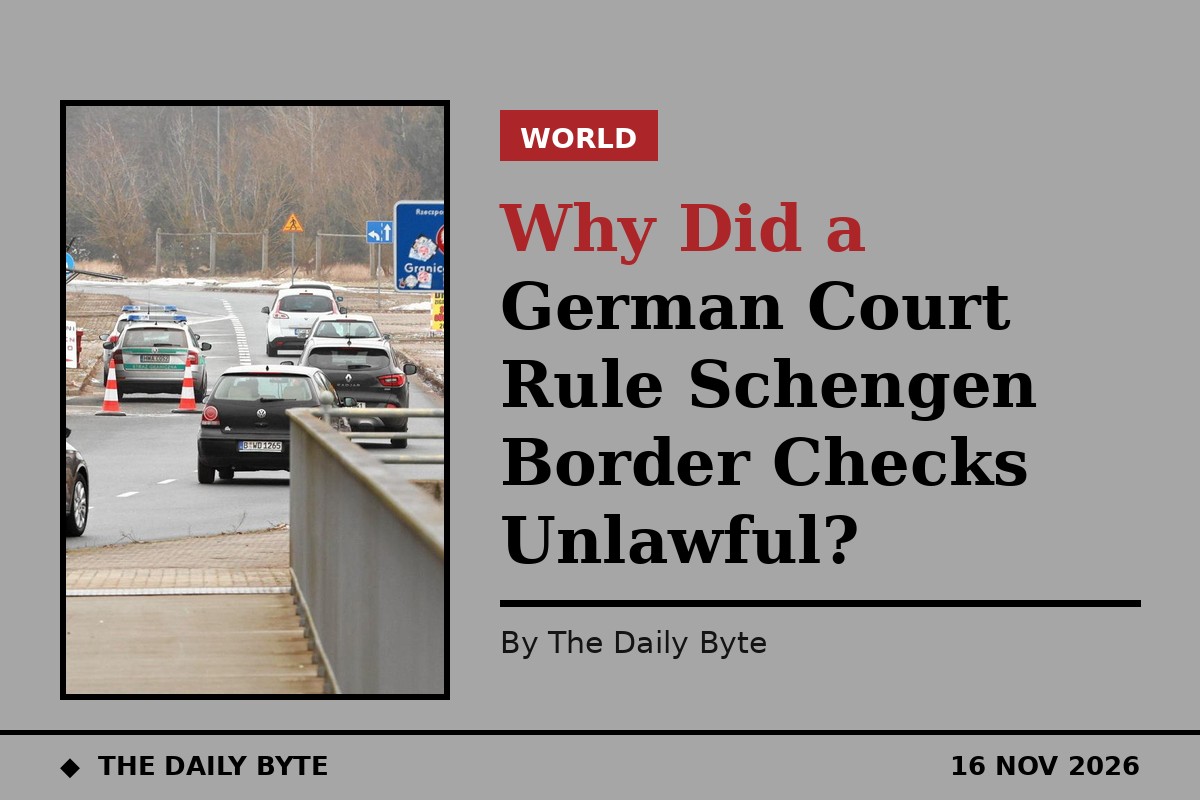
A German court has ruled that two border checks carried out by German police on travellers crossing from Poland and Czechia were unlawful, because the government failed to show that the checks met the strict tests in EU law. The rulings, announced by the Dresden Administrative Court on 12 November 2026, do not end Germany's border controls — checks are still in place and will run until at least 15 March 2027. This guide explains what Schengen border checks are, what the law allows, what the court actually decided, and what it means for travellers.
What happened in Dresden?
The Dresden Administrative Court announced two judgments on 12 November 2026, after a hearing the previous day. Both cases were brought by individual travellers who had been stopped by German federal police at internal EU borders.
The first case concerned a Polish citizen whose identity was checked and whose vehicle was searched after crossing from Zgorzelec in Poland into Görlitz in Germany on 25 September 2024. The second involved a German citizen travelling from Prague on a replacement coach service, who was checked by police near Breitenau, on the Czech border, on 18 May 2026.
In both cases, the court found the checks unlawful. Its reasoning, as reported, was that the German Interior Ministry's blanket order reintroducing border controls did not by itself justify the specific checks. Under the Schengen Borders Code, the police must be able to show a serious, immediate threat to public order or internal security that the checks are proportionate to — and in these cases, the court found that test had not been met. The court allowed appeals in both cases because of their wider legal importance, and written judgments were not yet available when the decisions were announced.
What is the Schengen area?
The Schengen area is a zone of 29 European countries — 25 EU member states plus Iceland, Norway, Switzerland and Liechtenstein — in which people can normally travel across internal borders without being stopped for passport or identity checks. It is one of the most visible achievements of European integration: a driver can cross from France into Germany, or from Poland into Czechia, without routinely showing any documents at all.
That freedom is not unlimited. The Schengen Borders Code, the EU law that governs the area, allows member states to bring back checks at internal borders temporarily, in exceptional circumstances, when there is a serious threat to public policy or internal security. It also allows police spot checks near borders in some circumstances. What it does not allow is permanent, routine border control inside the area — that would defeat the purpose of Schengen itself.
The United Kingdom is not a member of the Schengen area and never has been. British travellers going to Schengen countries must show a passport, and they are subject to the EU's Entry/Exit System, which records entries and exits at the external border. That is a separate system from the internal checks discussed in this article.
What does the Schengen Borders Code actually allow?
The rules are set out in Regulation (EU) 2016/399, the Schengen Borders Code. Article 25 is the key provision. It says that where there is a serious threat to public policy or internal security, a member state may exceptionally reintroduce border control at all or part of its internal borders, for a limited period of up to 30 days — or for the foreseeable duration of the threat if it lasts longer. The scope and duration of the checks must not go beyond what is strictly necessary to deal with the threat, and reintroducing checks is meant to be a last resort.
| Rule | What the Code says |
|---|---|
| Trigger (Article 25) | A serious threat to public policy or internal security |
| Initial period | Up to 30 days, or the foreseeable duration of the threat |
| Proportionality | Scope and duration must not exceed what is strictly necessary |
| Last resort | Checks may only be reintroduced as a last resort |
| Extensions | Renewable periods of up to 30 days, up to a total of six months |
| Exceptional cases (Article 29) | Total period can be extended to a maximum of two years |
| Notification (Article 27) | Other member states and the European Commission must be notified, normally at least four weeks in advance, with reasons and evidence |
Article 26 sets out the criteria a government must assess before reintroducing checks: whether the measure is likely to deal with the threat adequately, and whether it is proportionate to that threat. Article 27 requires the government to notify the European Commission and other member states in advance, giving the reasons, the scope of the checks, and the evidence behind them. The Commission and other member states can give opinions, and there is a consultation process to examine whether the measures are proportionate.
A reformed version of the Schengen Borders Code has been in force since 2024, tightening the rules on how long checks can run and how they must be justified. Even so, several member states have kept checks in place for long periods — which is why the courts keep being asked to decide whether the legal tests have actually been met.
Why does Germany have border checks at all?
Germany first reintroduced checks on its borders with Czechia and Poland in October 2023. In September 2024, the checks were extended to all of Germany's land borders — nine neighbouring countries in total — and they have been renewed repeatedly since. The German government, led by Chancellor Friedrich Merz with Interior Minister Alexander Dobrindt, says the checks are needed to curb irregular migration and people-smuggling networks, and to relieve pressure on the asylum system.
The current notification to the European Commission runs until 15 March 2027. Poland, which also carries out checks on its borders with Germany and Lithuania, has notified measures running until 30 March 2027. Germany is not alone: seven Schengen countries have kept border checks in place into 2027, according to notifications recorded by the European Commission.
The Dresden rulings are not the first time German courts have questioned the checks. In April 2026, the Administrative Court of Koblenz ruled that an extension of checks on the Luxembourg–Germany border between March and September 2025 was unlawful, finding that the Interior Ministry had offered only general references to irregular migration rather than concrete evidence of a serious threat, and had not shown that less intrusive measures — such as mobile police patrols — would have been insufficient. The ministry appealed that ruling and kept the checks running. A Berlin court has also ruled that turning back asylum seekers at the German border without going through the EU's Dublin procedure was unlawful.
What did the court actually decide — and what did it not decide?
This is the part most often misunderstood, so it is worth being precise. The Dresden court ruled on two specific checks, on two specific people, on two specific dates. It did not rule that all German border checks are unlawful, and it did not order the government to end the current controls. The checks at Germany's borders continue, and the government is expected to appeal.
What the rulings do is harder for the government to ignore. If the reasoning holds — that a general reference to migration pressure is not enough, and that each check must be justified by a specific, proportionate threat — then the legal basis for the whole system of checks looks weaker. Lawyers say the reasoning could be applied to other challenges, and the court's decision to allow appeals reflects the wider importance of the question. The issue may ultimately have to be decided by a higher court, or by the Court of Justice of the European Union.
For now, the practical position is unchanged: travellers crossing Germany's land borders should expect to be stopped and asked for identification, because the controls remain in force under the notification running until March 2027. The European Commission has said it will assess Germany's latest notification, and a Schengen evaluation of Germany is expected next spring.
What does this mean for travellers?
For most people crossing an internal Schengen border, the honest answer is: very little will change in the short term. The checks are still running, and the court rulings do not stop them. But there are some practical points worth knowing:
- Carry identification. Even inside Schengen, police can ask for ID during a border check. EU citizens should carry a national identity card or passport; non-EU nationals should carry their passport and any residence permit or visa.
- Allow extra time. Checks can cause queues at busy crossings, particularly at weekends and holidays, and on routes between Germany and Poland or Czechia.
- Checks are not the same as a visa requirement. The rulings are about whether police can stop and check people at an internal border — they do not change who needs a visa, or the rules for entering the Schengen area from outside it.
- UK travellers are unaffected directly. The UK is outside Schengen, so British travellers already go through passport control when entering the Schengen area. The internal checks are an additional layer within the area, and they apply to everyone crossing, whatever their nationality.
- Rules can change. Border measures in the Schengen area are notified, extended and challenged regularly. Anyone planning a trip should check the current position with the relevant government or the European Commission before travelling, rather than relying on a news report from months ago.
What happens next?
Three things will decide how this story develops. First, the appeals: the German government is expected to appeal the Dresden rulings, and higher courts will have to decide whether the lower court's reading of the proportionality test is right. Second, the politics: Interior Minister Dobrindt has already extended the checks to March 2027, and the government shows no sign of ending them voluntarily. Third, the European angle: the European Commission is assessing Germany's notification, and a Schengen evaluation next spring will examine how Germany is applying the rules.
The deeper question is whether the Schengen Borders Code can hold the line it was written to hold — that internal border checks are an exception, not the norm. When Germany first brought back checks in 2023, they were presented as temporary. Three years later, they are still in place, and the courts are now being asked, case by case, whether the exception has quietly become the rule.
Frequently asked questions
Are Germany's border checks now illegal?
No — not as a whole. A court in Dresden ruled that two specific checks were unlawful. The current system of checks remains in place until at least 15 March 2027, and the government is expected to appeal.
What is the Schengen Borders Code?
It is the EU law — Regulation (EU) 2016/399 — that sets the rules for crossing borders in the Schengen area. Article 25 allows a member state to bring back checks at internal borders temporarily, in exceptional circumstances, when there is a serious threat to public policy or internal security.
Which countries are in the Schengen area?
29 countries: 25 EU member states plus Iceland, Norway, Switzerland and Liechtenstein. Ireland is in the EU but not in Schengen; Cyprus is in the EU but has not yet joined Schengen fully.
Do I need a passport to travel inside Schengen?
Routine passport checks at internal borders were abolished, but police can still ask for identification during temporary checks or spot checks. Travellers should always carry a passport or national identity card.
Is the UK in Schengen?
No. The UK has never been a member of the Schengen area. British travellers must show a passport when entering Schengen countries and are recorded under the EU's Entry/Exit System.
Sources: Schengen Borders Code, Regulation (EU) 2016/399 — Articles 25–27 (legislation.gov.uk); reporting on the Dresden rulings from Travel and Tour World and VisaHQ News. For background, see our explainers What is a Schengen visa? How to apply from the UK, What is the EU Entry/Exit System (EES)? Explained and Seven Schengen countries keep border checks into 2027. Rules change: check the official source before travelling.