Metasploit adds Zimbra email impersonation modules
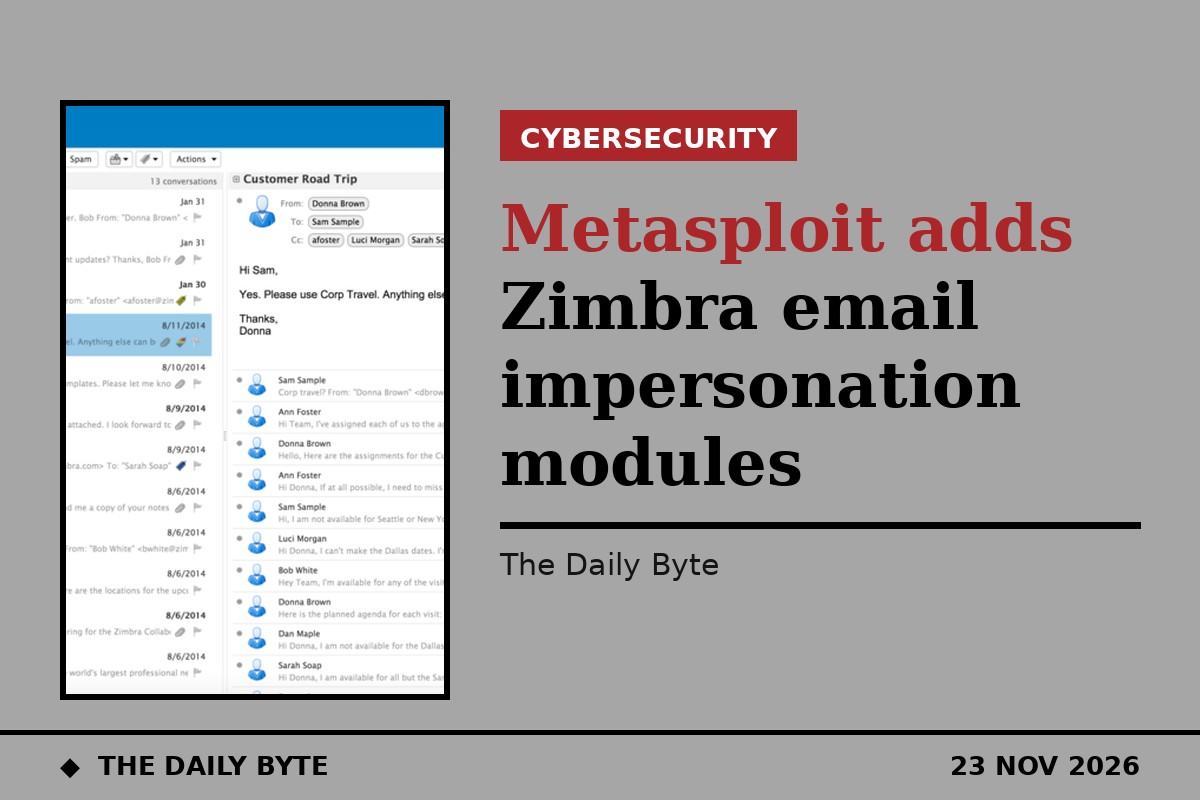
Rapid7 has released Metasploit modules that let security testers exploit two flaws in the Zimbra email platform, including one that allows an authenticated user to send email as somebody else. The modules were published in Rapid7's Metasploit wrap-up on 20 November 2026 and were validated against live Zimbra 10.1.16 Network Edition systems.
The release matters because Metasploit is the penetration-testing framework many security teams use to check their own defences. Once a flaw has a public Metasploit module, any tester, and any attacker, can reproduce the attack with far less effort.
The two flaws
CVE-2026-73571 (CVSS 4.3): email impersonation. An authorisation bypass in Zimbra's SaveDraftRequest handling lets an ordinary authenticated user send mail as another local mailbox without a delegation grant. The message lands in the victim's own Sent folder, making the forgery harder to spot. The Metasploit module is admin/http/zimbra_email_impersonation. The flaw affects Zimbra Collaboration Suite before 10.1.17.
CVE-2026-93637 (CVSS 3.7): login rate-limit bypass. A rate-limit bypass in the Network Edition GraphQL authentication endpoint lets unauthenticated attackers make repeated password guesses without incrementing Zimbra's source-IP failure counter, the lockout that normally blocks credential-stuffing attempts. The Metasploit module is scanner/http/zimbra_graphql_brute. It affects Zimbra Collaboration Suite 10.1.0 to 10.1.21.
Both modules were built on a shared Zimbra mixin, Msf::Exploit::Remote::HTTP::Zimbra, which handles account and administrator SOAP authentication, identity resolution, mailbox-server lookup and version parsing, so future Zimbra modules can reuse the same plumbing.
Part of a wider Zimbra research project
The modules implement coverage for flaws detailed in Rapid7's research series "Breaking Zimbra Identity Boundaries, Part One". During a broader assessment of Zimbra Collaboration Suite, Rapid7 reported more than 80 vulnerabilities spanning authentication, mailbox authorisation, calendar processing, web clients, document services and the host operating system.
The same Metasploit release also adds modules for other flaws, including an unauthenticated file-upload vulnerability in BeyondTrust Remote Support that leads to remote code execution (CVE-2026-102764), an Openfire authentication-bypass flaw, and two Cisco Secure Email Gateway flaws described as exploited in the wild.
What administrators should do
Zimbra administrators should apply the latest security updates for their installed version and check vendor guidance for the two CVEs, since no fixed-version timeline was given in the wrap-up. They should also review mailbox delegation settings, watch for mail sent from accounts without a delegation grant, and monitor GraphQL login traffic for unusual password-guessing patterns. No exploitation of these two Zimbra flaws in the wild has been reported.
Frequently asked questions
What is Metasploit? It is an open-source penetration-testing framework, maintained by Rapid7, that security professionals use to test whether their systems can be attacked. Its modules reproduce known vulnerabilities in a controlled way.
Are the Zimbra flaws being exploited by attackers? No exploitation in the wild has been reported for CVE-2026-73571 or CVE-2026-93637. The risk is that public Metasploit modules make the attacks easy to reproduce.
Which Zimbra versions are affected? CVE-2026-73571 affects Zimbra Collaboration Suite before 10.1.17, and CVE-2026-93637 affects versions 10.1.0 to 10.1.21. The modules were tested on Zimbra 10.1.16 Network Edition.